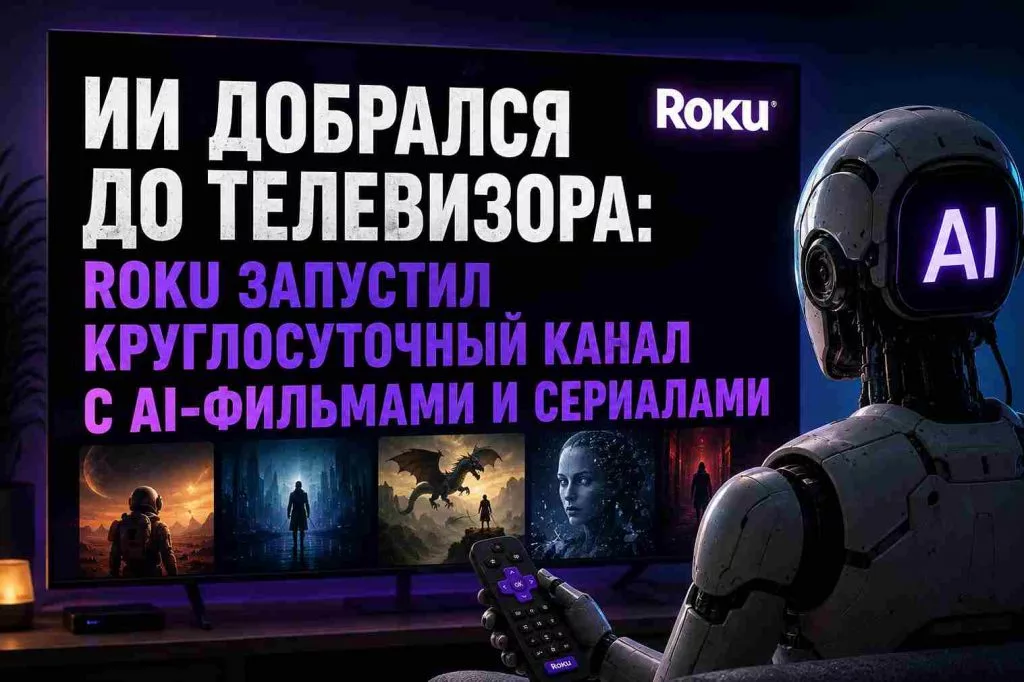
Until recently, synthetic AI cinema existed primarily across niche tech YouTube channels, TikTok feeds, and developer showcase reels. That dynamic has permanently shifted: generative AI video has arrived on the television screen as a continuous 24/7 linear broadcast. Roku has integrated Fairground AI Creator TV into its free streaming lineup, establishing the world’s first television channel programmed entirely with generative movies, episodic series, and animated narratives created by artificial intelligence.
Operating as a Free Ad-Supported Streaming TV (FAST) channel, Fairground monetizes through automated commercial breaks—placing generative cinema in direct competition against traditional cable sitcoms, reality programming, and indie features for viewer living-room attention. For foundational insights into frontier video diffusion architectures, explore our profile of CTO Erzat Dulat and video generation at Higgsfield AI.
Over 100 AI Directors Broadcast Across Household Screens
Fairground Entertainment, the American media venture curating the channel, aggregates cinematic productions from over 100 independent AI creators globally. The lineup encompasses science-fiction space operas, stylized film noir mysteries, high-concept surrealist drama, and dynamic animated shorts created using models such as Runway Gen-3, Luma Dream Machine, Sora, and Midjourney video pipelines.
Beyond short-form reels, Fairground has begun licensing independent graphic novels and comic books, utilizing generative tooling to adapt static print illustrations into fully voiced, animated broadcast series at a fraction of standard Hollywood animation budgets.
Current Limitations: The Struggle for Character and Narrative Consistency
Despite television distribution, AI cinema is far from matching Netflix or HBO quality. In commercial feature production, generating a single striking five-second visual shot is relatively trivial; maintaining consistent character facial anatomy, lighting conditions, acoustic timbre, and emotional resonance across a 90-minute narrative arc remains an immense technical barrier.
Audiences tuning into Fairground encounter a medium still in its early developmental infancy: surreal uncanny-valley artifacts, intermittent spatial warping, and dialogue that often feels detached from physical mouth movements. Yet historical precedent from computer-generated imagery (CGI) in the 1990s demonstrates that visual fidelity advances exponentially rather than linearly.
Kazakhstan at the Epicenter: The $1M Astana AI Film Festival
Kazakhstan is positioned directly at the forefront of this global creative evolution. While Roku scales television distribution in the United States, Astana is hosting the Astana AI Film Festival 2026 (AAIFF), establishing Central Asia as a premier international hub for generative cinematography.
With a massive total prize fund of $1,000,000, the festival represents one of the largest competitive film endowments on the planet dedicated entirely to synthetic media:
- 1st Place (Grand Prix): $450,000
- 2nd Place: $200,000
- 3rd Place: $100,000
- Category Awards: Five specialized $50,000 prizes honoring Best Character Design, Best Directing, Best Visual Aesthetics, Best Screenplay, and Best Conceptual Innovation.
With global submissions concluding in August 2026, the Astana festival cements Kazakhstan’s strategic policy of fostering creative AI economies, bridging local technical talent with international studio executives. For broader analysis on how human artists maintain irreplaceable creative value against algorithmic tooling, read our feature with Almaty muralist Aleksandr Voronchikhin on creative craftsmanship vs automated generative imagery.
Sources: The Verge Entertainment Coverage; Roku Press Room Announcements; Fairground Entertainment Disclosures; Astana AI Film Festival (AAIFF 2026) Official Charter.