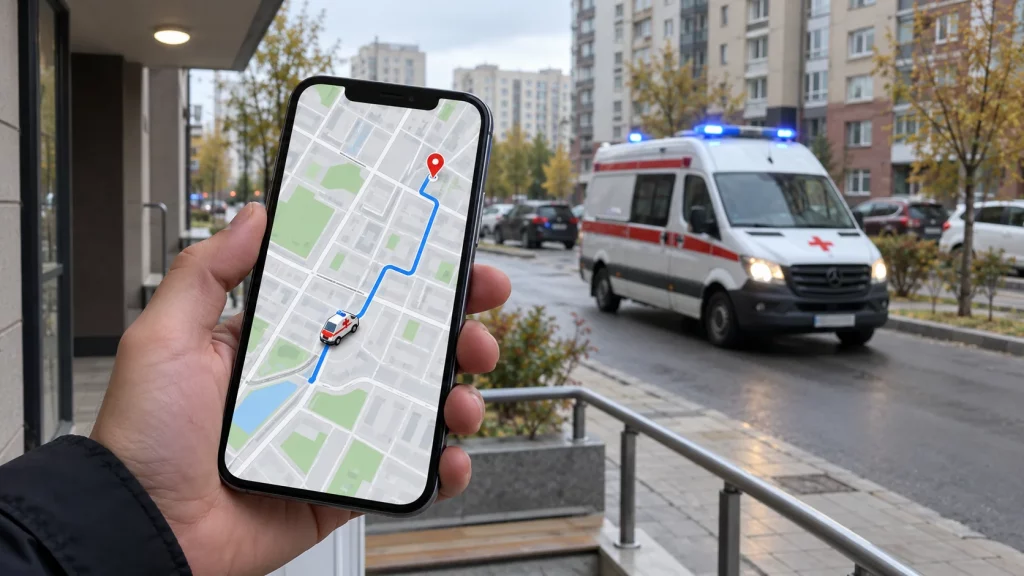
Starting October 13, amendments to the emergency medical care regulations come into effect in Kazakhstan. The new rules allow callers to track the ambulance crew’s live location on a digital map once a vehicle has been dispatched.
This mandate is outlined in Order No. 84 of the Ministry of Healthcare dated September 25, 2026, titled “On Approval of Rules for the Provision of Emergency Medical Care.” The document was officially published in the Reference Control Bank of Regulatory Legal Acts on October 2.
The initiative aims to improve transparency while patients wait for arriving emergency personnel. However, how the feature functions in practice depends heavily on technical implementation details.
How Dispatch Tracking Is Designed to Function
The regulations outline the following workflow: once a crew is assigned and routed to a call, the healthcare organization automatically notifies the caller and provides real-time tracking of the vehicle’s location and movement via a geospatial service.
Location data must be transmitted through the automated dispatch and emergency management system. Consequently, the tracking dot on the map appears only after a specific crew is dispatched, not merely upon initial call registration.
This distinction is critical for someone awaiting urgent care. Call intake and actual vehicle deployment are distinct operational stages. Live tracking visualizes vehicle transit, but it does not indicate how long unit triage and assignment will take.
The new capability can reduce uncertainty and help families prepare for medical arrivals. However, map tracking does not accelerate transit times: arrival speed still depends on regional dispatch capacity and roadway congestion.
Is a Dedicated Mobile App Required
Dialing 103 remains fully operational. The regulations also allow emergency calls via mobile applications, messengers, and automated chatbots, including direct geolocation sharing.
At the same time, the ministry order does not mandate a single nationwide tracking application, nor does it specify the delivery channel for individual notifications. Promising an automatic SMS link or unified nationwide application is therefore premature.
A similar system was previously piloted in Astana in collaboration with Yandex Qazaqstan. According to a Ministry of Healthcare briefing published by NewTimes, the pilot covered a subset of Category 1 urgent dispatches. Notifications featuring interactive maps were delivered via SMS or through Yandex Go if installed.
While that trial validated technological feasibility, its conditions cannot be assumed across all regions. A comprehensive rollout requires clear regional guidance: how notifications arrive, how to open the map interface, and what a missing signal indicates.
Approximately 25,000 Emergency Calls Daily
According to healthcare ministry figures, Kazakhstan’s emergency medical services handled 5,253,200 dispatches during the first seven months of 2026 — roughly 25,000 daily.
The ministry’s operational report lists 20 independent ambulance headquarters, 92 urban substations, and 189 district divisions, with 1,669 field teams on active duty every 24 hours.
Given this operational scale, automated vehicle dispatch notifications deliver practical utility. Callers gain real-time status updates without placing secondary inquiries to emergency dispatch operators.
Reducing repeat phone calls was a stated objective of the capital’s pilot program. According to ministry explanations cited by NewTimes, up to 40% of incoming inquiries were follow-ups checking crew whereabouts. This figure pertains to the pilot phase and cannot be extrapolated nationwide.
Digital Maps Must Reflect Genuine Transit Data
The utility of live vehicle tracking depends on telemetry accuracy. If coordinates update with latency, patients may misinterpret a technical lag as an idle crew. Real-time indicators showing data freshness and network status are just as crucial as the vehicle icon itself.
Data privacy is another key consideration. In its pilot disclosure, the ministry stated that personal and clinical patient records were not shared with technical partners and data exchanges occurred over encrypted channels. That safeguard applied to the specific pilot architecture.
As the program scales, citizens will require equal clarity regarding map link authorization, access token validity periods, and visible metadata.
Beginning October 13, tracking becomes a statutory component of emergency response services. The initiative’s success will be measured by whether citizens receive timely notifications upon ambulance departure and see accurate live vehicle locations. These two deliverables can bring much-needed clarity to emergency waiting times.