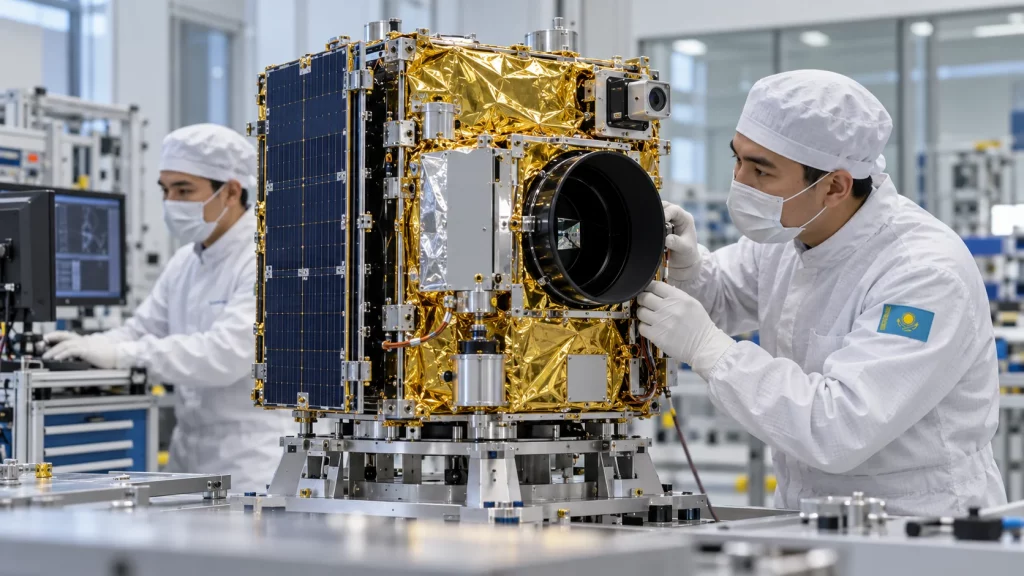
Kazakhstan is developing a constellation of six new Earth observation satellites and preparing three aerospace export initiatives valued at over $70 million. The plans were announced during a government cabinet meeting by Minister of Digital Development, Innovations, and Aerospace Industry Zhaslan Madiyev.
The new satellite constellation is designed to expand the capabilities of Kazakhstan’s national aerospace monitoring infrastructure while reducing reliance on foreign imagery providers. At the same time, the domestic industry confronts familiar challenges in scaling manufacturing and competing globally.
For Kazakhstan’s space sector, this represents a pivotal strategic transition: evolving from an importer of commercial satellite imagery into an aerospace design, manufacturing, and export hub.
Expectations for the New Satellite Constellation
According to ministerial statements, the constellation will combine medium- and high-resolution Earth observation platforms. They are designated for agricultural oversight, resource management, natural hazard mitigation, and land-use monitoring.
Deploying multiple platforms in coordinated orbits drastically increases revisit frequency, shortening intervals between flyovers and providing higher-frequency geospatial data.
Kazakhstan currently operates the KazEOSat-1 and KazEOSat-2 satellites, which have exceeded their designed operational lifespans under extended mission protocols. The new spacecraft group represents the next technological iteration of that infrastructure.
However, aerospace spacecraft engineering and launch procurement span multi-year development cycles. Announced capabilities must therefore be evaluated against realistic orbital launch schedules.
Three Aerospace Export Initiatives Valued at $70 Million
Export-oriented space manufacturing projects have appeared across policy briefings prior to this year. These programs entail the engineering, integration, and environmental testing of spacecraft for foreign clients.
In October 2026, the government formalized the aggregate value of three target export contracts at approximately $70 million, reflecting the projected pipeline value across the agreements.
Distinguishing contracted intent from delivered execution is vital for assessing industrial capacity. A signed contract creates prospective manufacturing workload. Successfully delivering a flight-ready spacecraft validates engineering competence. Repeat orders demonstrate whether aerospace manufacturing functions as a sustainable export enterprise.
For Kazakhstan, these contracts offer an opportunity to test the complete aerospace supply chain internationally — from component assembly to customer acceptance testing.
Who Manufactures the Spacecraft Hardware
A central entity in domestic aerospace assembly is Ghalam LLP, a Kazakh-French joint venture established to operate and commercialize the National Space Center’s Assembly and Testing Facility (AITF).
According to corporate filings from national company Kazakhstan Garysh Sapary (KGS), equity ownership is divided: KGS holds 72%, the Aerospace Committee holds 0.5%, and Airbus Defence & Space owns 27.5%. Domestic industrial capability has thus evolved within an international joint-venture framework.
Experience delivering to overseas prime contractors is not limited to complete satellite deliveries. KGS strategic development records note that Ghalam has manufactured spacecraft components for Airbus and other aerospace primes since 2019, including specialized wire harnesses and multi-layer insulation (MLI).
Component sub-contracting is less headline-grabbing than orbital rocket launches, but it builds disciplined aerospace manufacturing practices. Suppliers must comply with stringent European Space Agency (ESA) quality management and ISO standards.
Delivering integrated spacecraft represents the next evolutionary step, escalating technical complexity and programmatic risk. Labeling a satellite “Kazakh-made” does not imply 100% domestic parts sourcing: localization depth must be audited separately.
Examining the 977 Billion Tenge Economic Impact Estimate
The government’s headline economic assessment encompasses five cumulative years of satellite monitoring utilization. The public release lacked specific accounting methodology or sectoral profit-and-loss distributions. Consequently, this estimate should not be conflated with commercial operating profits or payback timelines for the six planned spacecraft.
The tangible utility of remote sensing is exemplified by environmental waste management. Satellite imaging identifies illegal landfill dumpsites. Yet KGS also notes physical limitations: snow cover invalidates visual detection, confining effective landfill auditing to warmer seasons.
Detecting an environmental infraction is merely the initial phase of public enforcement. Municipal inspection, regulatory fines, and physical site cleanup must follow. Similarly, satellite telemetry on grazing pastures or water basins delivers economic value only when integrated into local municipal governance.
Economic ROI therefore hinges on an end-to-end operational pipeline: imaging fidelity, automated processing speed, data dissemination, and inter-agency follow-through. Satellites expand data collection, but cannot single-handedly generate downstream economic gains.
How Aerospace Exports Could Reshape the Domestic Industry
By 2030, Kazakhstan envisions orchestrating an international satellite constellation comprising 14 operational platforms. This remains a strategic target rather than an active constellation.
Commercial export agreements provide continuous production utilization between sovereign government procurement cycles. A healthy production baseline sustains specialized engineering teams, environmental test laboratories, flight software developers, and geospatial processing experts.
Nevertheless, the authentic scale of this aerospace export market cannot be gauged purely by contracted dollar commitments. Proof will depend on verified orbital deliveries, domestic value-add margins, and recurring purchase orders.
Kazakhstan possesses verified credentials in subsystem manufacturing and high-level export contracts on paper. The true trial of its aerospace export strategy will be delivering on these commitments and expanding its customer roster. That execution will determine whether space manufacturing becomes a permanent pillar of Kazakh tech exports.