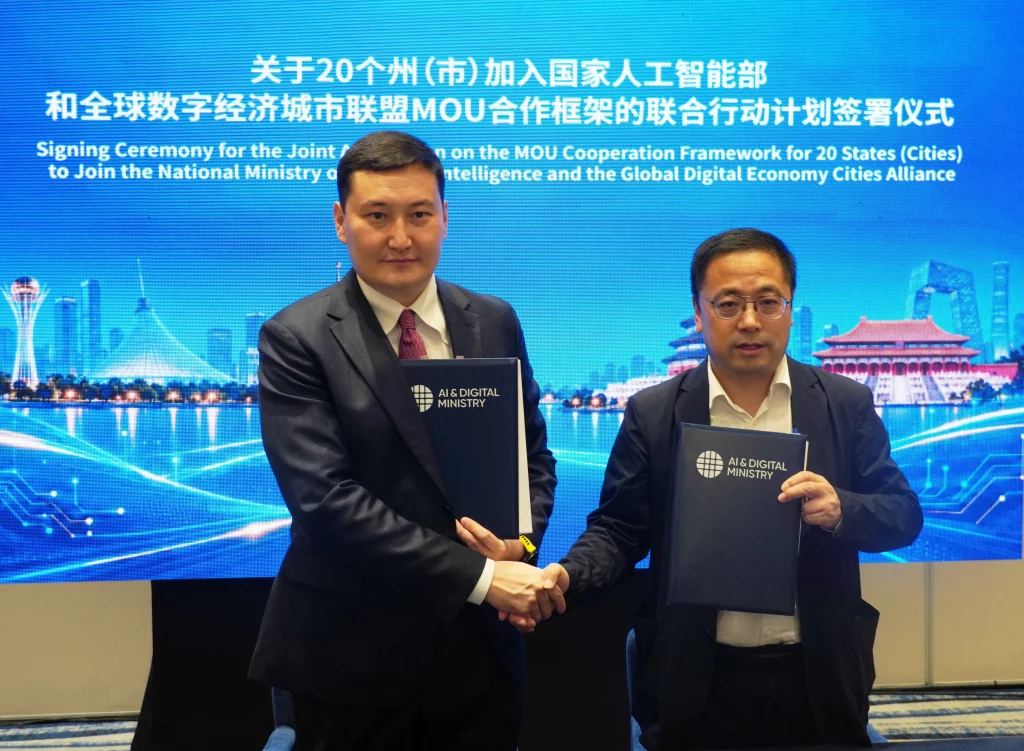
Kazakhstan is preparing a transition toward AI-Native smart region governance, deploying automated machine learning models into the daily municipal administration of regional capitals and provinces. The strategic model was examined during a joint forum in Astana convened by the Ministry of Artificial Intelligence and Digital Development alongside the DEC40 global alliance.
Preceding the AI & Digital Bridge 2026 summit, the Ministry, regional digitalization agency leaders, and DEC40 formalized a multilateral framework agreement. According to agency disclosures, this marks a new governance model: regional akimats (municipalities) interact directly with international technology vendors under ministerial architectural oversight.
For domestic Kazakhstani software enterprises, the initiative creates potential market opportunities spanning systems integration, municipal API tailoring, and local SLA support. Total addressable expenditure will depend on which pilots secure budgetary allocations and advance to production deployments.
Transitioning from High-Level Agreements to Regional Deployments
Foundations were established on July 28, 2026, when the Ministry and DEC40 signed a preliminary memorandum of understanding. The framework prioritizes Smart City and Smart Region architectures, international vendor attraction, municipal knowledge transfer, and executive civil service upskilling.
Initial implementation focuses on compiling a prioritized registry of regional civic infrastructure challenges. The portfolio was prepared for presentation to DEC40 partner ecosystems to source technical architectures and strategic co-investors, setting the stage for the Astana summit.
DEC40 — the Global Digital Economy Cities Alliance — convenes municipal technology operators globally. Founded in July 2025 and headquartered in Geneva, with operational bureaus across Geneva, Singapore, and Beijing, the alliance fosters urban technology architectures and municipal leadership training.
During the summit, bilateral negotiations were conducted between regional akimats and technology vendors including Sinomach Digital Technology, Sinosoft, Beijing Guang’an Xuanguang Technology, Beijing Unihannto Technology, UCloud, and Beijing Fengrun Shengjing Technology. Regional digitalization directors completed masterclasses on Beijing’s urban management architectures.
Defining the AI-Native Urban Model
The Ministry anchors the AI-Native paradigm in a unified regional data architecture, automated data pipelines, and scalable enterprise software modules. Initiatives align with the Digital Qazaqstan 2029 national strategy and updated smart region development methodologies.
Operationally, AI-Native denotes an operating philosophy where algorithmic synthesis is engineered directly into civil administrative workflows. To function, municipal departments require interoperable APIs, audited data integrity, and strict access governance.
For public utilities, an operational scenario involves cross-referencing IoT sensor telemetry, historic maintenance tickets, and citizen complaints to anticipate pipe bursts. In public transit, predictive models optimize bus routing. These represent illustrative scenarios rather than confirmed DEC40 commercial deliverables.
For civic algorithms to succeed, administrators must assign data accountability, audit recommendations, and retain human decision authority. Data corruption or stale registries quickly invalidate technically sophisticated machine learning systems.
Commercial Opportunities for Domestic IT Enterprises
The Ministry emphasized mandatory participation of domestic Kazakhstani IT contractors in localizing and implementing incoming international software suites. Vice Minister Bakhtiyar Mukhametkaliyev advocated a pilot-first execution path: verifying ROI locally before sanctioning national expansion.
Commercially, deploying urban operating software generates multiple integration revenue streams: connecting legacy databases, data engineering, custom UX design, municipal staff training, and ongoing tier-2 SLA support. Domestic developers can capture these allocations if tender frameworks require local participation.
Procurement economics combine upfront capital expenditure with recurring operational maintenance. Municipalities must model recurring software licenses, GPU cloud compute, version upgrades, and database vendor lock-in risks.
Evaluating pilot effectiveness demands empirical key performance indicators: ticket resolution velocity, infrastructure fault detection speed, repeat service dispatches, and manual civil service labor savings. These operational benchmarks clarify whether technology benefits offset lifetime total cost of ownership.
The tangible success of the partnership will be revealed by authorized project registries, approved budgets, domestic subcontracting shares, and audited pilot reports. These benchmarks will demonstrate how international alliances reshape regional governance and what commercial market they unlock for Kazakhstan’s IT sector.