
The capital of Kazakhstan hosted AI & Digital Bridge 2026, Central Asia’s premier international technology forum bringing together government leadership, venture capital investors, multinational tech corporations, and startup founders. Preliminary organizer data indicates over 17,000 visits during the forum’s opening two days. High-impact milestones include a bilateral agreement establishing the $50 million Tolqyn AI Venture Fund, new international acceleration corridors, sovereign GovTech AI deployments, and the inauguration of Central Asia’s first AI-Enabled university.
Held from October 1 to 3 at the EXPO International Exhibition Center in Astana, the forum spanned an ambitious agenda: generative artificial intelligence, computational and telecommunications infrastructure, venture financing, digital assets, sovereign cybersecurity, tech education, and creative economies. Below is a comprehensive breakdown of the core agreements and strategic developments from the forum’s decisive initial days.
Integrating Artificial Intelligence into the Real Industrial Economy
A primary strategic focus was the pragmatic adoption of artificial intelligence across Kazakhstan’s core industrial sectors. During the third meeting of the Presidential Council for AI Development, chaired by President Kassym-Jomart Tokayev, leaders examined deep structural transformation across mining, energy, and heavy manufacturing.
The President emphasized transitioning beyond isolated pilot demonstrations toward comprehensive, mission-critical technology rollouts delivering verifiable macroeconomic returns. Key national priorities include closely aligning engineering curricula with enterprise requirements. Specifically, the AI-Sana talent initiative is engineered to deploy young engineering talent directly onto industrial plant floors to resolve complex computational and automation bottlenecks.
For technology ventures, this strategic mandate signals that enterprise software value will be rigorously measured by unit productivity gains, energy efficiency, and cost reductions. Building a proof-of-concept model represents merely the initial step; the real hurdle is enterprise process integration and quantifiable ROI.
Tolqyn AI Venture Fund: Target Capitalization of $50 Million
In a major venture finance breakthrough, private investment firm Dasco Capital and state-backed Qazaqstan Investment Corporation (QIC) signed a strategic cooperation agreement outlining QIC’s planned cornerstone commitment to the Tolqyn AI Venture Fund. QIC serves as the private equity and venture capital arm of the Baiterek National Management Holding.
Targeted at an aggregate fund size of $50 million, the investment vehicle is dedicated to backing high-growth technology startups at the convergence of artificial intelligence and creative digital industries. The agreement was formalized by QIC Chairman Didar Karymsakov and Dasco Capital CEO Darmen Sadvakassov.
Corporate statements emphasize that the agreement formalizes QIC’s intended capital participation. The $50 million figure represents a targeted fund capitalization benchmark rather than deployed capital.
This initiative bridges two dominant themes of the forum: advanced AI pipelines and digital content generation. For regional technology teams developing generative media, algorithmic streaming, and immersive content, a specialized fund provides crucial early- and growth-stage capital. Exact investment mandates, check sizes, and governance terms will be published upon final fund closing.
Astana Hub and Freedom: AI Content Generation and Copyright Protection
Astana Hub and Freedom Cinema and Television formalized a strategic memorandum of understanding to advance digital media innovation and telecommunications technologies. The document was executed by Astana Hub CEO Magzhan Madiyev and Freedom Media CEO Timur Bairov.
A central pillar of the partnership focuses on advancing AI-driven content generation workflows, drawing on deep engineering expertise from Higgsfield AI, Kazakhstan’s historic AI unicorn. Concurrently, the parties committed to fortifying intellectual property protection, establishing automated protocols to swiftly counter digital copyright infringement.
Implementation plans include direct operational engagement with global platforms, including Telegram and TikTok. The memorandum encompasses commercialization pipelines for novel media tech and joint creative pilot productions.
The alliance simultaneously addresses two paramount imperatives of modern digital media: empowering creators with generative production velocity while establishing robust legal defenses against digital piracy.
Export Acceleration Corridors for Kazakhstani and Uzbek Startups
Astana Hub, IT Park Uzbekistan, and Eurasia Growth Hub established a trilateral alliance to accelerate international market access for technology companies across Central Asia.
The framework encompasses coordinated international tech delegations, investor roadshows, executive business missions, and B2B matchmaking. Through Eurasia Growth Hub, regional startups will receive structured soft-landing support when entering the United Kingdom and broader European ecosystems, including legal incorporation, compliance advisory, and local customer development.
Collaborative priorities also target enterprise contract acquisition, cross-border syndicate financing, applied R&D exchange, and executive mentorship in advanced AI architectures.
Separately, Astana Hub signed a dedicated memorandum with MOST Holding to expand the Central Eurasian Capital Bridge international investment program, signed by Magzhan Madiyev and MOST Holding CEO Pavel Koktyshev.
Both initiatives demonstrate accelerating integration across the Central Eurasian tech corridor, connecting regional founders directly to mature Western capital markets.
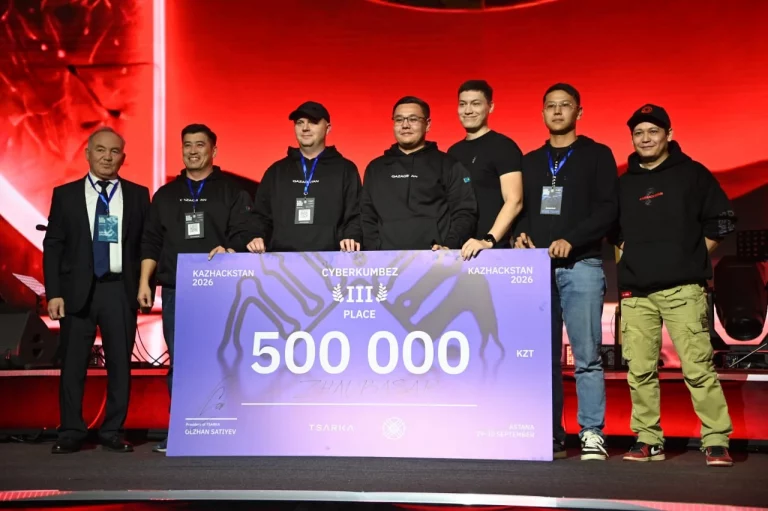
Astana Hub Battle 2026: 14 Finalists Compete for $100,000
The forum hosted the high-stakes semifinals of Astana Hub Battle 2026. From an initial pool of 50 vetted contenders, an expert jury selected 14 finalist startups to compete on the main stage for an aggregate prize fund of $100,000.
The 14 finalists represent an impressive cross-section of frontier tech: CYBERPACK.AI, Aman, MYupgrade, Hi Doctor, Astana Dynamics, BEST Vision, Spacelab, Welcome Video AI, NCSpeech, Pulsar AI, AuaSense, M3TRIQ, Behype, and Resti.
Finalists M3TRIQ and Spacelab secured an exclusive corporate award from Khan Tengri Innovation Hub: full sponsorship to participate in the prestigious AI Capacity Building Training Program in Shanghai.
Corporate partners also mobilized vital compute infrastructure: Kazakhtelecom allocated $25,000 in dedicated high-performance GPU cluster compute vouchers, while Yandex Qazaqstan provided 10 million KZT in cloud platform credits.
For early-stage AI ventures, subsidized access to accelerated compute is often more catalytic than direct cash grants, allowing teams to train proprietary models and iterate architectures without immediate cash burn.
AI Senim: Autonomous Resolution of 40% of Citizen Inquiries
State Corporation “Government for Citizens” presented operational metrics from Unified Contact Center 1414, highlighting the deployment of production-grade conversational AI.
The flagship solution is voice assistant AI Senim. Official data indicates the agent provides automated consultations across more than 100 high-frequency public services, processing an average of 25,000 to 30,000 citizen inquiries each month.
Remarkably, AI Senim resolves approximately 40% of inbound calls entirely autonomously without human intervention. The remaining 60% of nuanced cases are routed to human operators with pre-populated contextual summaries.
These metrics demonstrate an effective hybrid operational model: offloading repetitive informational inquiries to voice AI while conserving specialized civil service personnel for complex administrative casework.
Civic technology was also the focus of the “eGov 3.0” ministerial session, convening leaders from the Ministry of AI and Digital Development, National Information Technologies (NITEC), the Eurasian Development Bank (EDB), and global GovTech experts to map the next generation of predictive public services.
Qazaq AI Research University: Central Asia’s First AI-Enabled Institution
The forum marked the formal inauguration of Qazaq AI Research University, presided over by Deputy Prime Minister and Minister of Artificial Intelligence and Digital Development Zhaslan Madiyev.
Positioned as Central Asia’s first institution built from the ground up on an “AI-Enabled” operational framework, the university embeds machine intelligence across academic pedagogy, scientific research, faculty workflows, and campus administration.
This architectural approach fundamentally distinguishes the university from traditional institutions that simply teach computer science electives. Ultimate impact will depend on attracting world-class research faculty, securing state-of-the-art laboratory compute, and establishing direct research pipelines with global tech enterprises.
Dr. Kai-Fu Lee to Mentor Kazakhstani AI Founders
Astana Hub, Q.AI, and global AI unicorn 01.AI executed a trilateral cooperation memorandum to elevate Kazakhstan’s advanced AI talent pool.
A flagship deliverable is an elite, closed-door mentorship program for 20 to 25 leading Kazakhstani AI/ML engineers and founders. Selected participants will collaborate directly in small working groups with 01.AI founder Dr. Kai-Fu Lee (former President of Google China and author of AI Superpowers) and his core research teams to refine product strategies and position for global expansion.
Within this partnership, the Q.AI Research Lab was formally inaugurated at the alem.ai International AI Center in Astana, providing dedicated physical and computational infrastructure for high-potential local research squads.
17 Startups Pitch Smart City Solutions at Astana Innovations Demo Day
The forum stage hosted the Demo Day of the Astana Innovations Accelerator, where 17 selected startups unveiled municipal technologies engineered specifically for the capital city.
Projects addressed critical municipal verticals: digital healthcare triage, smart school safety, utility grid diagnostics, public transit optimization, automated surveillance, and accessible urban infrastructure.
For civic tech startups, pitch presentations mark only the gateway. Upcoming municipal pilot trials will determine whether these technologies survive live urban operating conditions and win long-term public procurement contracts.
Telecom Infrastructure and GSMA M360 Eurasia 2027
During the executive panel “Telecommunications Infrastructure in the Era of AI,” senior leadership from Kazakhstan’s primary telecom operators, international network architects, and regulatory bodies examined national grid and fiber modernization.
Organized by the Telecommunications Committee of the Ministry of AI and Digital Development, the session underscored that high-performance AI cannot operate without massive underlying fiber backbones, cross-border bandwidth, and low-latency 5G rollout.
Furthermore, the Ministry concluded a formal agreement with global telecom association GSMA, confirming that the flagship international conference M360 Eurasia will be hosted in Astana in autumn 2027, focusing on global telecom policy, spectrum allocation, sovereign AI infrastructure, and universal connectivity.
The Road Ahead: Converting Memorandums into Enterprise Reality
The opening days of AI & Digital Bridge 2026 combined institutional investment commitments, landmark educational launches, sovereign GovTech deployments, and cross-border acceleration pacts. Across the ecosystem, execution readiness spans a wide spectrum: while AI Senim handles tens of thousands of citizen calls today, other major venture funds and corporate partnerships remain at the memorandum stage.
The decisive measure of the forum’s impact will unfold over the coming quarters: finalizing binding limited partner agreements for venture funds, deploying production industrial pilots in mining and energy, and scaling domestic AI startups into verified international exporters. Kazakhstan has firmly established the ambition; the critical mandate now is disciplined execution.