

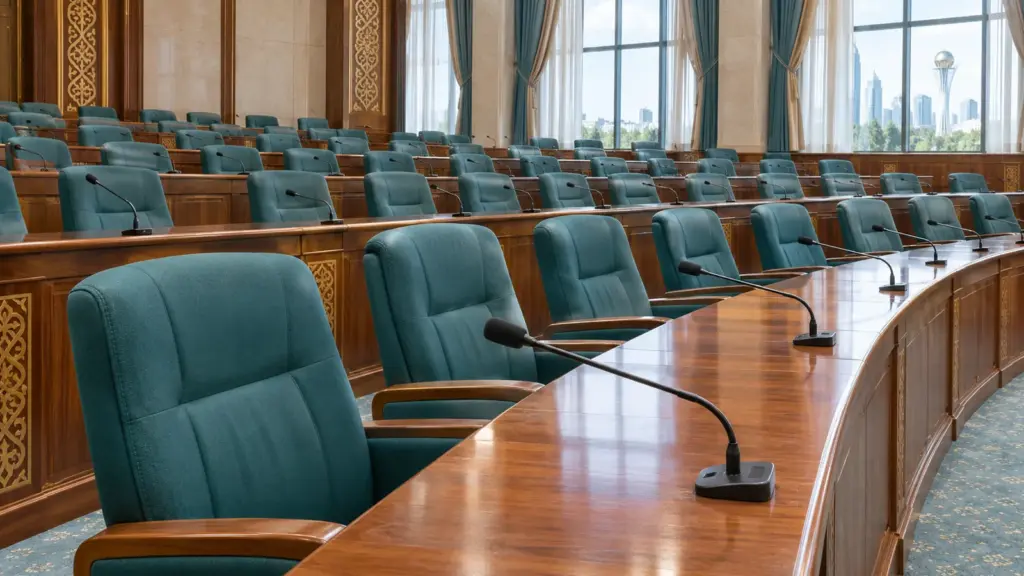
Illustration: AI
Kazakhstan is continuing to introduce e-Quryltai and AI tools for analysing bills, Dadebay told Tokayev on 23 November (kursiv.media). Since the session began, the Kurultai has passed 18 laws, with another 38 bills under consideration. These figures reflect parliament’s overall work: they cannot be treated as a tally of documents checked by AI.
AI-Quryltai was used to draft a child safety bill
The e-Quryltai platform brings together the digital processes used by MPs. Its next stage of development is set to be AI-Quryltai, an AI layer presented in Geneva on 12 November (airpress.kz).
The first bill drafted using AI-Quryltai was “On Children’s Digital and Information Safety”, Deputy Speaker Dinara Zakiyeva said (tengrinews.kz). This was the first time the legal model, backed by a database of more than 800,000 legal acts, had been used directly to draft a bill.
According to a report on the pilot, the model helped identify potential conflicts (zakon.kz).
Zakiyeva also reported that more than 120 amendments had been prepared. It is easy to mix up the two figures here: more than 800,000 acts make up the model’s database, while more than 120 amendments describe the scope of the bill. The latter figure does not show how many errors AI found.
The bill proposes parental controls. It also provides for labelling and verification of digital products, including apps and games. Blocking is proposed where threats or violations are detected.
These requirements remain proposals in a bill.
The child safety bill still needs a government opinion and discussion in a parliamentary working group. According to parliament’s press service, MPs have already checked and refined the AI’s suggestions with input from lawyers and experts.
Raem.kz previously covered AI in education through the example of Ustaz AI, which takes routine paperwork off teachers’ hands.
Isanov: finding a conflict still leaves a solution to agree on
Nariman Isanov of Fenix Law supports using AI in lawmaking. Speaking to the newsroom, he explained that the system finds conflicts and gaps in legislation faster than a person can (fenixlaw.org). It also identifies duplicate provisions and inconsistent terminology.
“But finding a conflict does not yet mean deciding which provision to change and whose interests that change should serve,” Isanov says.
In his view, a law can fall behind the economy and technology even when its provisions are formally consistent with one another. He therefore also sees potential for AI in analysing how laws are applied and modelling the effects of amendments.
The Justice Ministry reported that it was testing an AI adviser in the Adilet system as early as 3 May 2025 (gov.kz). It is designed to analyse legislation and provide legal assistance to the public. Automatic detection of conflicts between legal acts was planned for the next stage. Plans also include checks on legislative drafting and predictions of potential conflicts.
In Isanov’s experience working in government, the main difficulties begin when proposals need agreement across agencies. Each agency assesses a solution through the lens of its own powers and risks. They may all acknowledge the problem but disagree on how to fix it.
The lawyer considers this caution understandable. But the final compromise sometimes no longer fully addresses the original problem.
The technology sandbox retained a requirement to draft a bill
Isanov gives an example from his work at the Ministry of Digital Development. He oversaw the development of a regulatory sandbox that would allow the government to introduce temporary rules for testing new technologies. The legal basis and limits of this arrangement were to be set out in law.
The original model limited how long temporary rules could remain in force. It also limited the territory and subject matter they could cover. The test results could then form the basis for permanent rules, the lawyer explains.
But during the approval process, concerns arose over the division of powers between parliament and the government.
According to Isanov, the procedure ultimately chosen was the one for pilot projects set out in Article 241-10 of the Entrepreneurial Code. Even if an initiative receives a favourable assessment, that procedure still requires a bill to be drafted. In his view, this leaves some of the potential to respond quickly to new technologies untapped.
In this example, Isanov explains, the problem was known and a solution had already been developed. The difficulty was agreeing on an acceptable way to address it.
We explored the legal relationships between startup founders in “But we shook hands”: why friendship cannot save a startup when money comes in.
Teslya: people see fragments of the problem for years
Olga Teslya, a lawyer at TopLegal, believes AI can help specifically at the drafting stage. “When a law is still being written, even someone with extensive experience struggles to anticipate everything people will encounter later,” she tells the newsroom. If AI alerts drafters that a new provision will require changes to other acts, that is already useful. As for exactly how to change them, she says the people who work with those provisions every day are better placed to advise.
The first example from her practice concerns real estate. As a legal consultant, Teslya needed to establish who owned a property, but the justice authorities refused to provide the information. They cited an internal regulation: such information is provided at the request of advocates, courts, law enforcement agencies and certain others, but legal consultants are not on the list.
Yet the Law “On Advocacy and Legal Assistance” gives a legal consultant, like an advocate, the right to request information in order to provide legal assistance. The law on the registration of real estate rights has its own list, too. As a result, an advocate and a legal consultant may work on the same civil case for the same purpose but have different access to information through their requests.
The second example concerns foster carers. Under the Family Code, they have the same rights and duties as a guardian or custodian. But if a procedure explicitly names only parents and guardians, a foster carer is asked in what capacity they are applying. “And it is the child who loses time above all,” Teslya says.
Most of the time, she says, is lost before an amendment even comes up for discussion. “First one person encounters the problem, then another, and each resolves their own specific issue. Years can pass before anyone looks at these cases together,” the lawyer explains. She therefore proposes using both approaches: checking bills with AI and asking practitioners during drafting how the wording will work in real life.
The AI-Quryltai strategy covers 2027–2029
The parliamentary AI strategy presented in Geneva provides for e-Quryltai to develop into AI-Quryltai (inform.kz). The proposed environment would bring together digital processes, parliamentary data, legal knowledge and intelligent services.