
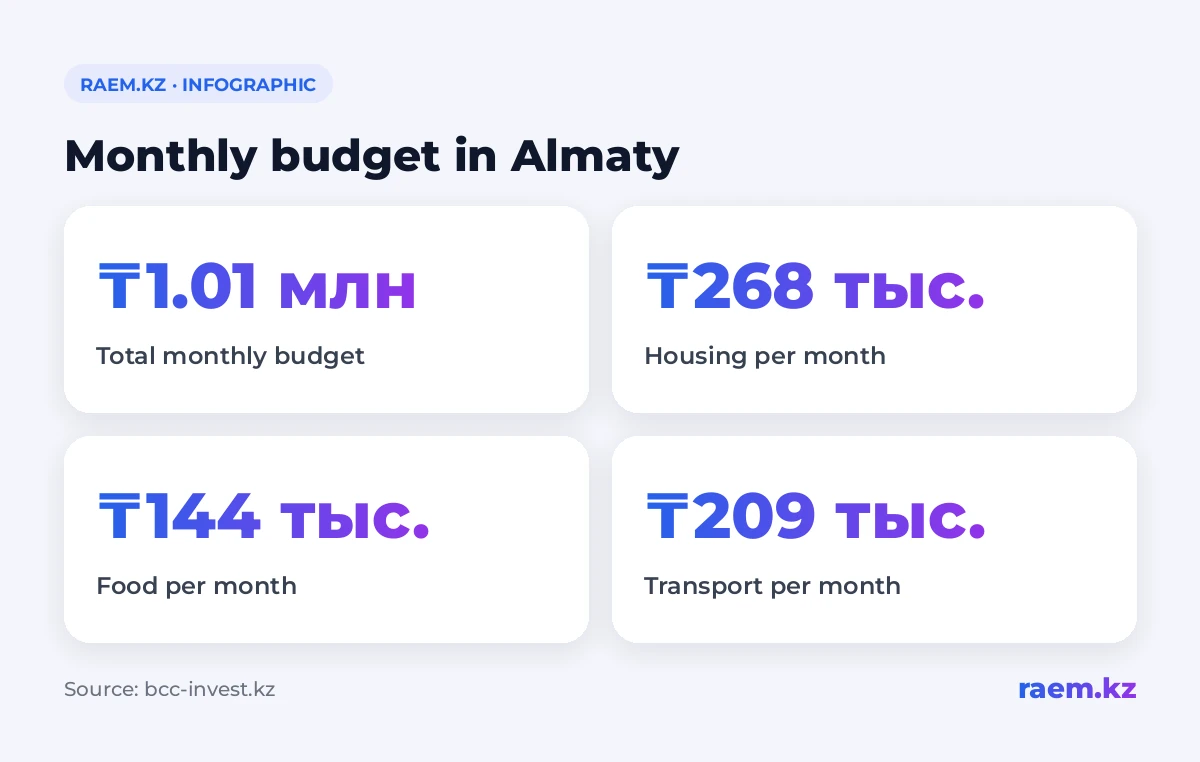
BCC Invest estimates a monthly budget of around 1.01 million tenge for a woman living alone in Almaty under its Decent Living Index. The figure represents the cost of the company’s chosen basket of goods and services, rather than actual spending by every woman in the city. Individual expenses may differ; the calculation uses June 2026 as its base period.

BCC Invest’s estimated budget for a woman living alone in Almaty
According to BCC Invest’s launch announcement, the estimate includes approximately 268,000 tenge for housing, 144,000 tenge for food and 209,000 tenge for transport.
| Spending category | Estimated monthly amount |
|---|---|
| Housing | Around 268,000 tenge |
| Food | Around 144,000 tenge |
| Transport | Around 209,000 tenge |
| Total, including all other categories | Around 1.01 million tenge |
The remaining categories cover needs including healthcare, clothing, communications and leisure. According to BCC Invest, transport costs include an allocation for buying and later replacing a car, spread over its expected useful life.
What BCC Invest includes in its calculation
According to the company, the model covers 10 main categories, 52 subcategories and 6,262 calculation items for goods and services. Categories include housing, food, transport, education and children, clothing and footwear, household goods, health, communications and technology, leisure and culture, and personal care.
The index calculates the cost of a basket that BCC Invest considers necessary for a decent standard of living. It therefore reflects the company’s consumption assumptions rather than a measurement of an individual’s actual expenses.
How the estimate differs from official spending statistics
The Bureau of National Statistics reports that food products accounted for 52% of monetary expenditure across Kazakhstan in 2025, while consumer spending overall accounted for 91.4%. Its household budget statistics are based on a sample survey of 12,000 households.
These statistics describe reported household spending. BCC Invest’s index instead prices a selected basket for a specified household type. The national survey figures cover a different population, period and approach, so they do not directly validate the company’s estimate for a woman living alone in Almaty.
What the Minimum Income Standard approach means
BCC Invest says its methodology takes account of international approaches, including the Minimum Income Standard (MIS). Loughborough University’s explanation of MIS describes a process in which groups of members of the public agree on the goods and services needed for an acceptable living standard in the UK. The baskets are then priced and reviewed, with experts advising on specific requirements.
The university explains that this standard extends beyond food, clothing and shelter to include opportunities to participate in society. This provides context for the approach cited by BCC Invest; it does not establish that the company’s Kazakhstan basket follows the same research process or independently confirm its results.
How BCC Invest spreads major purchases across months
The company says it converts expenses into a monthly format. The cost of durable goods is spread over their expected useful life, while the cost of an annual holiday is divided across 12 months.
The monthly total therefore includes both recurring payments and an allocation for purchases that happen less frequently. It should not be read solely as a list of bills paid every month.
How BCC Invest’s calculator accounts for household composition
According to BCC Invest, the calculator covers 17 cities in Kazakhstan and 13 household types, including adults living alone, pensioners, couples and families with children. Users select a city and household composition to see an estimated monthly total and a breakdown by category.
The company says each household type has its own basket, reflecting the number and ages of its members. Shared expenses such as housing, household appliances and internet access are counted jointly, so a family’s budget is not calculated simply by multiplying one person’s total.
How BCC Invest compares costs between cities
The service also includes an interactive map for comparing spending categories across cities. According to the company, some categories use local market prices. Others use Almaty prices adjusted with regional coefficients based on Bureau of National Statistics data. Items with negligible regional price differences use the same values nationwide.
BCC Invest directs users to its calculator and methodology. When comparing its estimate with your own budget, check the household type and category assumptions, including the amounts allocated to future major purchases. The 1.01 million tenge total applies to the company’s model for a woman living alone in Almaty.