
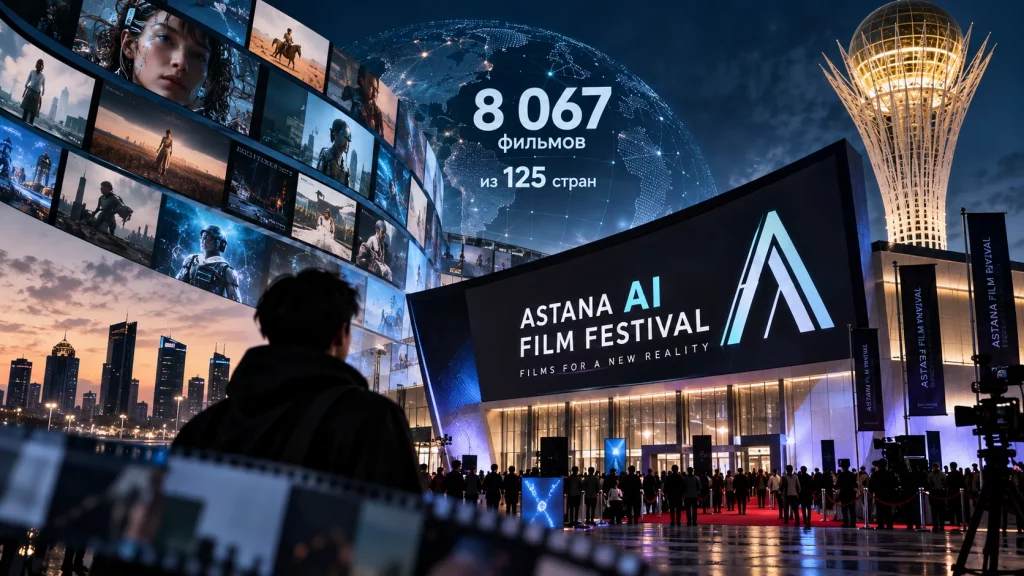
Astana AI Film Festival 2026 received 8,067 films from 125 countries, with Kazakhstan ranking second by submissions after the United States.
The festival takes place in Astana from October 1 to 3 as part of AI & Digital Bridge 2026. Organizers now put its total funding at $2 million: $1 million in competition prizes and another $1 million intended for new AI productions.
RAEM.KZ previously examined participants’ questions about the selection of more than 8,000 entries. After publication, additional information about the jury, criteria and competition rules appeared on the festival’s official website.
Our previous article:
“Were Films Watched for Three Seconds? Why AAIFF Participants Want the Selection of 8,000 Entries Explained”
The new information does answer some of those questions. However, key details of the preliminary selection commission’s work remain undisclosed publicly.
Kazakhstan ranks second after the United States
According to AAIFF’s current statistics, the United States supplied the most films: 1,396 entries.
It was followed by:
- Kazakhstan: 829;
- India: 705;
- China: 479;
- South Korea: 355.
The festival received 4,929 films for the Open Competition and 3,138 for the themed competition, The Future Worth Living In.
Combined runtime exceeds 80,000 minutes.
That is more than 55 days of uninterrupted viewing.
The longest entry runs for four hours and three minutes. In the final 24 hours of submissions alone, participants uploaded another 1,189 films.
This scale prompted questions about how the preliminary selection was carried out in practice.
What organizers disclosed after our first article
AAIFF’s official website now publishes the full international jury.
It includes:
Balaji Srinivasan, former Coinbase CTO and former a16z partner;
Audrey Azoulay, former UNESCO Director-General and former French Minister of Culture;
Ma Ping, representing China Film Studio;
Wang Hao, Beijing Film Academy;
Li Long, BytePlus General Manager for MEA, India, Türkiye and the CIS.
One of RAEM.KZ’s questions—who will assess the finalists—has therefore been answered.
The updated Terms & Conditions also describe the main assessment criteria.
Entries are to be assessed on:
- artistic merit;
- storytelling quality;
- technical execution;
- meaningful and original use of artificial intelligence.
The rules also introduce a procedure for potential conflicts of interest: an individual juror may be recused from considering a particular entry.
Some questions about the criteria and final jury’s work therefore now have an official answer.
The jury and preliminary commission are different bodies
Our earlier article’s central question concerned the initial screening of 8,067 submissions, rather than just the final jury.
The festival website says that after registration closes, entries undergo a technical check and are then reviewed by an international commission that determines the Official Selection.
The following have not yet been publicly specified:
how many people were on the commission;
who its members were;
how the 8,067 films were divided among them;
whether reviewers were required to watch each entry in full;
whether score sheets or another formal assessment system were used;
whether AI tools were used for initial sorting or technical analysis.
RAEM.KZ sent these questions to the festival’s press office.
The editorial team received no direct answer.
The selection timetable remains a central question
According to the current official website, submissions closed on September 7.
The Official Selection date is listed as September 15.
There are eight days between those milestones.
The total submitted content exceeds 80,000 minutes.
Even allowing for a large commission and the possibility that viewing began before submissions closed, organizers have not publicly explained how work on this volume of content was organized.
Participants’ questions about whether and how the films were watched therefore remain relevant.
Our previous article specifically noted that YouTube Analytics screenshots showing short views prove nothing by themselves.
Films could have been downloaded, viewed through Google Drive, opened directly or distributed to reviewers through other methods.
Without a description of the procedure, however, it is impossible to establish which mechanism was used.
The competition rules did change
Initial official announcements said submissions would be accepted until August 15.
At the time, organizers said selection would identify 25 top entries: ten in the main section and fifteen in the open section.
The current website sets the deadline at September 7.
The current Terms & Conditions are also dated September 15, 2026, meaning they were updated after submissions closed.
The rules now allow films at least three minutes long, without specifying a maximum runtime.
This aligns with the actual statistics: the longest submitted film runs for more than four hours.
RAEM.KZ asked which provisions changed after the competition launched and whether the changes applied equally to all participants.
That question also remains unanswered.
The website still contains conflicting statements on late submissions
The legal Terms & Conditions define registration as running from May 25 to September 7.
However, the FAQ on AAIFF’s main website says submissions may be sent after September 7, with consideration left to the jury’s discretion.
Two public pages for the same festival therefore give statements with different implications.
RAEM.KZ previously asked whether entries were actually accepted after the deadline and, if so, on what terms.
There is no public answer yet.
The allocation of the $2 million is clearer
Organizers have also added a significant clarification here.
$1 million is allocated directly to competition prizes.
Another $1 million forms a separate production fund to finance promising AI projects further.
Recipients of the second fund will be selected separately from projects deemed promising for further production.
According to Astana’s administration, selected teams are also being offered the opportunity to register a legal entity in Kazakhstan and become Astana Hub participants.
Under the BytePlus partnership, 25 finalists are also expected to receive one year of access to DRAMAGIC and a package of 60,000 credits.
The initiative therefore goes beyond awards for completed films.
The festival is seeking to use the competition to attract teams and new AI productions to Kazakhstan.
What has changed since RAEM.KZ’s first article
The situation has become considerably more transparent since our initial analysis.
It is now known:
who serves on the international jury;
which general criteria are used to assess entries;
what the current submission period is;
how the $2 million is allocated;
how submissions break down by country and section;
that 25 finalists will receive BytePlus technology support.
The main issue remains unresolved: how the preliminary selection of 8,067 films actually worked.
The international commission’s size and membership, allocation of entries, actual viewing procedure and internal assessment system remain undisclosed.
The official website also still contains differing statements about submissions after the deadline.
Why this matters
AAIFF’s scale is already substantial.
8,067 films.
125 countries.
More than 80,000 minutes of content.
$2 million in combined funding.
Kazakhstan ranked second globally by number of submissions.
For a new AI film festival, this is a strong start.
But the larger the competition, the more prominent its jury and the more money at stake, the more important transparent selection becomes.
The festival begins on October 1.
Competition screenings will take place at the Chaplin cinema in Astana, and winners will be announced on October 3 at AI & Digital Bridge 2026. Screenings will be free with an advance ticket.
RAEM.KZ will continue following the competition and is ready to update this article if organizers answer the questions previously sent to them.