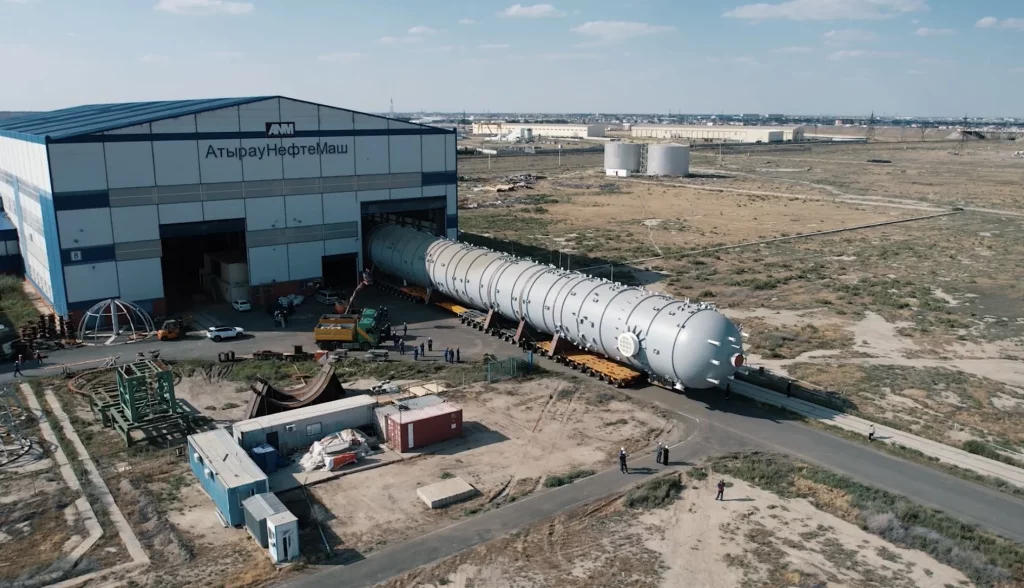
In the Karabatan special economic zone near Atyrau, construction is progressing on Kazakhstan’s largest industrial petrochemical initiative — a $7.7 billion polyethylene manufacturing facility with a design capacity of 1.25 million metric tons per year. Operated by the Silleno joint venture, the megaproject represents a decisive pivot from raw hydrocarbon export to high-margin chemical processing.
The facility will process ethane separated from natural gas produced at the offshore Kashagan and Tengiz oilfields, converting low-cost dry gas into premium grades of linear low-density and high-density polyethylene used worldwide in industrial packaging, automotive parts, medical equipment, and water pipeline infrastructure.
Engineering Milestone: Installing the Super-Heavy De-Ethanizer Column
Construction crews reached a critical milestone following load-bearing foundation tests rated at over 5,500 metric tons to support the main de-ethanizer fractionation column. Measuring dozens of meters in height and hundreds of tons in steel mass, this central apparatus separates ethane from associated gas streams under high pressure and cryogenic temperatures before cracking it into polymer-grade ethylene.
Why Kazakhstan Requires 1.25 Million Tons of Polyethylene
Currently, domestic plastics manufacturers import significant volumes of polymer raw materials. The Atyrau complex will:
- Fully substitute polymer imports across Kazakhstan’s construction, agricultural, and packaging sectors.
- Export over 80% of surplus production to lucrative consumer manufacturing markets across Central Asia, China, Turkey, and Europe.
- Generate thousands of permanent high-skilled engineering jobs and billions in long-term non-oil tax revenues.
Catalyzing a Downstream Plastics Cluster
The presence of abundant, competitively priced base polymer pellets directly in Atyrau is expected to stimulate a secondary manufacturing ecosystem: small and medium enterprises producing drip irrigation tubing, automotive components, consumer electronics casings, and sterile medical syringes.
International Consortium with Local Equipment Fabrication
The project brings together national operator KazMunayGas and international petrochemical strategic partners, including Sinopec and SIBUR. Notably, heavy pressure vessels, heat exchangers, and structural steel elements are being fabricated directly by Kazakhstani mechanical engineering plants, ensuring local content standards and technology transfer.
Mechanical completion and trial commissioning are scheduled for 2029, establishing Kazakhstan as a major polymer exporter in Eurasia.