
Photo: Jakub Zerdzicki / Pexels
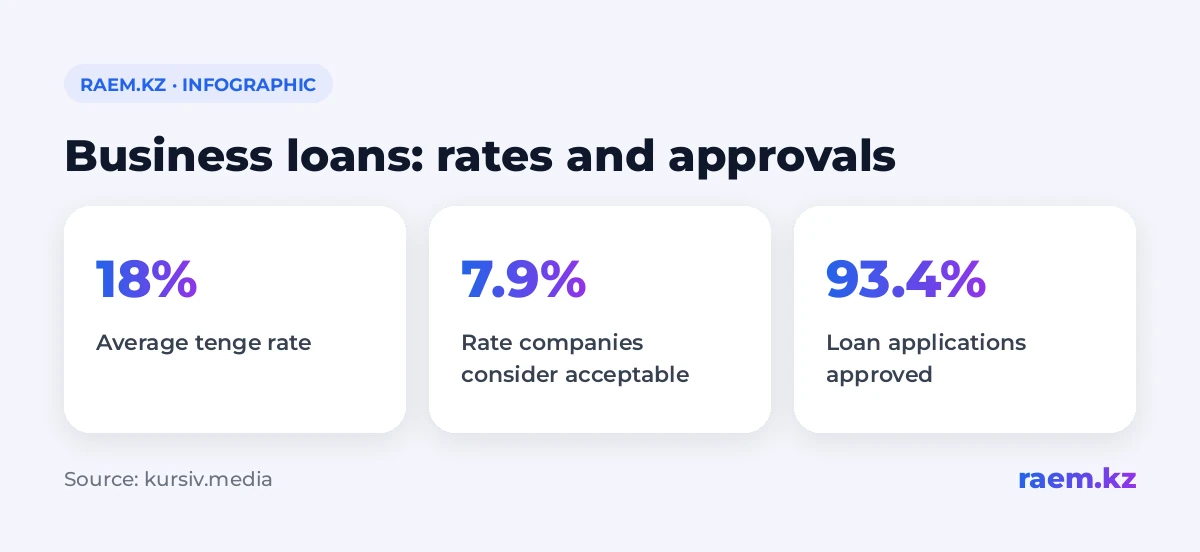
Kazakhstani companies pay an average annual interest rate of 18% on tenge loans, but say an acceptable rate would be 7.9%. The figures come from the National Bank’s business survey for the third quarter of 2026 (kursiv.media). The regulator surveyed 3,552 companies in the real economy. About one in five had applied for a loan.
What businesses pay for loans
Companies in the survey paid an average annual rate of 18% on tenge loans, unchanged from the second quarter. They paid an average of 5.3% on foreign-currency loans, while considering 3% acceptable.
The National Bank defines an acceptable rate as one a company can afford at its current level of production profitability. For tenge loans, the 7.9% rate named by businesses is 10.1 percentage points below the actual average.
How the base rate affects loans
The National Bank has been cutting its base rate since June 2026. By the end of September, it had fallen from 18% to 16.25%, and on October 23 it stood at 15.75%.
Yet the average rate on tenge loans to the companies surveyed was unchanged in the third quarter. Market participants estimate that banks take one to two quarters to adjust their terms after National Bank decisions.
How often banks approve applications
In the third quarter, 21.1% of surveyed companies applied for a loan. Of those, 93.4% received funding and 6.6% were turned down. A quarter earlier, 21.8% of companies had applied for loans.
Nearly half of respondents, 49.8%, had no debt. Among companies with loans, monthly payments most often came to no more than 20% of revenue. The weighted average debt burden was 16.1%.
What companies borrow for
Most loans, 79.2%, went toward working capital, including raw materials. Another 11.5% went toward fixed assets, including equipment, and 2.8% toward refinancing. Business expansion was the reason for borrowing for 1.3% of borrowers.
Some 86.9% of companies financed working capital with their own funds. Bank loans were used for this purpose by 19.3% of companies, including 9% that drew on an existing credit line.
What stops businesses from borrowing to grow
Companies named several obstacles to doing business. The most common was the tax burden, cited in 37.2% of responses. Competition, finding customers and a shortage of qualified staff followed. Read more in the section on taxes for sole proprietors and LLPs.
Demand for finished products fell in the third quarter, with a diffusion index of 48.7. A reading below 50 indicates a decline. Production capacity was used at an average of 50.9%, compared with a five-year average of 53.3%.
Put simply
In the third quarter, companies paid an average annual rate of 18% on tenge loans, although they considered 7.9% acceptable. If you are planning to take out a business loan, compare its rate with your profitability and consider what the loan is for. The National Bank’s next base rate decision is scheduled for December 4.