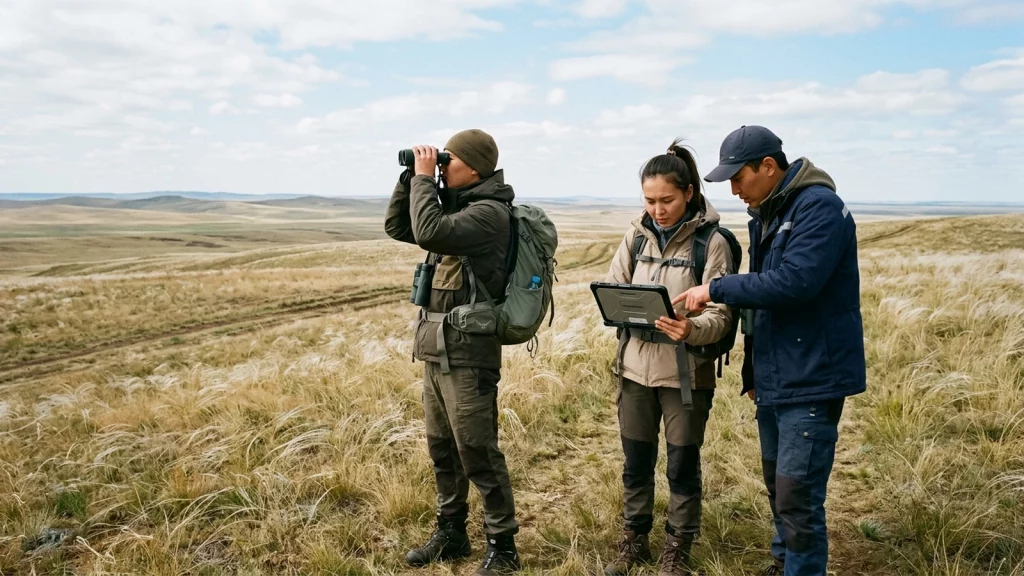
Teams in Kazakhstan can apply for the Conservation Leadership Programme’s Future Conservationist Award 2027, which provides up to $15,000 for a conservation project. The first-stage deadline is October 30, 2026, at 23:59 GMT. In Almaty, that is October 31 at 04:59. Applicants initially send a short concept note rather than a full application through the portal. (conservationleadershipprogramme.org).
CLP is a partnership of BirdLife International, Fauna & Flora and the Wildlife Conservation Society. It supports early-career conservationists and the development of their teams. For 2027, applications use a two-stage process: only shortlisted concept-note authors will be invited to prepare a full proposal. (conservationleadershipprogramme.org).
Why Kazakhstan meets the country rule
The current guidelines permit projects in countries not included in their exclusion list. Kazakhstan appears on neither that list nor the separate list requiring applicants to contact CLP before applying. A Kazakhstan-based team can therefore consider a project in the country, provided all other requirements are met. (conservationleadershipprogramme.org).
Country eligibility does not automatically qualify every applicant. Professional experience, team composition and project scope are assessed separately. Check these conditions first, then identify a conservation task that the team can realistically complete during the permitted project period.
The team must be early-career
At least three people are required. Every member must have no more than five years of paid conservation experience. Degree studies, unpaid volunteering and internships do not count as that experience; paid work in closely related areas, such as biodiversity research or environmental education, does. The restriction concerns a person’s career stage rather than age. (conservationleadershipprogramme.org).
If paid experience is exactly five years, clarify eligibility with CLP: the summary says “less than five”, while the detailed criterion says “no more than five years”.
Members should normally be nationals of the project country. One non-national from an eligible country may participate if the expertise they bring is clearly justified. The proposal should explain each member’s role and how the project will develop their capacity. (conservationleadershipprogramme.org).
Create a simple internal map of responsibilities before drafting. It can reveal whether the necessary skills are present and whether most of the work has been assigned to one person.
Some applicants are specifically excluded
CLP does not require a particular academic qualification. Undergraduate and master’s students may apply, but people currently enrolled in a PhD programme are ineligible. Projects tied directly to doctoral research are also excluded. Work associated with an undergraduate or master’s degree may qualify if it demonstrates benefits beyond academic study. (conservationleadershipprogramme.org).
No member can be a paid employee or contractor of any of the three CLP partner organisations during project development and implementation. A volunteer relationship must be disclosed, with an explanation of how the proposal differs from the partner’s work. Participation in an active CLP project is not allowed, and a person may participate in no more than three Future Conservationist Award projects in total, leading only one. (conservationleadershipprogramme.org).
Check these rules for every member. A qualifying leader does not compensate for another person’s ineligibility. If the team changes, review the requirements again against the revised membership before sending the concept note.
Show what conservation will achieve
The call supports effective interventions for globally important, at-risk habitats and species. Relevant themes include climate adaptation, biodiversity, habitat restoration, environmental policy, human–wildlife conflict, community participation, education and citizen science. Research should connect to conservation action that can be applied. (conservationleadershipprogramme.org).
Species can qualify through IUCN categories Critically Endangered, Endangered, Vulnerable or Data Deficient, or evidence showing a need for urgent local action. The proposed project must be new rather than simply continuing an established initiative. Its duration must be between six and twelve months. (conservationleadershipprogramme.org).
Separate the problem, the action and the expected result. Data collection should answer a defined question, and work with people should explain who can use the findings. Avoid promising an impact that cannot be assessed within the project period. A smaller, coherent plan is easier to evaluate than a collection of loosely connected ambitions.
Understand the funding and budget ratio
A request to CLP cannot exceed $15,000, and CLP’s contribution must cover at least 50% of the total budget. This does not require every applicant to find an additional half from another donor. Full funding within the award ceiling does not conflict with the rule; mixed funding must respect the stated share. (conservationleadershipprogramme.org).
Mathematically, a request for the maximum $15,000 implies a total project budget no greater than $30,000. This is a calculation of the ratio’s boundary, not a recommended project size. Build your own budget around necessary activities and supportable prices rather than aiming for the largest possible total.
Conference attendance, academic tuition and scholarships, consultants, and projects initiated by CLP partner organisations are excluded. Gene storage, invasive methods and captive breeding are also outside the funding scope. Any laboratory analysis must be justified as critical and urgent for conservation. (conservationleadershipprogramme.org).
How concept notes are assessed
The guidelines emphasise feasibility, technical capacity, conservation impact and contributions to diversity, equity and inclusion. Applicants need to connect their methods with team experience, justify costs, demonstrate local support, identify measurable outputs and show how members will develop their capabilities. The importance of the subject alone is insufficient. (conservationleadershipprogramme.org).
Interdisciplinary teams with complementary skills may be viewed favourably. Work at a conservation-priority site should relate to an at-risk species. Naming a well-known protected area does not replace an explanation of what the project will change or how its results can remain useful afterwards. (conservationleadershipprogramme.org).
Read the concept note as someone unfamiliar with the location. Can that reader understand the problem, who will perform the work and what will remain when the grant ends? Give each question a concrete answer connected to the methods and budget. This is a useful way to test whether the narrative and operational plan agree.
Stage one is submitted by email
For the 2027 round, applicants must complete the official English concept-note template and email it to clp.applications@birdlife.org. Late, incomplete or ineligible submissions are not considered. The original deadline is October 30, 2026, at 23:59 GMT, equivalent to October 31 at 04:59 in Almaty. (conservationleadershipprogramme.org).
The highest-scoring concept notes will receive invitations to submit a full application through the online portal. Shortlisted teams are expected to be contacted by the end of December 2026. This is a notification about progression, not a guaranteed payment date or a project start date. (conservationleadershipprogramme.org).
Do not begin with a full portal application from an earlier competition. Check the 2027 process, obtain the current template and verify that the initial document is complete. Before submission, ask a colleague to assess whether the plan is understandable and realistic.
Keep the proposal your own
The organisers expect applicants to develop the substantive proposal themselves. AI assistance with translation or shortening is permitted, but the concept note should express the team’s ideas, experience and realistic objectives. Answers generated extensively by AI are viewed negatively. Responsibility for the content remains with the applicants. (conservationleadershipprogramme.org).
Successful teams receive more than project funding: CLP also offers access to expertise and invites a team representative to international training. This is part of leadership development rather than a separate cash payment for each member. It should not be treated as an additional guaranteed project budget. (conservationleadershipprogramme.org).
A summary of the award and the concept-note email instructions are available in RAEM’s Russian-language directory entry CLP Future Conservationist Award 2027: грант до $15 000 для команд из Казахстана. RAEM’s Russian-language article $1000 на необычную экологическую идею: Awesome Foundation ждёт заявки до 27 ноября provides context on a different small environmental funding route. Cross-border support is examined in the archived article Call Closed: Central Asian Climate Innovation Projects Eligible for Grants up to €80,000 via SGCIF; that closed round is not a current alternative to CLP.
A practical preparation sequence is to establish each member’s eligibility, agree on one new task, calculate six to twelve months of activities and describe them in the current template. Then check the English, budget and submission address, leaving time before the deadline to correct errors.