
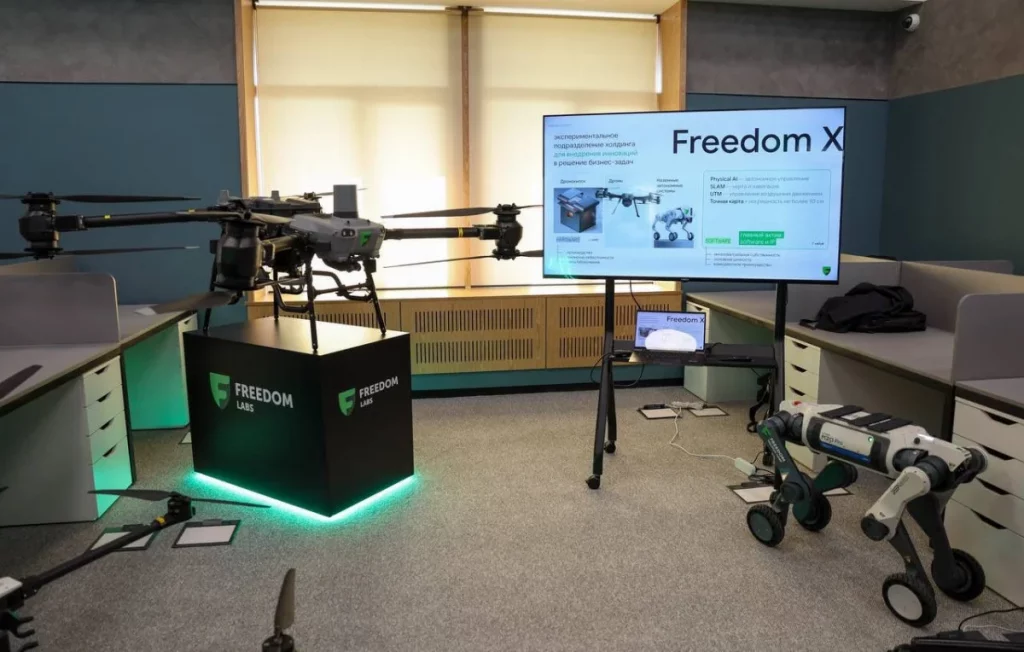
Freedom X is deploying commercial drone delivery for groceries across Almaty and has unveiled an automated pickup terminal—the “dronemat.” The company’s subsequent development phase targets quadruped robot dogs capable of carrying parcels directly to apartment doors.
The core logistical conundrum arises after the payload touches down. A customer residing on the fifth floor must still walk downstairs to collect the delivery box. Eliminating that final friction requires teaching autonomous robotics to navigate residential hallways, security gates, and elevators—while simultaneously driving down flight unit costs, managing severe weather, and safeguarding flight paths.
Over 100 Deliveries Daily, According to Company Disclosures
Freedom X represents the research and advanced engineering division of the Freedom financial and retail holding. According to company releases, scheduled commercial operations launched on January 15, 2026. Between January and August, the service completed over 1,000 deliveries, accelerating past 100 daily dispatches in September. These statistics were shared during the dronemat product debut at the AI Digital Bridge forum.
These figures originate directly from company self-reporting. Disclosures do not delineate whether 100 deliveries represents a steady-state daily average or peak single-day throughput. A comprehensive operational assessment would require published monthly order completions, weather cancellation percentages, and human operator intervention rates.
The initiative benefited from structured governmental coordination. The Ministry of Artificial Intelligence and Digital Development signed a preliminary memorandum with Freedom Lifestyle on December 26, 2025. Early pilot parameters covered daytime transport of groceries, convenience goods, and OTC medications under clear meteorological conditions. In January, Freedom X secured commercial aerial operating authorization from the Aviation Administration of Kazakhstan.
Fifteen-Minute Flight Windows and 60-Minute Delivery SLAs
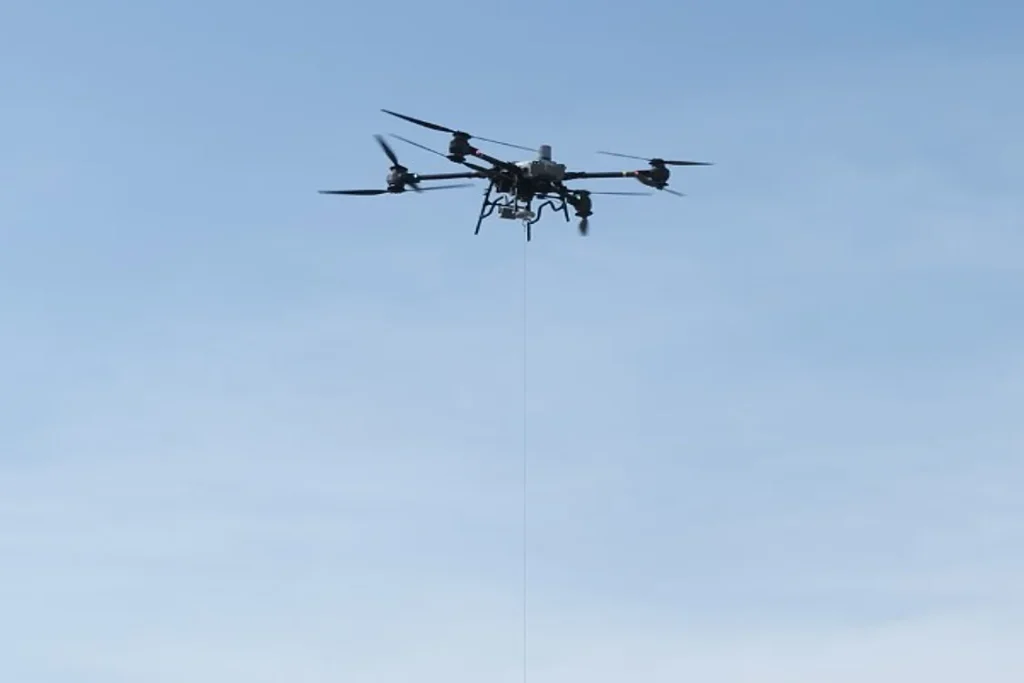
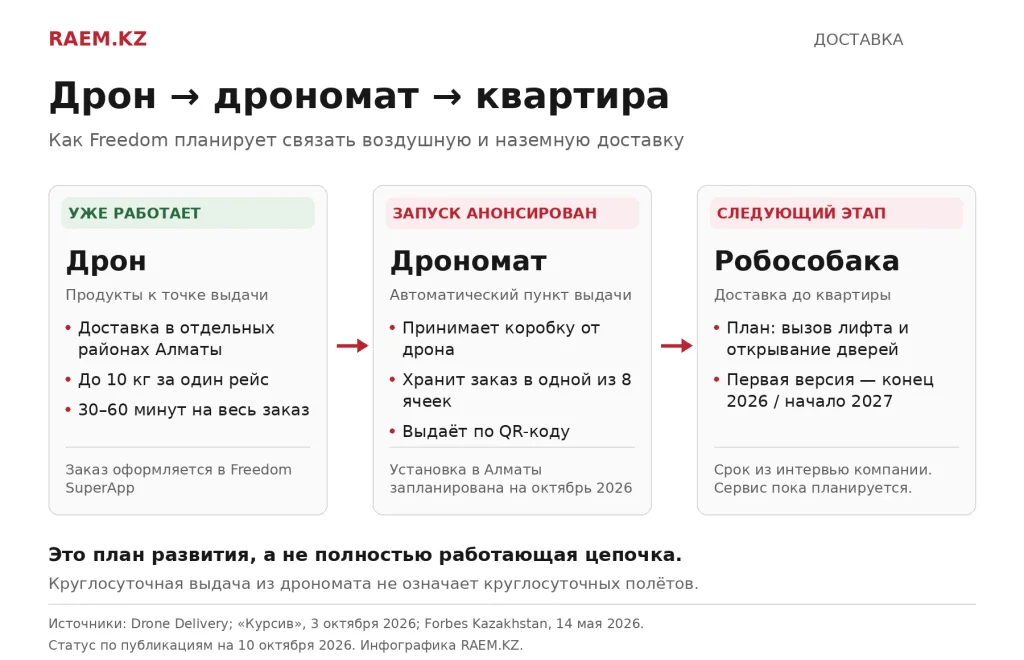
Consumer orders are routed via the Freedom SuperApp. Specifications on the Drone Delivery portal indicate maximum payload weight of 10 kg with delivery fulfillment windows spanning 30 to 60 minutes. Goods are packed in rigid branded containers; the drone hovers over the drop coordinate and lowers the cargo tether. Consumers must stand clear until the aircraft reels in the winch and departs.
Freedom’s October announcement highlighted a 15-minute flight phase. This covers transit airtime exclusively. Overall delivery SLAs on the consumer app range between 30 and 60 minutes, accounting for fulfillment picking, packing, and dispatch staging.
Addresses must be validated within defined geo-fenced flight corridors in select Almaty districts. While single-family properties offer unobstructed landing clearances, high-density residential towers present intermediate barriers: gated courtyards, elevators, and interior corridors.
Dronemat Terminals Ingest Payloads Through the Roof
At AI Digital Bridge, Freedom demonstrated an eight-compartment automated locker. Drones winch the parcel through an aperture in the retractable roof, an internal elevator lowers the container, and a robotic shuttle transfers it into a storage cell. Customers scan a QR code inside the SuperApp for 24/7 self-service pickup. Commercial installation of the pilot terminal in Almaty was scheduled for October; demonstration units on exhibition floors do not yet confirm full consumer deployment.
The automated parcel locker eliminates the requirement for recipients to meet the drone outdoors. Nonetheless, walking to the locker remains necessary, and 24/7 locker access does not equate to round-the-clock drone flights, which remain constrained by daylight flight windows.
By year-end, Freedom aims to expand its fleet to roughly 60 commercial drones and deploy at least three dronemat lockers. These benchmarks represent expansion targets rather than installed base capacity.
Teaching Quadruped Robots to Call Elevators
Freedom Lifestyle Group Executive Director Yerlan Yessimseitov outlined the next robotic phase to Forbes Kazakhstan in May. Under this operational concept, a quadruped robot dog receives the parcel from the locker, navigates interior building maps, and summons elevators via digital integration. An onboard mechanical manipulator opens fire doors. Freedom targeted late 2026 or early 2027 for initial pilot prototypes.
This initiative represents forward-looking development. Product roadmaps do not indicate that quadruped robots are actively delivering groceries across Almaty residential buildings. Pre-mapped hallway demonstrations differ vastly from reliable fleet operations across hundreds of unmapped multi-family buildings.
Elevator controllers use proprietary architectures, and apartment entrances employ distinct access credentials. Even if a robot traverses a hallway smoothly, engineers must resolve access control, elevator stall fail-safes, and consumer handover protocols. These real-world challenges cannot be evaluated solely on controlled obstacle courses.
Unit Economics: 5,554 KZT per Baseline Delivery
Freedom X published internal economic research on drone delivery dated January 8, 2026. In the baseline operational model, cost of goods sold per successful drop stood at 5,554 KZT. Modeling assumed 100 daily deliveries, six operating hours, and 20 flight days monthly. Low autonomy assumed two human operators per drone, excluding warehouse real estate and corporate overhead.
| Freedom X Economic Scenarios | Estimated Cost per Drop |
|---|---|
| 100 drops/day 2 operators per drone | 5,554 ₸ |
| 100 drops/day 5 drones per 1 operator | 2,753 ₸ |
| 1,000 drops/day 5 drones per operator 8 hours & 30 flight days/month | 1,576 ₸ |
These projections reflect January financial models rather than verified autumn unit costs. Because the 1,000-drop scenario alters multiple operating variables simultaneously, unit cost reduction cannot be credited purely to volume scale. Operating margins depend directly on operator-to-fleet ratios.
This raises the primary strategic metric: whether fleet scaling reduces human touch points per fulfilled order. If hardware fleets grow while requiring constant manual supervision, operational leverage will remain constrained.
Astana Weather Poses Steeper Challenges Than Southern Cities
In his interview, Yessimseitov explained the southern focus: high wind velocity, extended sub-zero winters, and restricted airspace complicate autonomous flight in Astana. Shymkent was identified as a prospective expansion target. This denotes strategic corporate prioritization rather than an absolute barrier to capital deployment in Astana.
Freedom X documents weather risks in its technical blogs. Pre-flight checks verify wind gust profiles, precipitation, and thermal visibility; missions are aborted or rerouted during severe weather. App terms explicitly specify order cancellation during adverse storms.
For consumer retail, predictability is vital. When weather grounds aircraft, customers still need groceries. Scaling necessitates fallback routing via ground couriers and automated refund mechanics. Tracking weather-induced cancellation rates will reveal how frequently hybrid contingencies are required.
Yandex Preserves the Human Courier for Final Steps
Freedom faces emerging domestic competition adopting an alternative operational paradigm. At Digital Bridge, Yandex Qazaqstan announced preparations for a drone delivery pilot in an Almaty residential development. Heavy drones will shuttle orders from Yandex Lavka dark stores to a community landing pad, where human couriers complete doorstep delivery. Operations await final regulatory clearance.
This workflow maintains human couriers within residential structures. Freedom seeks to automate that leg entirely. Comparing these models requires evaluating end-to-end SLAs: total delivery time, cost, failure rates, and customer convenience. Flight speed alone captures only part of the unit equation.
Global Benchmarks: Deliveries Measured in the Millions
International deployments show that autonomous delivery can scale beyond pilot demos. On April 28, 2026, Starship Technologies celebrated 10 million completed deliveries, deploying over 3,000 ground delivery bots across eight countries. However, these are wheeled sidewalk rovers; their success does not prove quadruped robot dogs can manipulate doors and elevators.
Aerial drone logistics is also expanding. On October 5, Alphabet’s Wing and Walmart announced expansion into the Seattle and Denver metropolitan areas for 2027. Wing reported access to over 3 million households, targeting more than 270 Walmart retail hubs. Prospective population coverage should not be confused with completed order volumes.
The universal lesson for Kazakhstan is clear: services scale where dark stores, flight units, and automated collection lockers link into repeatable routing loops. An aircraft may fly seamlessly, yet the business case ultimately hinges on dark store density and remaining human labor hours.
The Crucial Verification Happens at the Doorstep
Freedom is scaling aerial corridors, and the dronemat aims to streamline local collection. Quadruped robots face a much steeper trial: delivering goods into real apartment buildings with locked access gates, occupied elevators, and children in hallways. Audited multi-month deployments detailing unit costs and error exceptions will provide the true measure of viability.
Only then will it be clear what labor tasks machines can absorb and what human technician roles remain necessary. Similar questions face domestic hardware robotics manufacturers. What is known regarding QAZBOT Technologies and its partnership with AgiBot was analyzed in our dedicated report. [RAEM.KZ on QAZBOT Technologies]



