
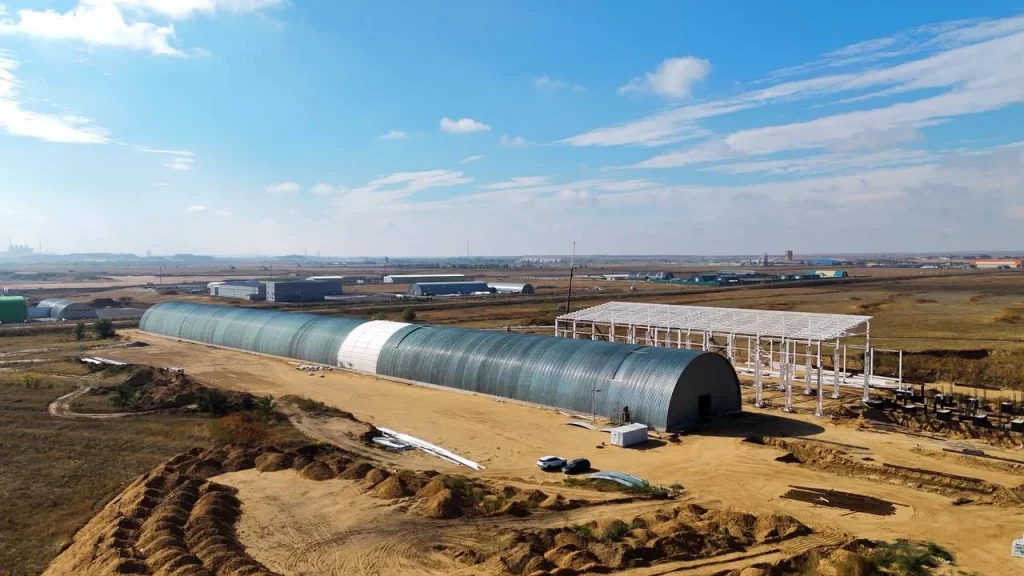
A manufacturing facility is under construction in Aktobe to produce paper and containerboard for packaging out of recovered waste paper. Spearheaded by Capital Plast KZ, the enterprise targets up to 42,000 metric tons of annual output, with commissioning targeted for 2027. Funding is tied to recycling and EPR levy reserves managed by Zhasyl Damu.
The core concept is practical: shipping containers retain high-strength cellulosic fibers after product delivery. These fibers can be reprocessed repeatedly. However, between discarded packaging and rolls of new containerboard lie supply aggregation, fiber pulping, contaminant screening, energy consumption, and off-take procurement. That operating chain will ultimately determine how much recovered paper the facility actually returns to economic use.
Facility Commissioning Slated for 2027
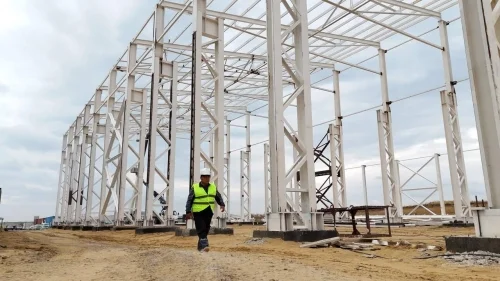
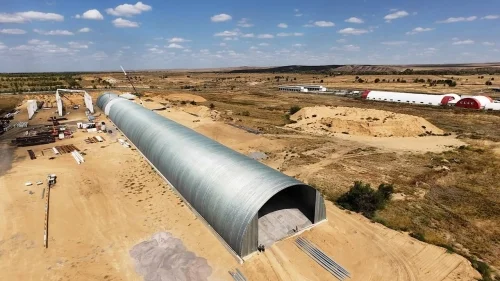
Official construction imagery reveals an extended arched hangar. Adjacent structural framing is being assembled using mobile cranes and hoists.
On October 8, Kazakhstan’s Ministry of Ecology reported the completion of foundation footings, driven pilings, and warehouse structures. The on-site boiler facility is constructed. Commercial launch is expected in 2027. Over 300 manufacturing jobs are projected once operations achieve nameplate throughput.
Of the projected 42,000-ton annual volume, 18,000 tons will be designated for fluting medium and 24,000 tons for linerboard. These two paper grades constitute the standard building blocks of corrugated transit boxes.
The Corrugated Architecture Inside a Box
Inspect the edge profile of any standard shipping carton: sandwiched between flat exterior sheets lies an arched, fluted wave. This geometry supplies rigidity and stacking resilience. Fluting medium creates the wave, while linerboard forms the exterior and interior facing sheets. The Aktobe plant is engineered to manufacture both substrates.
Recycling begins with collection, sorting, and baling of old corrugated containers (OCC). Bales arrive at the mill and enter hydropulpers, where water blends with paper to disperse individual fibers. Staples, tape fragments, plastics, and debris are screened out. The cleaned pulp slurry is then formed into rolls of industrial paper. This workflow reflects standard guidelines documented by the American Forest & Paper Association (AF&PA).
AF&PA technical documentation notes that during initial sheet formation on the forming wire, the slurry typically consists of 99% water and merely 1% fiber. The suspension drains across moving meshes, followed by mechanical press dewatering and heated cylinder drying. Process water is recirculated. This illustrates general paper-making physics rather than the Aktobe mill’s specific closed-loop water balance.
10 Billion in News Reports vs 12 Billion in Loan Documents
Financial metrics diverge across governmental statements. An October bulletin from the Ministry of Ecology listed the investment budget at approximately 10.3 billion KZT. During the original agreement signing, Zhasyl Damu publicized total investment at 12.28 billion KZT, highlighting 10.27 billion KZT in subsidized concessional financing.
According to Zhasyl Damu terms, the 10.27 billion KZT facility is disbursed via the Industrial Development Fund as a 7-year loan at a subsidized 3% annual interest rate. Consequently, this capital constitutes a repayable loan rather than a non-repayable grant. The funding originates from national recycling levies.
The 10.3 billion figure matches the rounded principal of this concessionary debt facility. However, the recent ministry release does not clarify whether total capex changed or why it equated total project cost to debt alone. Given these data points, 10.3 billion KZT cannot be verified as the total construction budget.
Employment figures also shifted: the initial press memo listed 200 jobs, whereas October briefings indicated over 300 upon reaching full capacity. The latter figure reflects operational targets; current payroll counts for the greenfield facility were not specified.
Feedstock Aggregation Requires Monthly Discipline
Annual nominal capacity of 42,000 tons translates into roughly 3,500 tons of monthly output under steady-state operating conditions. This calculation represents nameplate capacity rather than guaranteed output. Moreover, incoming OCC collection volume must surpass final paper weight to offset moisture, sorting residues, and screening fiber losses.
The national collection challenge is framed by official waste metrics. The Bureau of National Statistics reported that municipal waste operators collected 4.1 million tons of solid waste in 2025—up 7.7% year-over-year. Sorted waste reached 1.5 million tons, expanding 16.3%.
Recovered paper and board constituted 9.4% of sorted solid waste. This figure cannot be equated to nationwide recycling, as primary municipal sorting and secondary industrial mill conversion remain distinct phases requiring reverse logistics.
For an industrial papermaker, consistent feedstock is critical. Warehouses, retail distribution hubs, and industrial logistics facilities generate clean, segregated paper streams. Yet project announcements provide no disclosures regarding secured off-take contracts or dedicated feedstock suppliers, making initial mill capacity utilization difficult to model.
Dry OCC Is Superior to Wet Waste Piles
Fiber quality is determined long before raw stock reaches the pulper. AF&PA recommends removing contaminating packing tapes, flattening cartons, and keeping feedstock clean and dry. Mold, moisture, and pests degrade fiber tensile strength, rendering cardboard unrecyclable. Flattened cartons also optimize transit density.
Consequently, dedicated paper collection bins and weatherized transfer stations directly determine the economic efficiency of the Aktobe plant. The more contaminants mixed into the bales, the higher the pulping rejection rate. The mill’s viability relies upon regional collection infrastructure growing alongside machine capacity.
Environmental footprint monitoring will also be required. Papermaking consumes process water and thermal energy for cylinder dryers. A comprehensive environmental assessment will require published metrics on water reuse, wastewater treatment effluent standards, boiler emissions, and solid pulper rejects.
European Mills Recirculate Three-Quarters of All Paper
A proven international market exists for recycled containerboard. An EPRC report cited by Cepi on October 1, 2026, demonstrated a 76.4% paper and board recycling rate across Europe in 2025, with total recovered paper reaching 53.9 million tons.
This percentage is calculated against total apparent paper consumption, adjusted for net cross-border trade in secondary raw materials. While not directly comparable to Kazakhstan’s sorted municipal waste metrics, European experience proves the industrial scale attainable when waste collection networks interface smoothly with local mills.
In the United States, AF&PA 2025 statistics confirm that nearly half of all paper collected for recycling was consumed in containerboard production. Converting used shipping boxes into new packaging has become mainstream manufacturing practice.
Off-Take Contracts Remain Crucial
According to Zhasyl Damu, Capital Plast KZ operates an established distribution presence across 11 cities in Kazakhstan, serving more than 800 commercial customers.
While an existing network supports distribution, customer counts alone do not guarantee forward procurement for 42,000 annual tons. Zhasyl Damu aims to curb national reliance on imported packaging board. The extent of import substitution will be demonstrated by sales velocity and how competitively local reels displace foreign imports.
Following startup, the benchmark for Aktobe will be monthly audited OCC procurement tonnage and merchantable board shipments. Only then can operational utilization, permanent jobs, and ecological impact be evaluated. The publicized 42,000 tons currently represents engineering design capacity.
Similar waste-processing ventures are under consideration in other regions. RAEM.KZ previously examined recycling development plans in East Kazakhstan. The Aktobe venture has advanced to physical construction; the next milestone will be demonstrating how feedstock logistics will supply the factory for its scheduled 2027 opening. [RAEM.KZ, East Kazakhstan waste recycling complex plans]



