
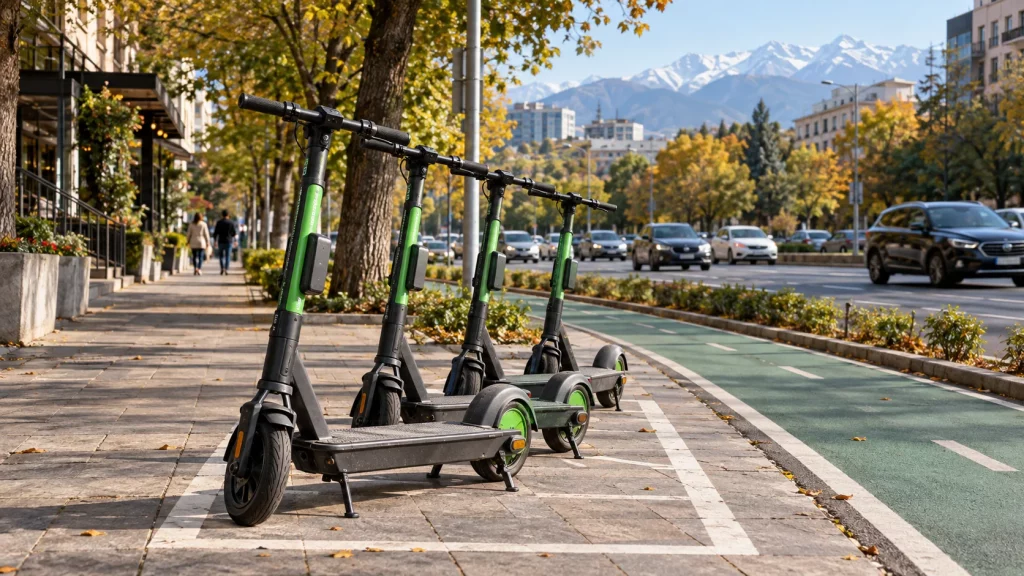
Electric scooters were never outlawed in Almaty. Yet micromobility operator Bolt reported an 80% plunge in ride volume, while competitor JET recorded a 77.8% decline. These metrics were shared by executives in an interview with Forbes Kazakhstan published on October 8.
Effective August 25, 2026, Kazakhstani traffic regulations strictly prohibited electric scooters from operating on pedestrian sidewalks and walkways. Designed to safeguard pedestrians, the mandate created an immediate operational barrier for commuters without driver’s licenses: How can one commute to work when dedicated cycle tracks terminate mid-route?
From 120,000 Daily Trips Down to Around 20,000
According to JET estimates cited by Forbes, Almaty micromobility fleets accommodated approximately 120,000 daily rental rides in September 2025. Following the regulatory enforcement, the operator estimates daily volume at roughly 20,000 trips—representing a sixfold drop, or approximately 83%.
Citywide fleet projections must be distinguished from operator-specific metrics such as Bolt’s 80% drop and JET’s 77.8% decrease. The report does not cite third-party audit data or standardized methodologies. While operators attribute the downtown to recent statutory restrictions, isolating regulatory drag from seasonality remains challenging.
Licenses Were Required Before — The Sidewalk Ban is What Changed
The requirement holding that e-scooter riders possess any valid driver’s license category was first codified into law in August 2023. However, that stipulation applied strictly when operating along the right-hand curb of public roadways. At that juncture, riders retained legal permission to navigate sidewalks at speeds capped at 6 km/h.
The August 2026 statutory amendments completely sealed sidewalks to motorized micro-vehicles. Today, riders face a rigid binary: merge into active motor vehicle lanes (requiring a valid driving license, fastened helmet, and minimum age of 18) or dismount and walk the vehicle as a pedestrian.
Where Riders Can Still Travel Without a Driver’s License
Segregated bicycle tracks remain legally accessible without holding a motor vehicle license. Where dedicated cycling infrastructure is absent, the law also accommodates travel along unpaved road shoulders. The license mandate in Paragraph 5, Article 57 of the Law “On Road Traffic” applies specifically to travel on the right-hand edge of vehicular carriageways.
Crucially, road shoulders and pedestrian sidewalks constitute legally distinct highway elements. A pedestrian sidewalk cannot be treated as a shoulder.
| Route Segment | Permitted Operation |
|---|---|
| Segregated Cycle Track | Permitted without a driver’s license. |
| Designated On-Street Cycle Lane | Permitted by law. Requires a fastened helmet as part of the carriageway. |
| Right Edge of Roadway Carriageway | Only when bike paths/lanes are absent: Age 18+, any driver’s license category, and fastened helmet required. |
| Road Shoulder | Permitted by statute when bike paths or designated lanes are absent. |
| Sidewalks & Pedestrian Crossings | Strictly prohibited riding. Must dismount and push vehicle on foot. |
An individual dismounted and pushing an e-scooter alongside is legally categorized as a pedestrian.
Consider a standard commuter journey from residence to office. The initial kilometer proceeds smoothly along a segregated cycle path, which then abruptly ends. If the remaining transit corridor offers only high-speed traffic lanes or pedestrian sidewalks, an unlicensed rider cannot legally continue riding and must push the device on foot.
Real Accidents Behind the Stricter Rules
Pedestrians have undeniable justification demanding protected footpaths. Municipal police statistics indicate that Almaty logged 386 traffic collisions involving electric scooters in 2025 alone, resulting in over 400 injuries.
These figures represent cumulative municipal incident data across all electric micromobility devices, without segregating commercial shared fleets from privately owned units.
Riders themselves face severe vulnerability. In regulatory commentary, Kazakhstan’s General Prosecutor’s Office noted 47 accidents triggered by e-scooter operators and 145 incidents where motorists collided with riders nationwide during early 2026. Because these metrics encompass divergent collision dynamics, aggregating them without granular methodological controls is misleading.
Consequently, plummeting ride volumes alone do not prove urban thoroughfares have become safer. Evaluating net safety requires analyzing post-amendment collision frequencies alongside total commuter exposure rates.
Bike Lanes Promised to Expand — But Will Commuters Reach Work?
The Almaty City Akimat announced capital targets to expand municipal cycling infrastructure from 87 kilometers to 125.5 kilometers during 2026—an addition of nearly 40 kilometers. However, administrative planning documents do not confirm that these segments are completed or interconnected.
For daily transportation, network continuity is paramount. A cycle path outside an apartment complex provides minimal utility if it terminates abruptly before reaching transit hubs, universities, or commercial corridors.
A gap of merely three blocks forces commuters to reconsider the utility of renting an e-scooter if substantial walking is unavoidable. This tension highlights where public safety mandates collide with urban reality: statutory restrictions arrived overnight, yet contiguous micro-transit infrastructure remains incomplete.
What This Means for Shared Micromobility
JET disclosed to Forbes that it has initiated staff reductions across field maintenance teams and paused regional capital expenditure. The operator estimates utilization dropped from 5–6 daily rides per vehicle down to 2–3 rides.
For rental platforms, this collapse crushes revenue generation while battery charging, fleet maintenance, and software overheads remain fixed. For urban riders, downstream consequences include reduced vehicle density and shrinking operational geofences. Nonetheless, current data does not indicate complete platform abandonment of the Kazakhstani market.
Protecting pedestrian safety on sidewalks is essential. Simultaneously, commuters utilizing light electric vehicles require continuous, physically segregated transit corridors to reach destinations safely.
The pivotal question now facing city planners is straightforward: When will contiguous, protected cycling routes replace vanished sidewalk commutes—and how quickly can urban residents rely on them?



