
Huawei is integrating solutions across state agencies; Kai-Fu Lee’s 01.AI established joint venture Q.AI; and China’s Hengtong participates in Data Center Valley. Concurrently, Kazakhstan formalized a massive multi-billion-dollar GPU supercomputing framework with US-based Firebird and NVIDIA. Kazakhstan is assembling sovereign artificial intelligence infrastructure bridging two geopolitical tech hemispheres—yet fundamental questions remain over who retains ultimate control over model weights, hardware perimeters, and sovereign citizen data.
Huawei Secures Strategic Public Sector Access
Huawei’s penetration across Kazakhstan’s digital governance is comprehensive, spanning cloud telecommunications, optical backbone networks, and municipal smart city infrastructure. Concurrently, the establishment of Q.AI—a joint enterprise between Kazakhstan’s national digital institutes and Beijing-based 01.AI—aims to localize foundational LLMs for public administration, legal indexing, and state registries.
The American Pillar: NVIDIA and Firebird Supercomputing
To balance Chinese hardware reliance, Kazakhstan forged strategic partnerships with Western silicon leaders. The landmark agreement with Firebird and NVIDIA targets building Central Asia’s largest Tier IV data center cluster, powered by up to 100,000 NVIDIA enterprise GPUs utilizing cheap domestic electrical power from Northern Kazakhstan.

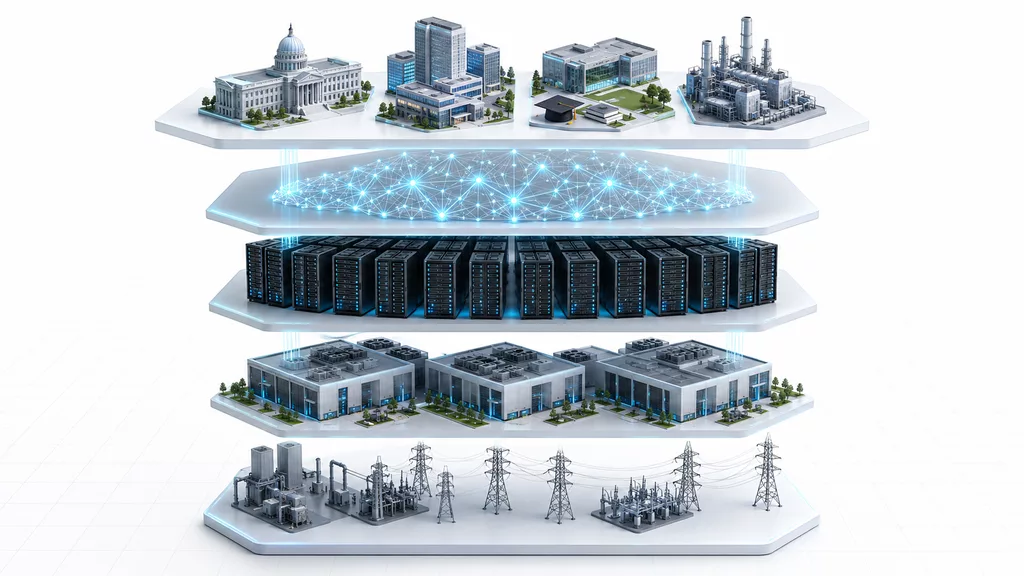
Five Interconnected Layers of AI Sovereignty
National digital sovereignty cannot be achieved through public relations announcements; it requires sovereign ownership across five distinct architectural layers:
- 1. Physical Power and Facilities: Land, water cooling, and high-voltage electrical grid connections inside Kazakhstan;
- 2. Hardware Silicon: Ownership of physical servers and enterprise GPUs without remote kill-switches or foreign export restrictions;
- 3. Foundational Model Weights: Unfettered access to model parameters and fine-tuning weights rather than cloud API query access;
- 4. Data Residency: Ensuring citizen telemetry, tax records, and medical databases remain strictly air-gapped within domestic borders;
- 5. Human Engineering Competence: A domestic elite cohort of Kazakhstani machine learning scientists capable of retraining and debugging models independently.
Multi-vector tech diplomacy offers Kazakhstan immense leverage. However, unless the sovereign control layer resides permanently in Astana, the country risks hosting other superpowers’ datacenters while remaining dependent on foreign cognitive infrastructure.