
Photo: Bia Limova / Pexels
A borrower’s total loan payments in Kazakhstan must not exceed half their average monthly income. For someone earning 500 thousand tenge, that means a maximum of 250 thousand tenge a month. The Agency for Regulation and Development of the Financial Market (ARDFM) has launched regular checks at 11 major banks to verify their calculations (kursiv.media). The checks focus on compliance with the existing limit: no new ban on lending is being introduced.
How a borrower’s debt burden is calculated
The debt burden ratio, or DBR, measures a person’s monthly payments across all loans against their average monthly income. The maximum ratio is 0.5, or 50% of income.
This measure helps assess whether a person can afford payments on their existing commitments and a new loan. Both sides of the calculation therefore matter: the borrower’s income and their loan payments.
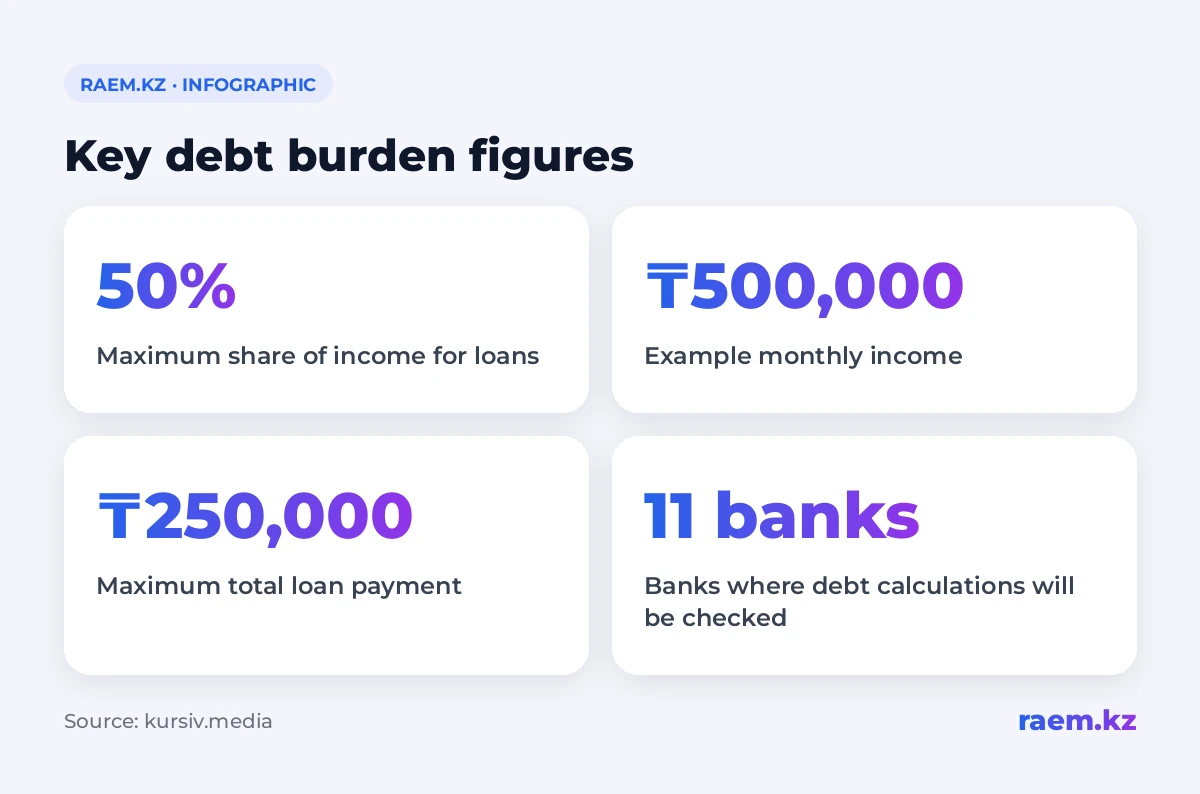
How much you can pay if you earn 500 thousand tenge
With an average monthly income of 500 thousand tenge, total loan payments must not exceed 250 thousand tenge. This limit applies to all loans combined.
When assessing a new loan, a bank must take existing commitments into account. Looking only at the payment on the proposed loan will not give a complete picture of the borrower’s debt burden.
Could you be refused a new loan after the checks?
The launch of the checks does not in itself introduce any additional restriction for borrowers. The debt burden limit remains unchanged at half of average monthly income.
However, an accurate calculation could affect the decision on a new application. If payments exceed the permitted level, the borrower may be turned down. This is a possible consequence of checking the calculations, rather than an announced ban on lending.
What ARDFM will check at 11 banks
The new process is called Debt Service Review, or DSR. Its purpose is to check whether banks correctly calculate the DBR and assess customers’ income and loan commitments.
Before launching regular checks, the agency ran a pilot project at eight banks. It found differences in calculation methods. “The results of the pilot project confirmed the need to incorporate DSR into the regular supervisory process,” ARDFM said.
The agency intends to standardise calculation practices. In its assessment, underestimating debt burdens increases risks for banks and leaves people more heavily indebted.
What will happen after the checks
ARDFM will assess the nature and severity of any breaches identified. The agency will then consider supervisory measures and whether banks need plans to address shortcomings.
The findings will also be used to draw up proposals to amend the requirements for calculating the DBR. These are still future proposals: the launch of the checks does not mean such changes have already been adopted.
In plain terms
Before applying for a new loan, compare all your monthly payments with your average monthly income. The benchmark is no more than half your income, including the payment on the proposed loan.
If you earn 500 thousand tenge, compare your total payments with the limit of 250 thousand tenge. The accuracy of this ratio is precisely what will now be checked regularly at 11 banks.