
Photo: Faheem Ahamad / Pexels
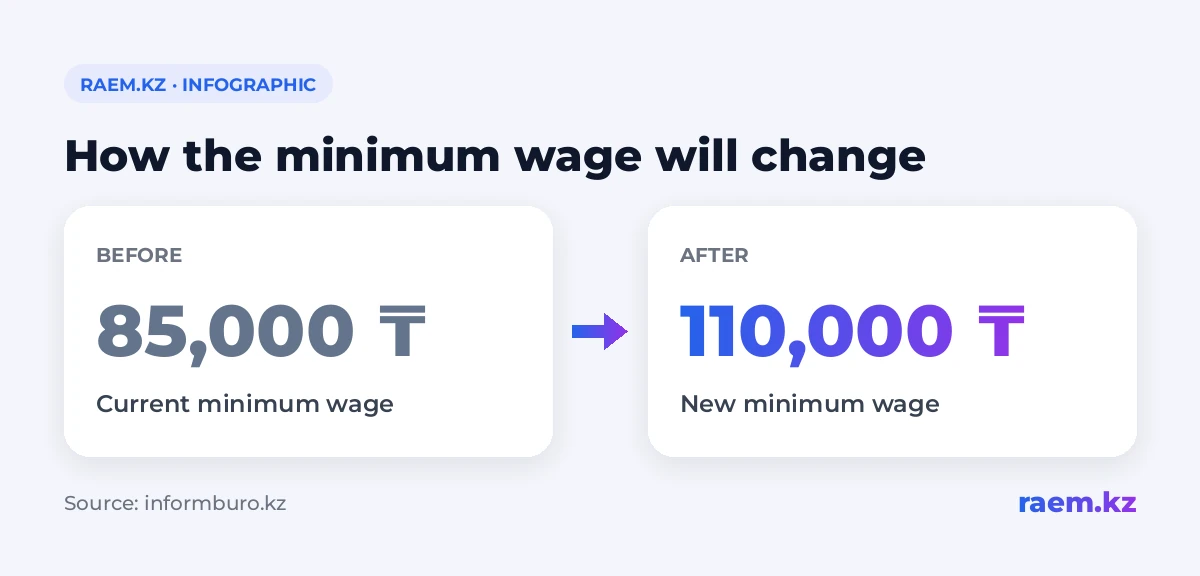
When the minimum wage rises from 85 thousand to 110 thousand tenge, employers must raise pay for employees currently earning the minimum. Employers will decide for themselves whether to increase other salaries. First Deputy Minister of National Economy Azamat Amrin said this at a government briefing (informburo.kz). The ministry’s preliminary calculations put the additional cost to businesses at around 430 billion tenge.
Who must get a pay rise to 110 thousand tenge
According to Amrin, employers must pay employees currently earning 85 thousand tenge at least the new minimum wage. He recalled that, in his address, the president spoke of around 1.8 million people who would be affected by the increase.
For this group of workers, the pay rise is tied to the change in the minimum wage. The new threshold sets the floor employers must observe when setting pay.
Will workers earning above the minimum get a pay rise?
A rise in the minimum wage does not automatically mean the same pay increase for every employee. The vice-minister explained that employers would discuss any increases above the new minimum directly with their employees.
When discussing your pay, it is therefore worth distinguishing between the new minimum and any additional increase. If you already earn more than 110 thousand tenge, Amrin’s statement does not promise a mandatory pay rise. General employer obligations on pay are covered in a separate article.
How much the minimum wage rise will cost businesses
The Ministry of National Economy has provisionally estimated the increase in the total wage bill at around 426 billion tenge. Rounded up, that means 430 billion tenge in additional payroll costs for businesses.
Amrin clarified that the calculation covers only companies currently paying employees the minimum wage. Any decision by employers to raise other salaries as well would be their own. The issue is also covered for entrepreneurs in an article on the minimum wage rise for sole proprietors.
Why the Ministry of National Economy expects businesses to pay less tax
Higher payroll costs mean larger tax deductions, Amrin explained. He estimates that businesses will consequently pay 60–68 billion tenge less in corporate income tax — a tax on company income.
This is an estimate of the overall effect on businesses. It accompanies the preliminary calculation of the increase in the wage bill and explains why the ministry links higher wages to lower tax payments.
Could the minimum wage rise push up prices?
Amrin estimates that the increase should not significantly affect production costs or cause a noticeable rise in prices. This is the vice-minister’s forecast, rather than a guarantee that prices will stay the same.
In plain terms
If you currently earn 85 thousand tenge, your employer must raise your pay to at least 110 thousand tenge when the new minimum wage takes effect. If your salary is already above the new threshold, any additional increase needs to be discussed separately. A practical step now is to ask your employer how the change in the minimum wage will affect your pay.