Illustration: AI
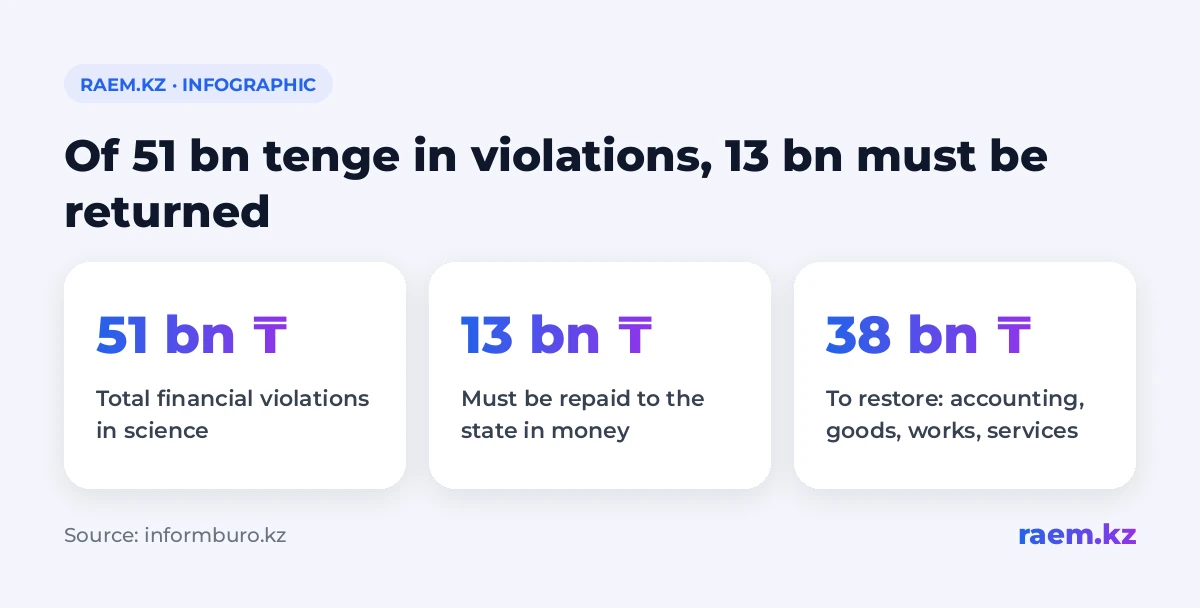
Of the 51 billion tenge in financial violations in science, 13 billion tenge must be repaid to the state. Another 38 billion is subject to restoration: correcting accounting records, delivering goods, or completing work and services. Alikhan Smailov, Chairman of the Supreme Audit Chamber, explained the difference at a session of the Kurultai (informburo.kz). So the total amount of violations does not mean the same amount of money coming back.
How much money must go back to the state
According to Smailov, most of the 13 billion tenge to be repaid is tied to the obligations of subsoil users. These are their spending on research and development, known as R&D.
The head of the Chamber named three sums:
- 10 billion tenge, under the Ministry of Industry and Construction;
- 600 million tenge, under the Ministry of Energy;
- 2.4 billion tenge, unfulfilled obligations of subsoil users to Astana Hub.
This money is classed as repayment. As the head of the Chamber explained, that status means the cash itself has to be returned.
What restoration of 38 billion tenge means
Restoration covers several ways of fixing a violation. You can correct the bookkeeping, deliver the goods that were due, or carry out the required work or services.
The difference in actions matters here. Repayment returns money, while restoration may mean fixing how expenses are recorded in documents or how obligations are fulfilled.
Of the 38 billion tenge to be restored, 35.2 billion relates to how research spending was recorded. The Science Committee wrongly classed it as capital expenditure.
Which other expenses need correcting
Another 2.2 billion tenge relates to cuts in budget obligations for commercialization projects in future periods. In the past period, these projects were not completed.
Commercialization means taking a scientific development to the point where it is used and sold. See also: talks between Kazakhstan and China.
Why auditors check project results
The audit also found problems with how research is paid for. Before the final evaluation, contractors receive 96–98% of a project’s cost. According to Smailov, even if the final report is not accepted, most of the money stays with the contractor (lsm.kz).
176 projects worth 16 billion tenge failed to reach their final results. And 62 billion tenge went to 79 programme-targeted financing projects without a breakdown of spending.
These figures describe separate funding problems. They can’t automatically be counted as extra sums to be returned to the state.
What happens after the audit
A repeat audit from February to May again found violations in science. By the time Smailov spoke, 55% of the Chamber’s instructions from last year’s audit had been carried out.
The head of the Chamber said changes to legislation and to how the sector is managed have not yet been introduced. He also relayed the words of the Minister of Science and Higher Education: the remaining instructions will be carried out soon.
In plain terms
51 billion tenge is the total of financial violations, and 13 billion is what must go back to the state. The other 38 billion needs restoration, including corrections to accounting.
The share of completed instructions shows how the fixing of violations is going, but on its own it doesn’t say how much money has already been returned.