

Photo: Kost9n4 / Pixabay
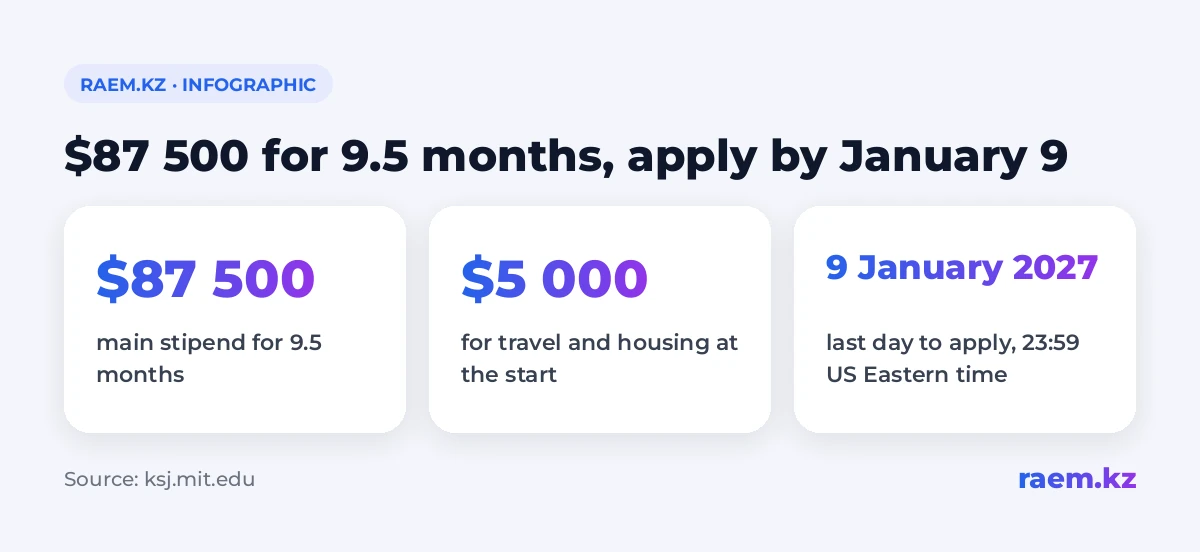
MIT’s Knight Science Journalism Academic-Year Fellowship 2027–2028 pays journalists $87,500 to work on a research project and study. Applications are open until 23:59 US Eastern time on January 9, 2027 (ksj.mit.edu). The program is open to journalists worldwide, and applicants from Kazakhstan face the same professional and visa requirements as everyone else.
Who can apply for the Knight Science Journalism Academic-Year Fellowship 2027–2028
The Massachusetts Institute of Technology, or MIT, picks ten science journalists every year. Staff members of newsrooms and freelancers can apply, as long as journalism is their main job. Part-time work doesn’t qualify.
You need at least three years in a row covering science, health, technology or the environment. The program takes reporters, editors, producers, illustrators, photographers, book authors and filmmakers.
Applicants must be able to get a visa to live in the US for the length of the program. Usually that’s a J-1. Citizens of countries for which the US has suspended visa issuance are advised to apply once the restrictions are lifted. If you hold a second citizenship and a passport from a country without restrictions, you can apply with that one.
How much it pays and what it covers
The main stipend is $87,500 for 9.5 months. That works out to about $9,200 a month. Closer to the start of the program, fellows also get $5,000 for travel and housing.
MIT pays for health insurance for the fellow and accompanying family members. Those who qualify can get help with child care costs: $500–750 a month.
Fellows also get free or discounted public transport, free museum entry and discounts on other programs.
What project to propose
During the program, fellows work on a journalistic investigation in Cambridge. The project has to make use of MIT and the research institutions of Greater Boston.
A long feature, a series of stories, a multimedia project, video or audio all work. You can also prepare a book proposal. At the end of the academic year, fellows present their projects.
Alongside that, they attend seminars and classes at MIT, Harvard and other local universities. Each semester, fellows must choose at least one science course. Attendance is arranged with the instructor.
How to apply in 2026
- Check your years of experience, your main employment and the restrictions that apply after other programs.
- Pick a journalistic project and explain why it needs the resources of MIT and Greater Boston.
- Put together the documents: essays, a résumé and five work samples. What’s required and how long it can be is described in the next section.
- Record a short video about yourself and why you want to take part.
- Go to the official application form, available at ksj.mit.edu, and fill it out before the deadline.
Which documents to prepare
The main essays have length limits. The motivation essay is up to 500 words: explain your interest in the program and how it ties to your professional goals. The research project proposal is also up to 500 words, and it should show how MIT’s resources and connections will help. The career description is shorter: up to 200 words about your previous work.
- Video introduction: 30 seconds introducing yourself and explaining your motivation.
- Résumé: education, work experience and professional awards.
- Five work samples that show the applicant’s interests and skills.
Freelancers need to add to their résumé a list of assignments completed over the past 12 months. For each piece, give the title and the date of publication or broadcast.
IELTS or TOEFL certificates aren’t required, but they can strengthen an application. MIT checks English in an interview and/or through a language test. Visa documents aren’t needed at the first stage.
When applications close and what counts in selection
Applications for the 2027–2028 academic year opened on November 15, 2026. The deadline is 23:59 US Eastern time on January 9, 2027.
The program looks for journalists with strong professional records and a lasting interest in their work. The proposed project has to stay journalistic, though its format can go beyond the usual articles and reports.
What to check before you submit
Here’s an important detail: you have to write the application texts yourself. Using artificial intelligence to write them gets a candidate disqualified.
AI is allowed only for minor editing, including catching grammar and spelling errors. You have to disclose that use in the application. The rule applies to non-native English speakers too.
There’s also a restriction tied to other programs: in the two years before applying, you can’t have completed a full-time residential program lasting four months or longer. This mainly means academic programs that require you to step away from regular journalism work. Grants for producing stories while keeping your main job are fine.
You can research a book proposal during the program, but you can’t sell it in that period. Arriving with a book contract to write during the program is also not allowed.
To compare terms, take a look at the JSK fellowship at Stanford for journalists, or at the Yale World Fellows program. Other opportunities are collected in the “Grants for Kazakhstanis” section. Before filling out the form, check how your proposed project connects specifically to MIT’s resources: that’s a separate requirement of the program.