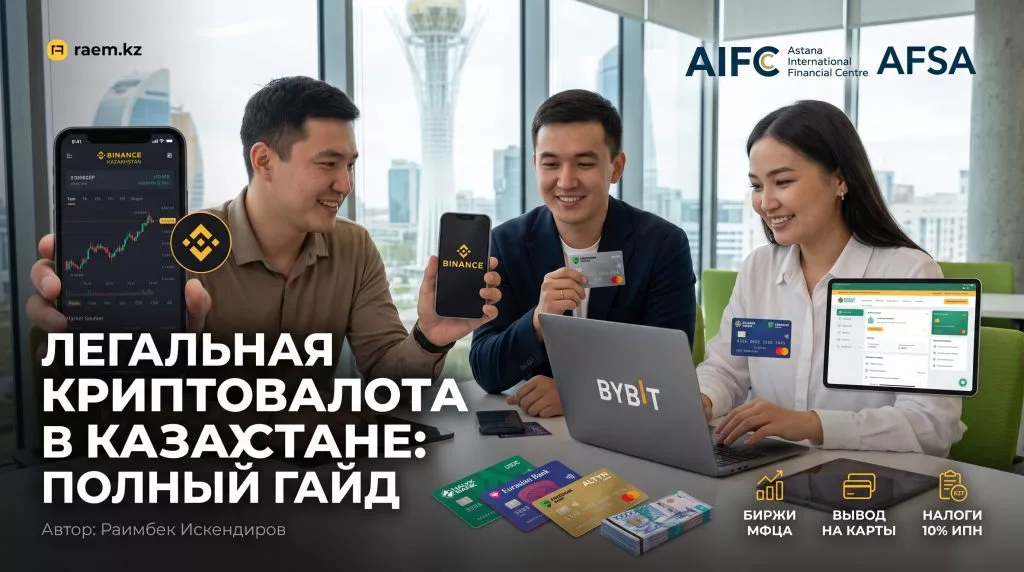
Updated September 2026. Following updated tax code revisions and regulatory guidance released by the State Revenue Committee (SRC) and the Astana Financial Services Authority (AFSA), below is the authoritative legal and taxation framework governing individual digital asset transactions in the Republic of Kazakhstan.
Where to Legally Buy and Sell Cryptocurrency in Kazakhstan
AFSA strongly advises residents to transact exclusively through officially authorized Digital Asset Service Providers (DASPs) and verify their regulatory status on the public register. As of September 2026, licensed entities holding an active license for Operating a Digital Asset Trading Facility include BN KZ Technologies Limited (Binance Kazakhstan), Bybit Limited, and ATAIX Eurasia Ltd.
Investors must exercise due diligence: a brand name on a mobile application is insufficient. Before depositing fiat currency, users should inspect the legal entity’s profile in the AFSA Public Register to verify that its status is explicitly marked as Active with authorized trading permissions. Interim designations such as Pending Approval, Suspended, Expired, or Withdrawn do not constitute full operating authorization.
How Individual Crypto Income Is Taxed in 2026
- Taxable Base: Net taxable income is defined as the positive difference between the realized sale price of a digital asset and its documented acquisition cost.
- Progressive PIT Rates: Under Kazakhstan’s reformed tax structure, individual capital income is subject to a progressive personal income tax (PIT) scale: a 10% rate applies to annual income up to 8,500 Monthly Calculation Indices (MRP), and a 15% rate applies to income exceeding this threshold.
- Mandatory Tax Declaration (Form 270.00): Independent income from digital asset disposals must be reported on Form 270.00. Per SRC guidelines, declarations must be submitted by September 15 of the year following the reporting tax period, with tax payments finalized by September 25.
- Value Added Tax (VAT): Cryptocurrency disposal transactions are exempt from VAT under statutory provisions; this statutory exemption is distinct from a 0% rate regime.
Documentation and Record-Keeping Requirements
To successfully claim acquisition costs and avoid paying tax on gross turnover, investors must preserve complete audit documentation:
- Exchange statements and ledger extracts showing transaction timestamps, asset volumes, and execution prices for all purchases and sales.
- Banking records confirming domestic fiat deposits and bank card withdrawals.
- On-chain cryptographic transaction hashes detailing transfers between personal self-custody wallets and licensed exchange wallets.
- Trading fee invoices and broker fee receipts verifying acquisition deductions.
If an investor cannot legally substantiate the original purchase price, tax authorities may assess liability against the entire gross sale value. Note that the taxable event is triggered upon the disposal of the asset, not merely upon card withdrawal.
The Regulatory Status of P2P Trading
The State Revenue Committee affirms that buying and selling cryptocurrency within the territory of Kazakhstan is legally sanctioned through AIFC-registered digital asset exchanges. Conducting unregulated peer-to-peer (P2P) transfers between personal bank cards with unidentified third parties exposes accounts to immediate anti-money laundering (AML) compliance freezes and does not satisfy statutory exchange licensing requirements.
Official Regulatory Sources and Verification Links
- AFSA Public Register of Digital Asset Service Providers;
- AFSA Advisory on Selecting Authorized Digital Asset Providers;
- State Revenue Committee (SRC) Guidance on Digital Asset Taxation;
- Official Form 270.00 Declaration Filing Portal.
Disclaimer: This article is provided for informational and analytical purposes only. For complex portfolio reorganizations, cross-border corporate holdings, or unrecorded historical transactions, consult a certified tax professional.