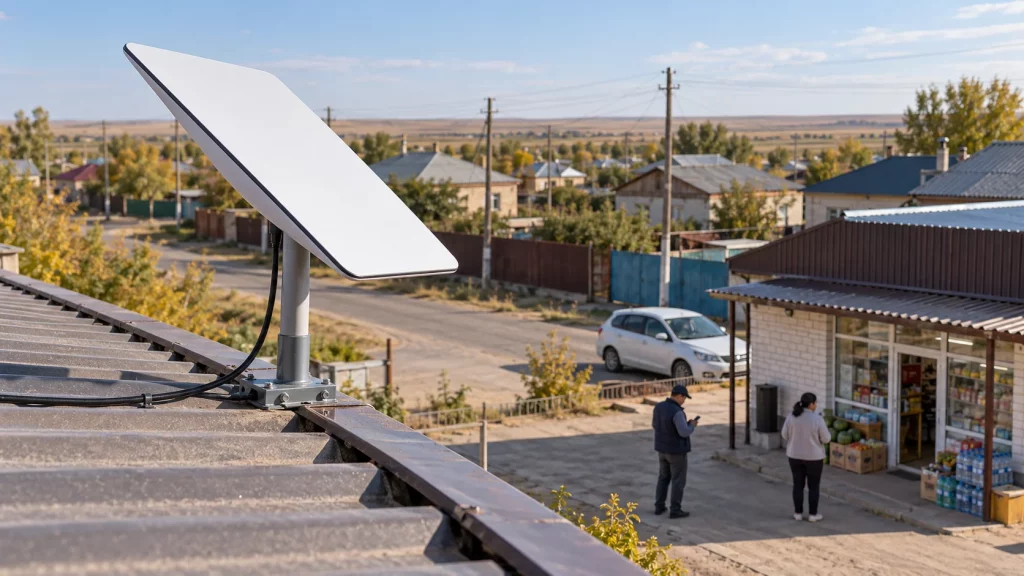
A single satellite dish, several neighboring homes, and paid internet access by the hour, day, or month. Starlink is accepting applications for its Community Host beta program, allowing equipment owners to generate revenue by sharing connectivity with local users. According to Digital Business, Kazakhstan is already selectable in the registration form. However, this currently represents an intake of interested participants rather than an official commercial rollout in the country.
For a rural Kazakhstani village, a roadside cafe, or a small eco-lodge, this model could serve as a supplementary business venture. Rather than each household purchasing an independent hardware kit, internet access is purchased on demand while the host houses and operates the base station.
Yet essential commercial terms remain undisclosed: the end-user access tariff, the host’s revenue share percentage, and the operational expenses borne by the equipment owner.
How Starlink Community Host Works
On its official portal, Starlink outlines the operational framework: a participant installs the terminal where nearby demand exists and establishes a communal Wi-Fi access point. The company handles billing processing, user authorization, and core network transit. The host earns revenue from paid connections. Network expansion is supported through auxiliary mesh routers or supplementary Starlink kits.
Prospective users are offered four distinct access tiers:
| Pass Type | Validity Period | Number of Devices |
|---|---|---|
| Hourly | 1 hour | 1 |
| Daily | 24 hours | 1 |
| Weekly | 7 days | 1 |
| Monthly | 1 month | Up to 4 |
These tier specifications are published on the program’s documentation page. Specific pass pricing has not yet been designated.
For a transit cafe patron, a short pass can satisfy an immediate need: dispatching documents, messaging family, or working remotely en route. A weekly pass suits visiting tourists, while monthly tiers target permanent neighbors adjacent to the hotspot. These reflect potential operational scenarios rather than verified production deployments within Kazakhstan.
Kazakhstan Appears on the Form: What It Signifies
The registration portal is titled the Starlink Community Beta Interest Form and serves as a waitlist for potential pilot participation. Submitting the questionnaire does not guarantee commercial activation or hardware delivery.
As reported by Digital Business, applicants are asked to describe the prospective site: an operating business, clustered residential homes, a multi-unit dwelling, or a civic public space. The company also surveys planned access point counts, projected user volumes, and local willingness to pay. Kazakhstan is actively listed among supported regions.
Based on the survey’s structure, Starlink is assessing regional demand patterns and the localized unit economics of shared access points. Country inclusion enables hosts to register interest, but does not independently confirm launch dates, localized billing rates, or site approval.
On the Community Host landing page, the company advises submitting an application to receive notifications regarding regional rollouts. Therefore, asserting that “Kazakhstanis can now earn income from their satellite dishes” overstates confirmed terms. At present, the initiative represents an exploratory waitlist.
Projected Earnings for Site Hosts
As of October 7, 2026, reviewed public materials contain neither pass pricing schedules nor host commission splits. Industry coverage by TeslaNorth highlighted the same omissions in the announced program. Accurately modeling hotspot payback periods remains impossible without these baselines.
Financial forecasting requires knowing the net revenue share retained per pass, whether recurring monthly subscription fees apply to the host, and who finances hardware procurement, installation, and maintenance. Disbursement mechanics — payout currencies, clearing schedules, and transaction fees — present additional variables.
Economics will also vary sharply by geographic setting. A highway service plaza may see high-frequency short sessions; a mountain guesthouse will see multi-day tourist traffic; a residential village hotspot will rely on steady monthly subscribers. Given identical user totals, top-line revenues across these venues will diverge substantially.
Beyond initial kit procurement, capital calculations must account for electricity consumption, local area network cabling, outdoor enclosures, hardware repairs, and labor. Gross pass revenues do not equal net host profit. Until Starlink publishes contractual terms, localized earnings estimates in tenge remain hypothetical.
One Satellite Dish Does Not Cover an Entire Village
In the Kazakhstani context, the most viable use case is a concentrated micro-hub where residents need internet and terrestrial options are lacking. Potential candidates include rural convenience stores, campsites, guesthouses, and roadside service stations.
However, satellite uplink throughput and local Wi-Fi coverage represent distinct technical layers. While the dish terminal receives satellite downlink data, connectivity must still propagate to end-user devices. Inter-building distances, masonry walls, and router topologies dictate where the signal functions reliably.
Increasing concurrent client loads also stresses bandwidth capacity. Starlink explicitly cautions that advertised peak speeds are not guaranteed and degrade during network congestion. Consequently, an access point must be evaluated on sustained multi-user throughput rather than isolated speed tests.
Community Host also differs fundamentally from Direct to Cell satellite cellular connectivity, previously covered by RAEM. Here, the service relies on an installed physical terminal creating a local wireless network for visiting patrons or neighbors.
How to Submit an Application
Applications can be submitted via the official Starlink Community Host interest form. Before completing the submission, applicants should evaluate their installation site, estimate user volume, and identify the most demanded pass duration.
For an entrepreneur, the next meaningful step is securing venue-specific operating conditions from Starlink. These must clarify initial hardware investment, revenue compensation schedules, and service level requirements. An initial survey submission alone does not mean a commercial business is ready to launch.
If the program launches in Kazakhstan under sustainable terms, small business owners will be able to market connectivity as an independent service line. However, site selection will ultimately depend on genuine purchasing power: how many local users will consistently buy passes and whether aggregate revenues cover hotspot upkeep. Those metrics alone will determine whether a Starlink dish becomes a viable revenue source.