
In the United States, 66% of adults favor mandatory age verification to bar teenagers under 16 from social media platforms. Concurrently, Kazakhstan’s Ministry of Culture and Information is drafting legislative measures to restrict independent social network registration below age 16. However, to identify who is underage, technology platforms will inevitably be forced to verify the identity of every single user.
The global internet is rapidly approaching a milestone where checking an unverified box declaring «I am at least 18 years old» will no longer suffice under sovereign law. For statutory compliance requirements regarding user identification and data privacy, explore our comprehensive guide on Kazakhstan’s Personal Data Law and domestic storage requirements.
A nationwide Reuters/Ipsos public opinion survey reveals that 61% of Americans favor tighter government regulation of social media companies, while 66% endorse mandatory age verification to prevent children under 16 from creating accounts without parental consent. While the United States debates statutory frameworks, Kazakhstan, Australia, and European nations are moving aggressively toward concrete legislative mandates.
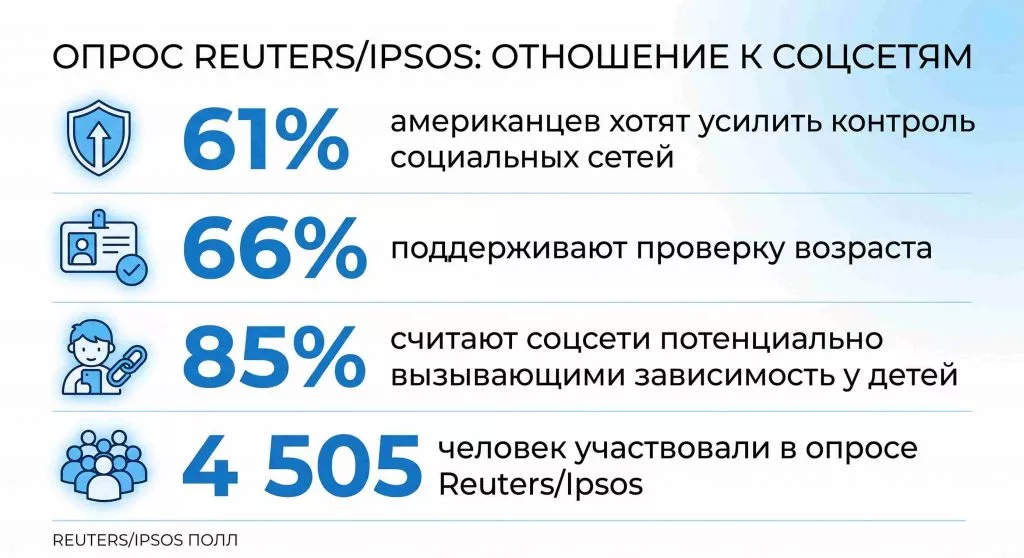
85% of Americans View Social Platforms as Addictive for Youth
The Reuters/Ipsos survey sampled 4,505 American adults across the political spectrum, uncovering overwhelming public consensus regarding social media’s detrimental psychological toll on adolescents:
- 85% agree that major social media algorithms are engineered to induce behavioral addiction among children and teenagers.
- 76% believe that prolonged smartphone screen time and algorithmic feeds inflict measurable harm on adolescent mental well-being.
- 69% support allowing parents to sue technology platforms for damages if algorithmic recommendation systems cause clinical mental health harms.
Mounting Litigation Against Meta and ByteDance
Public outrage is rapidly translating into immense legal liabilities for Big Tech. In federal multidistrict litigation in California, over 30 state attorneys general alongside hundreds of school districts have filed consolidated suits against Meta (Instagram), ByteDance (TikTok), Snap, and Alphabet (YouTube).
Internal corporate communications unsealed in court revealed that platform executives were acutely aware that features like infinite scroll, autoplay algorithms, and push notifications exacerbated depressive symptoms among teen demographics. Analysts estimate that aggregate settlement reserves could eventually run into hundreds of millions of dollars.
Kazakhstan Prepares Mandatory 16+ Registration Threshold
Central Asia is following the global regulatory wave. In Kazakhstan, the Ministry of Culture and Information has initiated working-group consultations to mandate a minimum registration age of 16 for domestic users across social platforms, including TikTok, Instagram, and Telegram.
Domestic lawmakers point to rising cyberbullying, unauthorized online gambling advertising, and predatory algorithmic rabbit holes as justifications for tightening platform registration. Parliamentary discussions contemplate holding foreign platforms accountable through local administrative fines and bandwidth throttling if they fail to implement verified age gating.
Global Regulatory Comparison: Under-16 Restrictions
Kazakhstan is not alone in reassessing youth digital access. Multiple sovereign jurisdictions are pursuing comparable statutory curbs:
| Country | Age Threshold | Legislative & Regulatory Status |
|---|---|---|
| 🇰🇿 Kazakhstan | Under 16 years | Legislative amendments under parliamentary review |
| 🇦🇿 Azerbaijan | Under 16 years | Statutory bill submitted to National Assembly |
| 🇦🇲 Armenia | Under 16 years | Regulatory feasibility and technical audit in progress |
| 🇬🇧 United Kingdom | Under 16 years | Online Safety Act enforcement and age verification rules |
| 🇦🇺 Australia | Under 16 years | Enacted nationwide social media age ban |
The Technical Paradox: To Gate Children, Platforms Must Verify Everyone
The primary obstacle confronting age restrictions is not political will, but computer engineering and constitutional privacy. For thirty years, the internet operated on an honor system where a user merely checked a box.
To mathematically guarantee that a TikTok or Instagram registrant is at least 16 years old, the platform must verify their real-world identity. There are four primary technical mechanisms currently available, each carrying severe tradeoffs:
- Sovereign Digital ID Integration (eGov / Bank ID): Authenticating via state databases (such as Kazakhstan’s eGov or Kaspi Bank ID). While highly reliable, it strips away digital anonymity and raises serious privacy concerns regarding state tracking of private browsing habits.
- Facial Biometric Age Estimation (AI / Yoti): Having an algorithmic model analyze a real-time selfie. While privacy-preserving, error margins around puberty (ages 14 to 17) can reach 15–20%, resulting in widespread wrongful exclusions.
- Payment Card Pre-Authorization: Verifying age through active credit cards. This systematically discriminates against unbanked populations and fails where minors utilize parental payment cards.
- Behavioral Telemetry Analysis: Inferring age through linguistic patterns, viewing habits, and social graphs. This requires intrusive surveillance of private communications, creating acute privacy dilemmas.
The Fundamental Question of Digital Citizenship
If Kazakhstan and international regulators enact strict age prohibitions on social networks, the ultimate societal dilemma is not merely whether adolescents can launch TikTok on their smartphones.
The decisive question is how every adult citizen will be forced to prove their adulthood just to browse the open web. Balancing child safety against universal digital surveillance represents one of the defining civil-liberties challenges of the decade. For constructive, safe digital learning alternatives designed specifically for children, read our profile on digital educational alternatives and youth STEM platforms like CodiPlay.
Sources: Reuters/Ipsos National Survey (August 2026); Ministry of Culture and Information of the Republic of Kazakhstan; UK Ofcom Online Safety Guidance; Australian Federal Communications Disclosures.