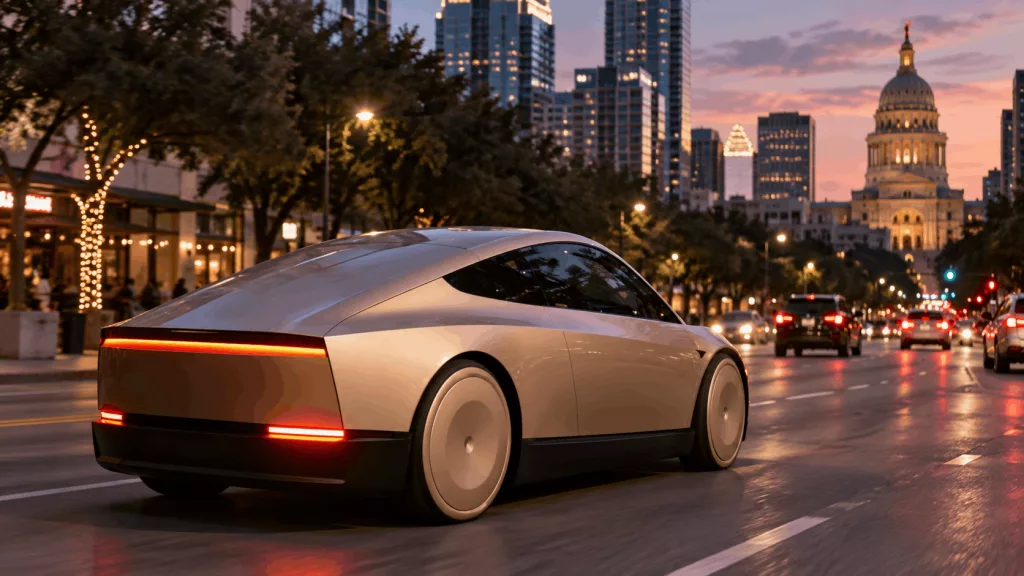
On September 3, Tesla officially rolled out its dedicated Cybercab robotaxi onto the public streets of Austin, Texas—a two-seater fully autonomous electric vehicle built without a steering wheel, accelerator pedals, or exterior side-view mirrors. Passengers hail the ride exclusively via a mobile application, with zero safety drivers or onboard personnel. Within hours of deployment, federal automotive safety regulators initiated a formal audit inquiry.
No Prior Federal Road Approval for Cybercab: The Self-Certification Loophole
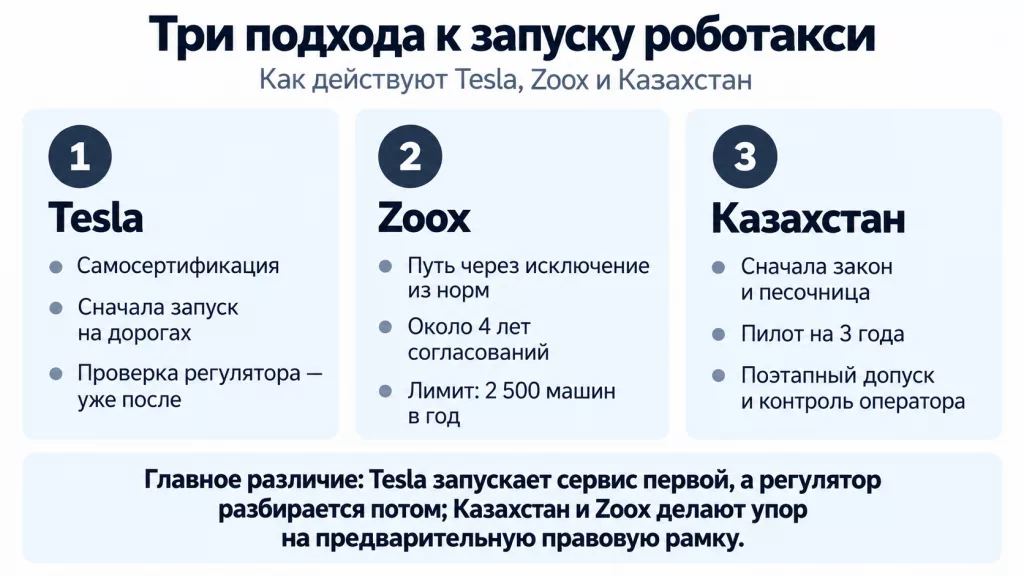
Under United States federal law, commercial automakers do not receive mandatory pre-market approval before introducing new passenger vehicle models. Instead, automotive manufacturers self-certify that their vehicles conform to Federal Motor Vehicle Safety Standards (FMVSS), while regulators intervene retrospectively if compliance discrepancies or public safety defects arise. This framework governs the broader American automotive sector, and Tesla operated under the established self-certification standard.
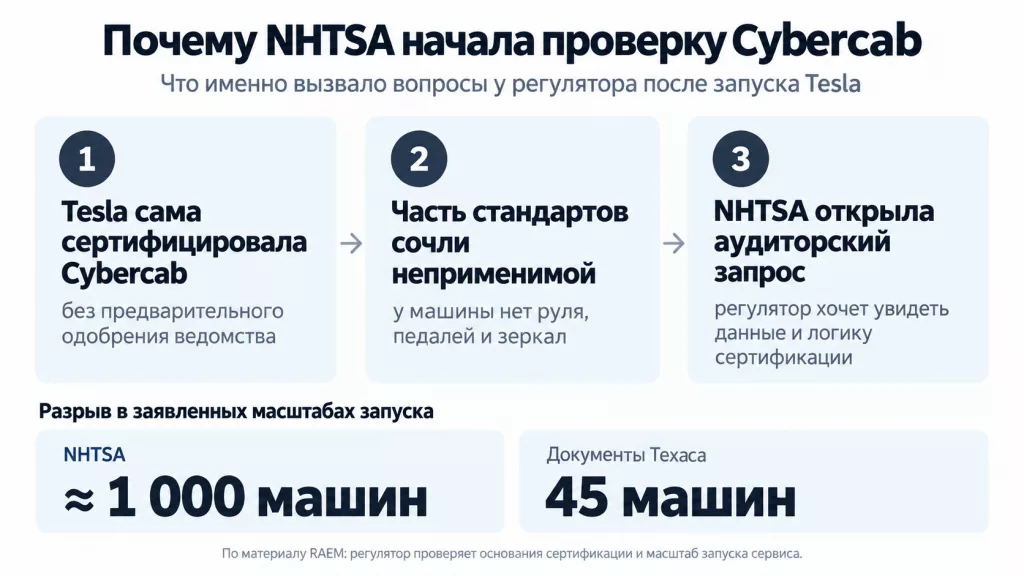
However, an acute regulatory bottleneck emerged. Decades-old federal safety standards presuppose an alert human driver seated behind manual vehicle controls: regulations mandate physical steering columns, mechanical braking pedals, acceleration linkages, and optical rear-view mirrors. Cybercab incorporates none of these mechanical interfaces. Tesla navigated this hurdle by unilaterally deeming entire sections of the FMVSS standards inapplicable to an autonomous vehicle engineered entirely without human driving positions.
Now, the National Highway Traffic Safety Administration (NHTSA) is demanding full architectural and legal justification for that self-exemption determination.
Regulator Demands Engineering Proof Supporting Tesla’s Certification
The regulatory inquiry, cataloged under audit query AQ26002, is overseen directly by the NHTSA Office of Defects Investigation. While formally triggered by media reports covering the commercial launch in Austin, Tesla was already legally obligated to submit formal notification detailing its FMVSS self-certification for Cybercab.
Federal investigators are reviewing the empirical sensor datasets, redundant fail-safe systems, and neural network safety validations upon which Tesla grounded its self-certification. Crucially, regulators are evaluating the extent to which Tesla’s unilateral exclusion of federal equipment rules compromise road safety. NHTSA Administrator Jonathan Morrison stated that while the agency actively supports the advancement of autonomous mobility technologies, it remains legally bound to enforce statutory compliance and public road safety.
Fleet Discrepancy: Federal Records Cite 1,000 Vehicles vs. Texas Filings of 45
In official NHTSA investigation documentation, federal officials cite an estimated operating fleet of approximately 1,000 Cybercab vehicles. Conversely, regulatory registration filings submitted by Tesla to state authorities in Texas report only 45 operational vehicles assigned to the autonomous commercial service. Even accounting for speculative projections, the numerical disparity indicates sharp variance between deployed testing fleets and commercially licensed vehicles.
The commercial rollout was orchestrated with uncharacteristic corporate discretion: no live-streamed keynote, no mass product unveiling, and no public keynote address from Elon Musk. The debut invited a select cohort of private retail investors and approved content creators, several of whom were subject to non-disclosure protocols. Public access through the mobile ride-hailing app commenced only following this closed preview.
By mid-day trading following the announcement and subsequent regulatory inquiry, Tesla shares dropped by more than 6% on the Nasdaq.
NHTSA Prepares to Overhaul Outdated Autonomous Vehicle Safety Standards
In its official press release outlining the audit inquiry, NHTSA acknowledged that the agency is actively rewriting federal motor vehicle safety standards to accommodate autonomous architectures, aligned with federal technology modernization mandates. The US Department of Transportation has repeatedly proposed rescinding mandatory requirements for manual foot pedals and steering wheels for vehicles conceived from inception as driverless autonomous systems.
Consequently, the standoff is less a debate over the fundamental efficacy of autonomous driving and more a jurisdictional clash over who possesses statutory authority to dismantle legacy regulations that both industry and government concede are obsolete.
The Zoox Precedent: Four Years to Secure Commercial Operating Exemptions
In 2022, Amazon subsidiary Zoox pursued an identical self-certification route for its purpose-built bidirectional robotaxi lacking pedals and steering equipment. NHTSA promptly demanded technical dossiers, launched a formal probe a year later, and prolonged Zoox’s path to commercial fare-charging deployment.
Zoox subsequently adjusted course by seeking formal statutory exemptions from eight specific FMVSS regulations. Final federal approval was granted only in July 2026, capped at a strict commercial production threshold of 2,500 vehicles per year. From initial self-certification to certified passenger revenue service, Zoox navigated nearly four years of intense regulatory arbitration.
Kazakhstan’s Regulatory Sandboxes: Establishing Frameworks Before Vehicles Hit Public Roads
On June 24, 2026, President Kassym-Jomart Tokayev signed into law comprehensive legislation establishing statutory frameworks governing autonomous vehicles, aerial drone taxis, and automated railway transit across Kazakhstan.
Rather than permitting unregulated deployment, Kazakhstan established a three-year regulatory sandbox. The protocol mandates initial closed proving-ground trials, followed by phased access to municipal traffic across predetermined urban corridors under continuous remote teleoperation monitoring. Initial operational zones span Astana, Almaty, and Kosshy, partnered directly with leading regional platforms Yandex Qazaqstan and inDrive. In Kazakhstan’s jurisdiction, the legislative architecture preceded autonomous wheels on tarmac.
As autonomous pilot fleets transition from designated proving grounds to bustling city avenues, the central policy question remains: when a driverless vehicle encounters an unforeseen incident, where will legal liability rest—with the vehicle manufacturer, the software operating platform, or municipal transit regulators?