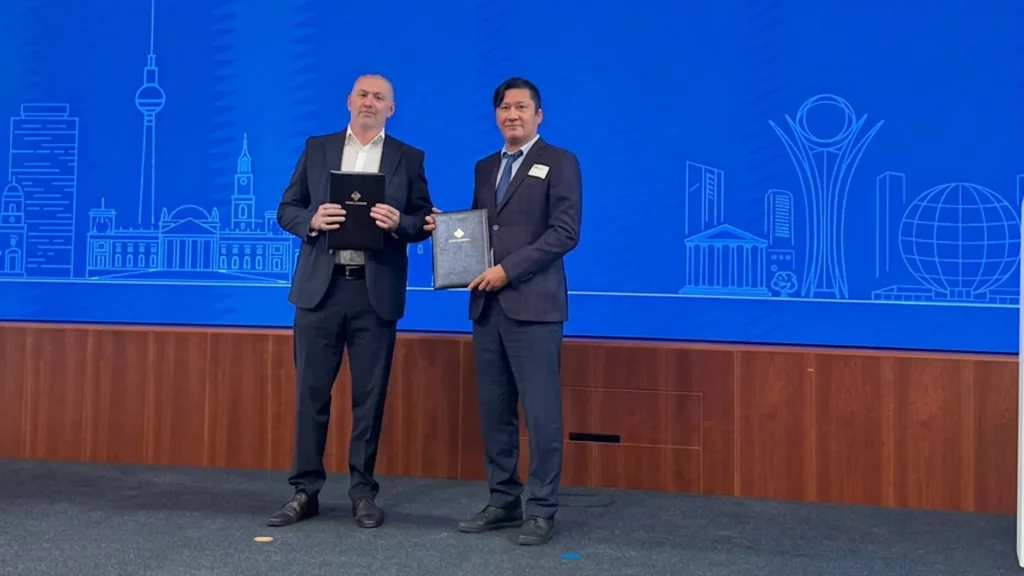
KazPetFood, an operating business of Kusto Group, and Germany’s Wagner Feedmill and Silo Plants GmbH finalized a €31 million agreement to construct an industrial pet food manufacturing plant in Alatau, Almaty Region. The Phase 1 installation is designed for an annual capacity of 27,000 tons of dry and wet pet formulations, with 350 direct manufacturing jobs planned.
The bilateral agreement was executed on September 29 in Berlin during the Kazakh-German Business Forum, held concurrently with the state visit of President Kassym-Jomart Tokayev to Germany.
According to KazPetFood, the German industrial engineering partner will supply machinery lines, engineering design, and automated processing systems. The venture is positioned as Kazakhstan’s first modern domestic pet nutrition production plant.
Deliverables Under the €31 Million Agreement
The contract with Wagner provides the core technological infrastructure: processing lines and automated extrusion systems for commercial pet food manufacturing.
The reported €31 million reflects the equipment supply and technology transfer contract. The comprehensive civil construction budget and commissioning capital requirements were not disclosed.
Phase 1 annual capacity targets 27,000 tons across extruded kibbles and canned wet lines. KazPetFood plans phased facility expansion and product diversification. Target commissioning dates were not specified in the release.
Domestic Agricultural Feedstock and Regional Sourcing
Plant processing is planned around local agricultural grains and animal proteins, with scheduled increases in domestic value-add localization.
KazPetFood seeks to establish an integrated domestic supply chain spanning raw grains, processing, packaging, cold-chain distribution, and plant engineering support.
For regional agribusinesses, this could generate ongoing procurement demand for feed commodities, packaging materials, freight transport, and industrial maintenance. Concrete procurement volumes depend on plant commissioning and operational run-rates.
“Our long-term commitment is scaling local production, deepening localization ratios, and engineering consumer brands capable of competing in international markets,” stated KazPetFood CEO Kenen Zhandos.
Central Asian Export Footprint
The facility is built for domestic import substitution and regional export. Target initial foreign markets encompass neighboring Central Asian states, followed by wider Eurasian distribution.
Domestically, output is designed to substitute pet food imports. Retail brand identities, wholesale pricing tiers, and anticipated market share metrics were not disclosed.
The export framework relies on the Alatau hub as a centralized regional processing center. Commercial realization will depend on product quality certifications, unit costs, freight logistics, and distribution agreements.
German-Kazakh Industrial Partnership
At the Berlin summit, Kazakhstan highlighted readiness to inaugurate a joint industrial investment partnership portfolio alongside German manufacturing leaders.
The agreement between KazPetFood and Wagner aligns with strategic bilateral goals: advanced German machinery transfer, localized manufacturing, and production of high-margin finished goods.
For Alatau, the plant represents an industrial project linking urban logistics with surrounding regional agriculture. The planned 350 manufacturing jobs represent operational targets contingent on construction milestones.
Specialized Initiative: Preserving the Kazakh Tazy
KazPetFood concurrently announced formal support for the international breed accreditation campaign for the historic Kazakh Tazy canine breed, which recently secured provisional recognition from the Fédération Cynologique Internationale.
The company is collaborating alongside veterinary nutritionists to formulate breed-specific nutritional diets tailored to the physiological characteristics of the ancient hunting breed.
The foundational commercial project remains the Alatau feed manufacturing facility. Upcoming milestones include ground breaking, machinery delivery, and Phase 1 commissioning, which will determine actual throughput and export performance.