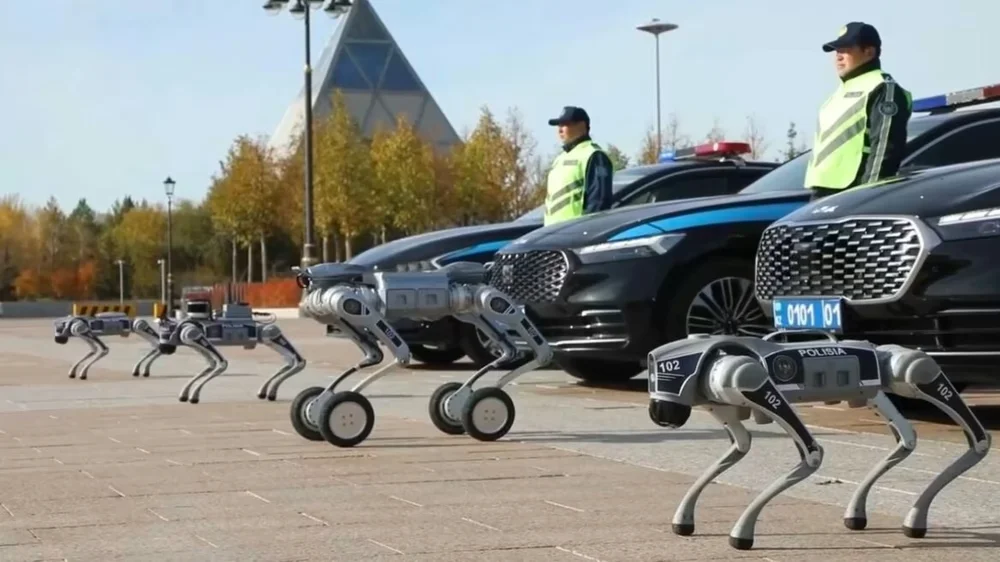
Four quadrupedal robotic units equipped with surveillance optical payloads are patrolling shopping centers and public thoroughfares in Astana. The camera feeds stream directly to law enforcement consoles and, according to the Ministry of Internal Affairs, support automated facial recognition against national fugitive databases.
Operational deployment details were confirmed by capital police authorities on October 15. Optical streams transmit in real time to the Operational Control Center (OCC), enabling remote situational awareness and rapid dispatch intervention.
A flagship technical capability is biometric face matching. The integrated system cross-references pedestrian faces captured by the robotic units against active watchlists, automatically dispatching alert telemetry to OCC watch commanders upon a probabilistic match.
However, police authorities have not disclosed metrics regarding verified identifications, false alarm frequencies, or field accuracy under variable lighting conditions.
Autonomous Patrol System Architecture
The robotic quadrupeds serve as mobile sensor platforms. Onboard camera arrays relay live feeds from pedestrian ground levels, while integrated wireless links enable remote teleoperation and command oversight.
According to MIA disclosures, patrols focus on high-density pedestrian hubs across Astana, primarily major retail malls and central transit zones.
The operational framework divides into two workflows: real-time situational video streaming for operator awareness, and automated algorithmic scanning to detect watchlist candidates.
An automated match notification serves strictly as an investigative lead requiring manual officer verification. Disclosures do not specify operational standard operating procedures (SOPs) or tactical escalation rules following a match trigger.
Authorities have likewise not detailed edge computing capabilities—specifically, whether initial facial vectorization occurs onboard the unit or within centralized data centers.
Deployment Preceded October Disclosures
The use of robotic quadrupeds in Astana does not represent an unannounced rollout. Initial field trials were publicized as early as January 28, 2026, when prototype units were deployed in transit facilities and retail centers.
At that time, officials showcased real-time video relays and OCC integration as deterrent tools for municipal crime prevention.
The October report formalizes fleet dimensions—confirming four operational quadrupeds—and provides technical clarity on biometric matching workflows.
Accordingly, recent coverage details the technical capabilities of existing municipal assets rather than a newly initiated procurement rollout.
Operational Efficacy and Data Governance Questions
Capital procurement costs, lifecycle maintenance agreements, and hardware vendors remain undisclosed, limiting independent assessment of capital return compared to fixed camera infrastructure.
Performance telemetry—including patrol hours logged, aggregate alerts generated, confirmed apprehensions, and false positive ratios—has not been made public.
Biometric surveillance requires rigorous evaluation of algorithmic accuracy, particularly regarding false positives in crowded commercial environments.
Data governance and retention frameworks remain unaddressed: published records do not disclose whether raw video is archived, retention duration policies, or cryptographic protections against unauthorized access.
While municipal police position the robotic quadrupeds as assistive safety assets, future disclosures detailing verifiable field arrests, error thresholds, and operating expenditure will be crucial to evaluate their practical return for municipal security.