
Car leasing can offer lower monthly payments than a car loan by deferring part of the vehicle’s price until the end of the contract. Customers still need to budget for an upfront payment, annual comprehensive insurance and running costs. A lower monthly payment alone does not mean the car will cost less overall.

Darkhan Abdykalyk, chairman of the presidium of the KazLeasing association, outlined the payment structure and customer expenses in an interview with LS. Separately, Zakon.kz reported on 9 October 2026 that the Nomad Leasing Solutions and Allur programme offers a residual-payment option, with part of the vehicle’s price deferred until the end of the contract.
How much you need to pay upfront
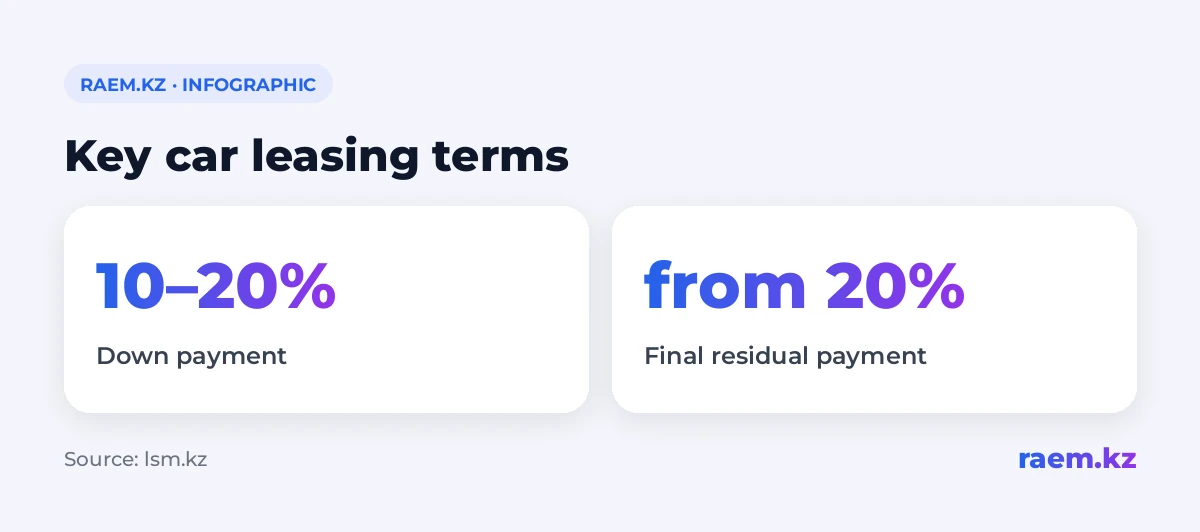
The upfront payment depends on the leasing company. According to Abdykalyk, it can range from 10–20% of the car’s price. This is the initial payment, after which the customer continues making payments under the contract.
As a specific example, Zakon.kz reported that the Nomad Leasing Solutions and Allur programme requires an upfront payment of at least 20%. That is a condition of this programme rather than a universal minimum for all leasing offers.
Insurance also needs to be factored in alongside the upfront payment. According to Abdykalyk, the lessee must pay for KASKO—comprehensive insurance covering the car itself—every year. Customers should therefore consider the upfront payment, regular payments and annual insurance together.
Why monthly payments can be lower
The leasing company can defer part of the car’s price until the end of the contract. According to KazLeasing’s comments to LS, this final residual payment typically starts at 20% of the car’s price. The association says this can reduce monthly payments compared with a conventional car loan for the same amount and term.
Zakon.kz separately reported that the Nomad Leasing Solutions and Allur programme allows customers to defer at least 20% of the vehicle’s price as a residual payment, reducing monthly payments.
This structure eases the immediate pressure on the budget. The final payment still remains, however, and must be factored in if the aim is to buy the car. Compare offers using the same vehicle price and financing term, while also checking the upfront and final payments.
Which costs are included in the rate
The annual effective interest rate, or AEIR, helps customers assess the cost of financing. According to Abdykalyk, mandatory expenses, including insurance and the installation of GPS equipment, must be included when calculating this rate for car leasing.
Other costs associated with running and maintaining the car are excluded from the rate, he explained. He cited tyre replacement and servicing as examples. These expenses also affect the customer’s budget, even if they are not included in the AEIR.
Who owns the car before it is bought outright
The car remains the property of the leasing company until it is fully bought out. The customer uses the car and makes payments, while ownership remains with the lessor. Both the LS interview and Zakon.kz’s report describe this ownership structure.
At the end of the contract, KazLeasing explained to LS, the customer can buy the car outright or return it to the company. The availability and conditions of a return should be checked in the specific offer: Zakon.kz reported that returns and vehicle exchanges under the Nomad Leasing Solutions and Allur programme are available for domestically produced vehicles.
Can you get a lease after a bank turns you down?
Abdykalyk told LS that this may be possible. Leasing companies assess risks independently, taking into account the customer’s credit history, financial obligations and other circumstances.
A bank rejection therefore does not necessarily rule out lease approval. Approval remains at the discretion of the individual leasing company and depends on its assessment of the applicant.
What to compare before signing
A lower monthly payment spreads the cost over time, but buying the car also requires accounting for the final residual payment. Before signing, compare the upfront, monthly and final payments, the AEIR and annual KASKO insurance. Check how insurance is charged so that it is counted correctly in your budget.
Also clarify the conditions for buying or returning the car and budget separately for servicing, tyres and other running costs. This will help you assess the total expense of using the vehicle and the amount needed to keep it at the end of the contract.