Illustration: AI
The National Bank’s base rate is a benchmark for the cost of money, used by the regulator to influence lending, savings and inflation. It stands at 15.75% a year following the decision of October 23, 2026, according to the National Bank’s statement (nationalbank.kz). The cut may gradually change what banks offer. Payments on an existing fixed-rate loan do not automatically fall, the banking ombudsman explains (bank-ombudsman.kz).
The National Bank’s base rate explained simply
The National Bank uses its base rate to set a target interest rate for short-term transactions between banks. This allows the regulator to influence the cost of money in the economy to curb price rises.
A rate increase makes money more expensive. It encourages saving and limits spending: lower demand means less pressure on prices. A rate cut gradually creates conditions for cheaper financing.
What is the current base rate?
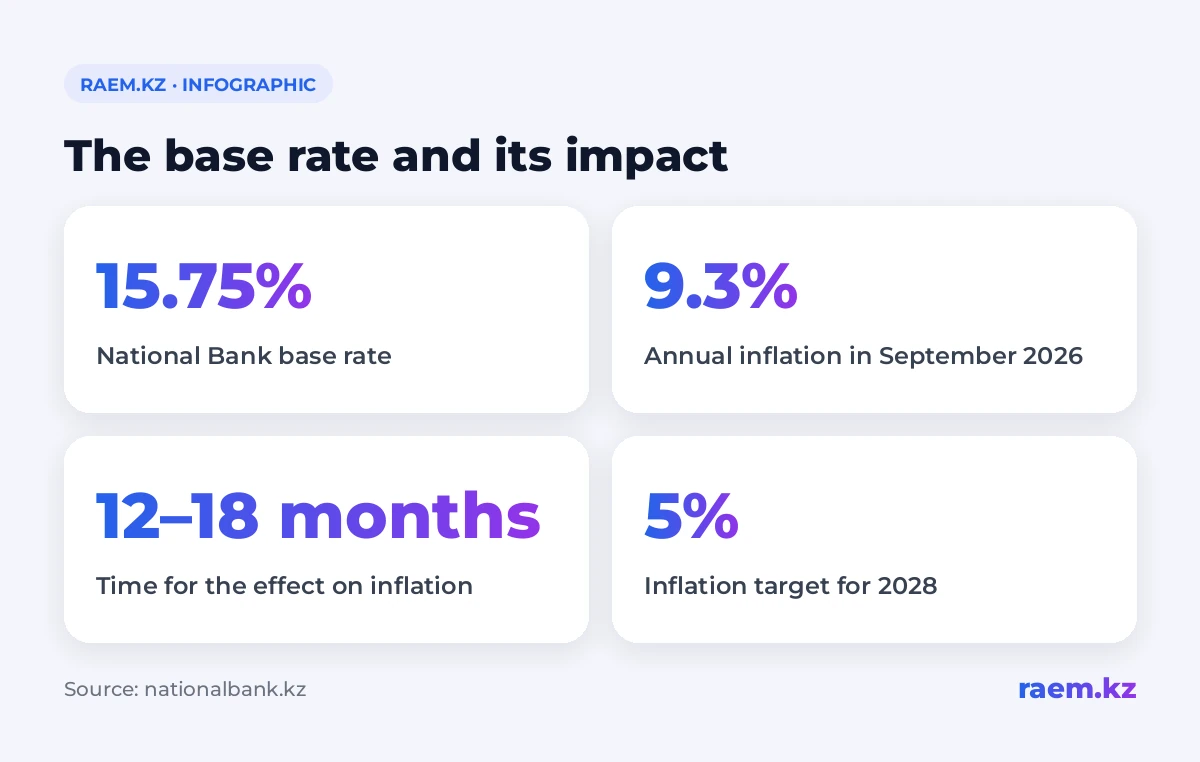
As of November 3, 2026, the base rate is 15.75% a year. The corridor around it is plus or minus one percentage point, or 14.75–16.75%.
Rates on individual banking products are set separately. That means the effects of a rate cut on a loan or deposit depend on the bank’s terms and the contract.
When will a rate change affect prices?
The National Bank estimates that the effect on inflation takes 12–18 months to emerge — roughly a year to a year and a half. The impact over the coming weeks is limited.
Annual inflation stood at 9.3% in September 2026. Slower price growth and lower inflation expectations allowed the regulator to cut the rate. Its goal is to bring inflation back to 5% in 2028.
Will payments on an existing loan fall?
With a fixed rate, the terms of the signed contract remain in place. The National Bank’s decision alone does not change the interest rate or monthly payment. The same principle applies when the base rate rises.
To see whether you could save money, check your contract and refinancing offers. Refinancing means taking out a new loan to repay the old one. It pays off when the savings exceed fees, insurance and other costs.
Compare the annual effective interest rate and the total amount repayable. Also consider making a partial early repayment: the banking ombudsman lists it as one way to reduce costs.
Why don’t new loans get cheaper straight away?
Banks continue to use money raised earlier at higher interest rates. Their funding costs therefore fall gradually. The final rate also depends on the borrower’s risk and the bank’s costs and profit.
Mortgages may respond even more slowly because of their long terms and risks. The down payment, collateral, insurance and subsidies all affect the terms. A base rate cut does not guarantee an equivalent reduction in interest on a new loan.
What to do with a deposit when rates fall
Returns on new tenge deposits may fall with a delay. How quickly this happens depends on banks’ access to funds and competition between them. This is the assessment economists give in a Tengrinews article; it is a forecast, not a guarantee of future terms (tengrinews.kz).
If you will not need the money for a long time, compare term and savings deposits to consider locking in a return. Before opening an account, check the deposit rate and the contract terms.
Keep some of your savings accessible. Withdrawing money early from a savings deposit is more difficult, so a high return alone is not enough to make a choice.
When will the National Bank announce its next decision?
The next scheduled announcement is set for December 4, 2026, at 12:00 Astana time. The Monetary Policy Committee makes decisions eight times a year. Further cuts depend on a sustained easing of price pressures.
The announcement date should be distinguished from the date the decision takes effect. Under the National Bank’s schedule, decisions take effect on the first working day of the following week.
Put simply, the base rate sets the direction, while your banking contract determines your personal costs. Check the terms of your loan or deposit now and compare offers by their total cost and how easily you can access your money.