Photo: Bia Limova / Pexels
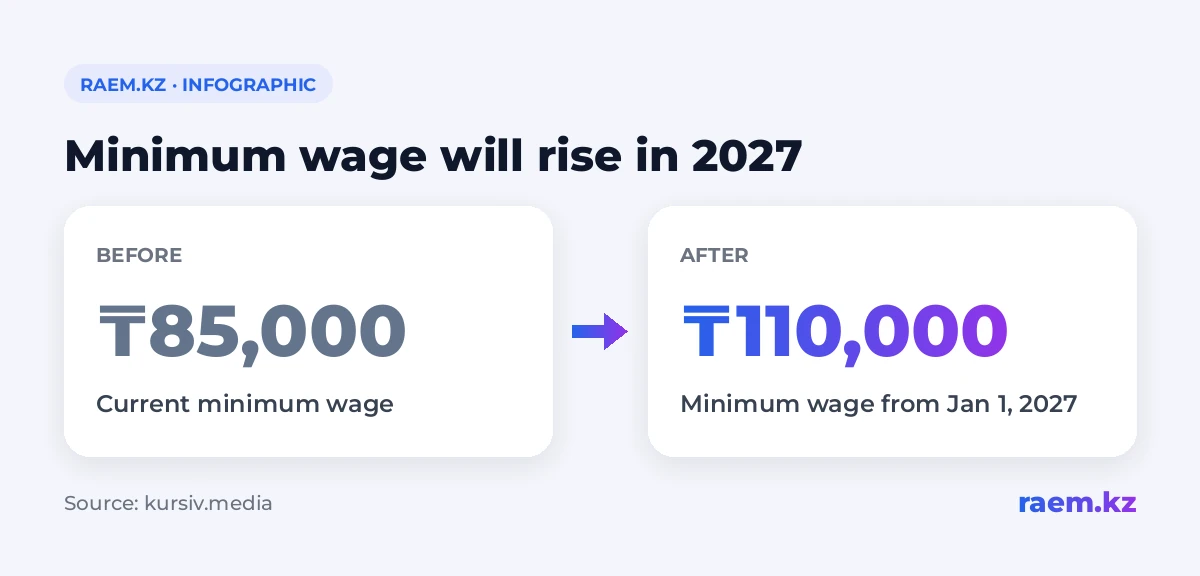
The Kurultai has passed the 2027–2029 budget, which raises the minimum wage from 85 thousand to 110 thousand tenge (kursiv.media). The increase is scheduled for January 1, 2027. Next year’s budget allocates 75.9 billion tenge for it.
Minimum wage increase to affect around 1.8 million people
The government says the increase will affect around 1.8 million people, including more than 370 thousand public sector workers (primeminister.kz). This is its estimate of how many people the upcoming minimum wage increase will reach.
The minimum wage last rose on January 1, 2024, from 70 thousand to 85 thousand tenge (informburo.kz). The approved 2027 budget sets the new rate at 110 thousand tenge.
The minimum wage increase will also affect social benefit caps. According to Informburo, it will change the maximum payments for unemployment, childcare, pregnancy and childbirth.
The limits on social contributions and the maximum amount of mandatory pension contributions will also change.
raem.kz previously explained which benefits the minimum wage increase will affect. That article provides background to the approved budget: Informburo’s report refers specifically to the maximum amounts of benefits and contributions.
Spending revised after the October 28 address
The draft budget passed its first reading on October 14. Later, in his October 28 address, President Kassym-Jomart Tokayev ordered a minimum wage increase from the start of 2027.
During subsequent deliberations, lawmakers revised next year’s spending to reflect the president’s instructions.
At the November 18 session, the document was approved at its second reading and passed at its third, the Kurultai’s press service said. The minimum wage increase was included in the adopted law on the national budget.
According to Informburo, the additional funding will come from presidential and government reserves. Another source is lower spending on servicing government debt.
Businesses’ corporate income tax liabilities could fall by around 68 billion tenge
Preliminary calculations by First Vice Minister of National Economy Azamat Amrin put the increase in the wage bill at around 426 billion tenge. The estimate was published on the government’s official website.
Kursiv’s report on the budget’s adoption cites a different estimate from Amrin: 430 billion tenge. Both figures refer to the increase in Kazakhstan’s wage bill.
For legal entities, higher payroll costs will mean larger tax deductions. According to calculations published by the government, this will reduce corporate income tax liabilities by around 68 billion tenge.
In Kursiv’s original report, Amrin also explained that corporate income tax deductions would allow businesses to offset some of the additional costs.
raem.kz previously published an explainer on what to consider when the minimum wage rises. Other articles on the subject are collected in the “Taxes for sole proprietors and LLPs” section.
The 114.1 billion tenge package includes healthcare salaries and AI in schools
The budget allocates 114.1 billion tenge for initiatives announced in the address. Spending on the minimum wage increase is included in that total.
The same package allocates 20 billion tenge to raise salaries for staff at primary healthcare organisations. Another 600 million tenge is earmarked for introducing artificial intelligence in schools.
A further 101.5 billion tenge was allocated for separate presidential instructions. Of that, 34.5 billion tenge will go towards building a water pipeline from the Satpayev Canal to Astana.
Another 16.2 billion tenge is earmarked for survey work for the Balkhash nuclear power plant project.
To implement the budget, 135.5 billion tenge was reallocated between and within government agencies. More than a third of all budget funds is planned for developing human capital and meeting social commitments to citizens.
Funding was also allocated to modernise regional infrastructure and support the real sector of the economy. The Kurultai expects the budget to support economic growth, maintain social stability and allow the deficit to keep falling.