

Photo: marcinjozwiak / Pixabay
Kazakhstan’s Finance Ministry has postponed mandatory goods consignment notes for products subject to minimum prices until 1 June 2027 (inbusiness.kz). The ministry says the requirements will be introduced in stages. For businesses covered by the first phase of the previous schedule, this means six extra months to prepare.
December launch postponed after talks with businesses
The decision followed discussions with businesses. The Finance Ministry acknowledged that market participants are not yet ready to work through the Virtual Warehouse module.
The delay applies to goods subject to minimum price levels, abbreviated as MLP. The deadlines for mandatory goods consignment notes, known as SNT, and the use of Virtual Warehouse are changing for these products.
The State Revenue Committee (KGD) had already told companies to prepare for the new requirements. The previous schedule called for two batches of goods to join the system a month apart.
The committee must now agree with business representatives on the specific products to include in the system. The Finance Ministry says the transition period will allow companies to adapt their accounting systems, set up integration and train staff.
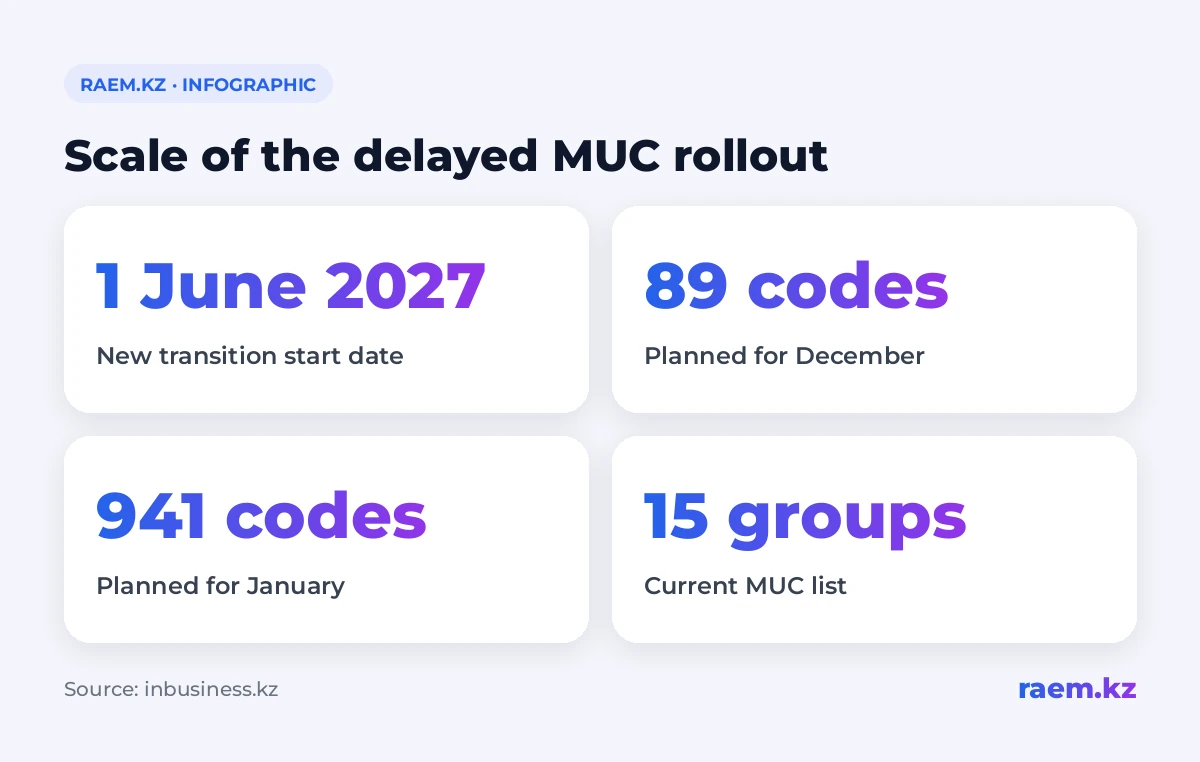
December rollout covered 89 codes, with another 941 planned for January
From 1 December 2026, the requirements were due to cover the existing MLP list. It included 15 product groups and 89 TN VED commodity codes.
Another 38 product groups, covering 941 TN VED commodity codes, were due to be added from 1 January 2027.
There are six months between the previous December deadline and 1 June 2027. The gap between the January deadline and the new start date is five months. These are the differences between the dates in the previous schedule and the announced start of the transition.
The rollout itself will be phased. Which groups join first, and how long the intervals between later groups will be, will be decided after agreement with businesses. The previous lists show the scale of the planned launch; the final products have yet to be agreed.
KGD promises not to apply new tax controls from 1 December
In a statement dated 26 November 2026, KGD explained the arrangements until the amendments are adopted (gov.kz). From 1 December 2026, tax controls will not be applied to the goods concerned.
The committee says it will make amendments retroactively to remove the provision requiring SNT for MLP goods from the December date. The changes are intended to cover the period from the original start date of the requirements.
This is how KGD described the arrangements for the period when the previous date may still appear in the regulation. The clarification concerns the new requirements for MLP goods.
Companies can connect their accounting software to Virtual Warehouse through an API
Virtual Warehouse is part of the Electronic Invoicing Information System, known as IS ESF. The module keeps electronic records of movements of certain categories of goods.
SNT documents accompany the movement and sale of these goods. Current rules require electronic consignment notes to be issued through IS ESF.
Companies can integrate their external accounting software with Virtual Warehouse through an API. The Finance Ministry lists setting up this integration as one of the tasks for the transition period, alongside adapting accounting processes and training staff.
December date to be removed from Order No. 661
To implement the delay, the Finance Ministry plans to amend Order No. 661, issued by the acting finance minister on 31 October 2025. It governs the list of goods for which electronic invoices must be issued using Virtual Warehouse.
The list was already expanded in September 2026 to include goods subject to minimum prices and certain types of agricultural products.
The ministry now plans to remove the provision requiring SNT for MLP goods from 1 December 2026. It intends to set the new deadlines and phased transition arrangements in a separate order.
In earlier coverage of business regulation, raem.kz examined the requirements a government service counted for car repair shops and the rules for driverless cars in Kazakhstan.
The next step for the Finance Ministry and KGD is to agree with businesses on the list of goods and how the transition will work. A separate order is to set the sequence for bringing goods under the new requirements, starting on 1 June 2027.