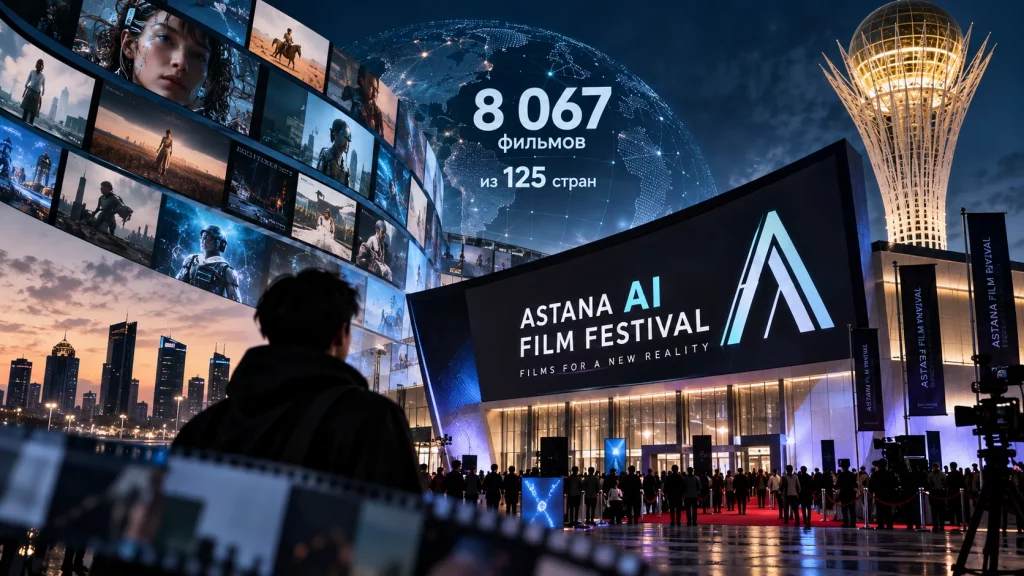
The Astana AI Film Festival 2026 received a staggering 8,067 film submissions from 125 countries, with Kazakhstan ranking second globally in application volume, trailing only the United States.
The festival will take place in Astana from October 1 to 3 as an integral cultural centerpiece of the AI & Digital Bridge 2026 international summit. The total fund of the initiative is currently valued by organizers at $2 million: $1 million allocated toward competitive prizes across categories, and an additional $1 million earmarked as co-investments into prospective generative AI film productions.
Previously, RAEM.KZ published an extensive investigation into participant concerns regarding the operational timeline and automated screening of over 8,000 submitted video works. Following our initial reporting, festival organizers updated their official portal with supplementary details regarding the judging panel, scoring rubrics, and competition rules.
Kazakhstan Ranks Second Behind the United States
According to updated festival analytics, the highest submission count originated from the United States (1,385 films), followed closely by Kazakhstan with 892 entries. Other prominent participant cohorts included China (714), the United Kingdom (542), and India (488).
This geographic distribution underscores the explosive democratization of generative artificial intelligence in media production. Independent directors and digital artists worldwide now produce broadcast-quality visual narratives using desktop neural synthesis tools without requiring traditional multimillion-dollar production studio budgets.
Information Disclosed Following RAEM.KZ’s Investigation
Following public inquiries regarding procedural transparency, festival organizers formally unveiled the Grand Jury roster. The panel features distinguished international filmmakers, visual effects supervisors, and generative art pioneers.
However, the crucial operational distinction between the preliminary curation committee and the final Grand Jury remains ambiguous. In film festival practice, a primary selection committee sifts through the uncurated slush pile to assemble a manageable shortlist of 50 to 100 works, which is subsequently handed to the celebrity jury for final trophy adjudication.
The Screening Timeline Remains the Core Question
The primary concern raised by international creators centered on mathematical screening feasibility. Screening 8,067 short films — even assuming an average runtime of three to five minutes — represents roughly 400 to 600 hours of continuous footage.
With only several days separating the late submission deadline from shortlist announcements, participants calculated that evaluators would have needed to review submissions in mere seconds, or deploy automated AI filtering algorithms. Organizers clarified that preliminary evaluations were conducted by a decentralized network of regional visual consultants who reviewed submissions in parallel cohorts.
Evolution of the Competition Rulebook
Scrutiny of the official website revealed several iterations of competition terms. Earlier drafts allowed hybrid submissions combining live-action camera footage with AI post-processing, whereas updated guidelines placed greater weight on predominantly synthetic, neural-generated visual pipelines.
Clarifications were also introduced regarding intellectual property rights. Initial terms featured clauses granting extensive commercial rights to event partners; revised agreements now explicitly confirm that creators retain copyright and commercial exploitation ownership of their intellectual property.
Clarifying the $2 Million Allocation
Greater clarity has emerged regarding the $2 million headline figure. Direct monetary prizes awarded across categories (Best Narrative, Best Animation, Best Music Video, Best Sci-Fi, and Grand Prix) total $1 million. The remaining $1 million represents venture co-financing credits and production grants managed by creative economy venture funds to finance long-form AI series developed by winning directors.
Why Institutional Transparency Matters
The Astana AI Film Festival represents Kazakhstan’s most ambitious bid to position the capital as an international epicenter for creative artificial intelligence. A massive debut of over 8,000 entries proves immense global interest.
Preserving long-term festival prestige requires scrupulous procedural transparency, transparent curation protocols, and unambiguous criteria. By engaging constructively with community scrutiny and updating contest documentation, organizers took essential steps toward establishing a sustainable international cultural institution.