
Illustration: AI
A 10 km taxi trip in Astana came to 5,500 tenge in LS’s calculation using Numbeo data (lsm.kz). Meanwhile, petrol in Kazakhstan’s capital was the cheapest among the cities selected, at 301 tenge per litre. The publication compared prices collected as of 24 November 2026.
500 tenge to start, then 500 per kilometre
LS compared taxi fares and petrol prices in the capitals of Kazakhstan and 15 other countries. An analyst at the publication selected the countries. Astana’s ranking in this comparison applies only to the cities selected.
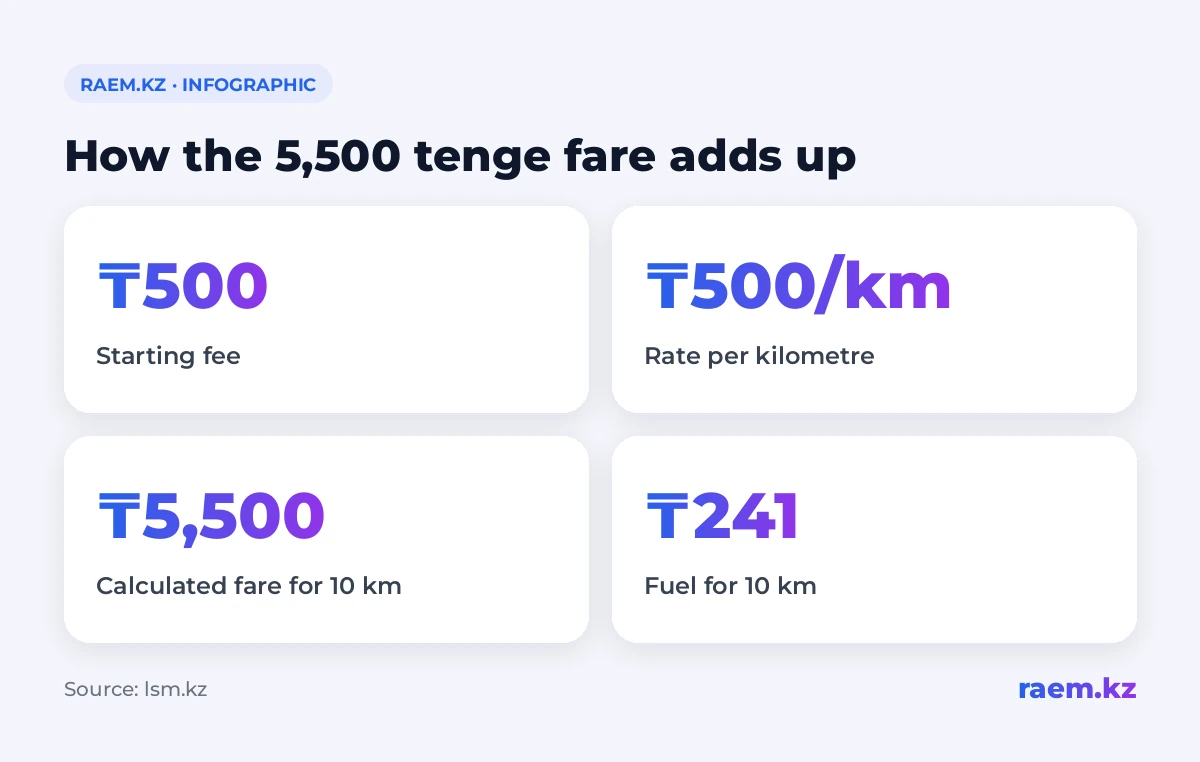
For Kazakhstan’s capital, LS used a minimum starting fare of 500 tenge and a standard rate of 500 tenge per kilometre. That gives a total of 500 + 500 × 10 = 5,500 tenge.
This formula explains LS’s calculation. It does not establish the price of any given ride in Astana and is not tied to a specific operator.
Yandex’s published fare, for example, combines distance and time. Comparing a single per-kilometre rate therefore leaves out part of the fare.
Yandex Economy charges for minutes as well as kilometres
Yandex Pro published changes to passenger fares in Astana on 29 July 2025 (pro.yandex.com). They were due to take effect on 31 July.
In Economy, the pickup charge was capped at 420 tenge. That included one kilometre and three minutes of travel, plus two minutes of waiting. After that, rates within the city were capped at 65 tenge per kilometre and 30 tenge per minute.
Paid waiting time at the pickup point and during the trip cost 40 tenge per minute.
Under these terms, distance alone is not enough to calculate the fare. For a 10 km trip, you also need to know the travel time and account separately for any paid waiting time.
It is therefore misleading to compare the 500 tenge per kilometre in LS’s calculation with Yandex’s per-kilometre rate alone. The published fare structures differ.
The dates differ too: the Yandex Pro announcement is from July 2025, while LS’s comparison is from November 2026. Yandex’s post does not confirm the fare in effect when LS collected its prices. We covered the service’s background in our article on the history of Yandex Go.
Astana ranks fifth per kilometre, but Moscow costs more for 10 km
In LS’s comparison, a kilometre in Astana cost more than in Moscow or Beijing. Kazakhstan’s capital ranked fifth among the selected cities on this measure.
Rates were higher only in Washington at 732 tenge, Berlin and Tokyo at 1,400 tenge each, and Bern at 2,100 tenge. In Dushanbe and Tashkent, a kilometre cost less than a third of Astana’s rate; in Bishkek, it cost 2.4 times less.
But a trip also has a starting fare.
The starting fare was 383 tenge in Tashkent, 392 in Hanoi, 394 in Bishkek and 499 in Dushanbe. To compare total fares for the same distance, LS added the starting fare to the cost of 10 km.
| City | Estimated fare for 10 km including the starting fare |
|---|---|
| Tashkent and Dushanbe | about 2,000 tenge |
| Beijing and Bishkek | about 2,500 tenge |
| Minsk | about 2,700 tenge |
| Seoul | about 4,400 tenge |
| Astana | 5,500 tenge |
| Moscow | about 5,700 tenge |
| Washington | about 9,200 tenge |
| Tokyo | about 15,900 tenge |
| Berlin | about 16,300 tenge |
| Bern | about 24,700 tenge |
Moscow’s total fare for 10 km came out higher than Astana’s. So Astana’s higher price relative to Moscow in LS’s comparison refers specifically to the per-kilometre rate.
In Seoul, the starting fare was 3.3 times Astana’s. Yet the estimated fare for 10 km was lower: 4,400 tenge against 5,500.
241 tenge for petrol covers fuel alone
Among the selected capitals, Astana had the cheapest petrol at 301 tenge per litre. It cost almost 40% more in Moscow and Minsk, and 1.5 times as much in Bishkek. In Dushanbe and Tashkent, it cost 1.8 times as much.
In Berlin and Bern, a litre cost more than 1,000 tenge.
To calculate fuel costs, LS used consumption of eight litres per 100 km, a figure the International Energy Agency uses in its calculations. At that consumption rate and Astana’s petrol price, fuel for 10 km costs 241 tenge.
That is almost 23 times less than the estimated taxi fare. However, LS did not include vehicle upkeep or depreciation in that amount. The comparison shows the gap between the taxi fare and petrol costs alone.
We also covered costs beyond the advertised price in our article on what you pay for with Pinduoduo’s free delivery.