Photo: BrainPatch
Artificial intelligence is moving into an area where results are measured by quality of life. UK-based BrainPatch®, co-founded by Kazakhstan’s Dauren Toleukhanov, is taking part in REVERSE, an international project with a total budget of €2,627,082. It brings together AI, brain monitoring and non-invasive neurostimulation to create a system that predicts and prevents epileptic seizures.
For BrainPatch.AI, the project is a chance to work in one of the most ambitious areas of applied AI: developing a wearable device that analyses brain signals and triggers an intervention when it detects a dangerous state. The company is building on its experience of making consumer devices and bringing them to international markets.
REVERSE is supported by the Eurostars programme and brings together partners from the UK, the Netherlands and Switzerland. The UK’s participation is funded by Innovate UK, part of UK Research and Innovation. The project will run for 36 months.
AI with a mission to change lives
Behind the familiar conversations about AI are systems increasingly designed to work in the real world, with medical signals, wearable electronics and people’s health. REVERSE sits at that intersection. Its goal is to study whether an approaching epileptic seizure can be detected early enough to intervene before it develops.
An estimate cited in the project description on the UKRI website says drug-resistant epilepsy affects around 15 million people worldwide. The unpredictability of seizures affects their independence, work and daily lives. Even the chance to gain time for a preventive intervention could make a big difference to patients and their families.
In the system being developed, a wearable EEG patch is intended to continuously record brain activity. AI algorithms will analyse the incoming data and identify signs of heightened risk. The stated research goal is to predict a seizure 10–30 minutes before it starts. When the risk is high, the system is designed to automatically trigger non-invasive neurostimulation to prevent the seizure from developing.
It is a closed loop: monitoring, risk assessment and intervention are combined in one system. The AI’s job is to turn a stream of complex physiological data into a timely decision to intervene. If the approach succeeds, it would be a significant step towards more personalised, proactive care.
BrainPatch.AI turns an AI prediction into a chance to intervene
BrainPatch.AI’s contribution comes at a critical point in the system. A prediction alone cannot stop a seizure. REVERSE needs an intervention technology that can fit into a wearable device and work with the monitoring system. That is where BrainPatch.AI brings its expertise in non-invasive neurostimulation and device development and manufacturing.
REVERSE brings the company into applied AI through joint product development. BrainPatch.AI is working in a consortium where algorithms, hardware and clinical testing are meant to come together in a single system. Alpha Brain Technologies leads AI prediction and system integration, while BrainPatch.AI provides its part of the technology needed for the intervention.
The team behind BrainPatch.AI’s consumer devices is applying its expertise to an international research programme. REVERSE expands the use of that experience as the developers work to combine neurostimulation, AI prediction and clinical testing in one system.
Research has yet to confirm the system’s safety, prediction accuracy and effectiveness in preventing seizures. REVERSE is a development and clinical testing programme; its goals are not a claim that an epilepsy treatment has already been proven.
Three countries and a budget of more than €2 million
The scale of REVERSE rests on its funding and the expertise of its partners. Three organisations make up the consortium, each responsible for a different part of the future system.
Alpha Brain Technologies B.V. (Netherlands) leads system integration and AI-based seizure prediction. BrainPatch Ltd (UK) contributes expertise in non-invasive neurostimulation and device manufacturing. Centre hospitalier universitaire vaudois (CHUV, Switzerland) leads clinical validation.
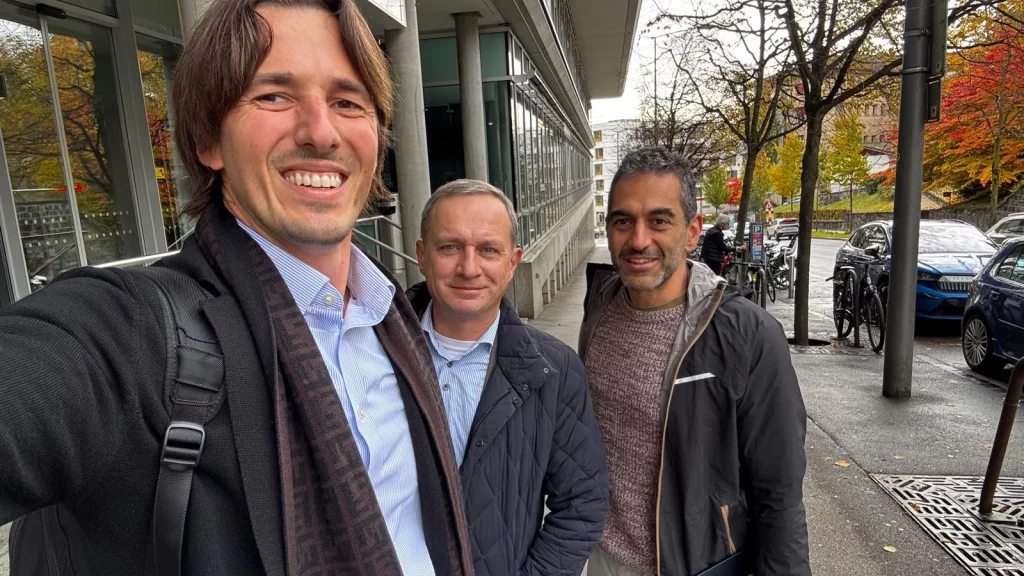
The university hospital’s participation connects technology development with clinical assessment. A meeting between the BrainPatch.AI team and its partners in Switzerland was part of that joint work: developers, engineers and clinical specialists are working together on the international project.
The consortium’s combined costs total €2,627,082, the project’s overall budget. The programme centres on developing and clinically testing a prototype. UKRI lists the funding period for the UK’s part as April 2026 to April 2029. The partners aim to have a prototype ready for large-scale clinical trials within a year of the project’s completion.
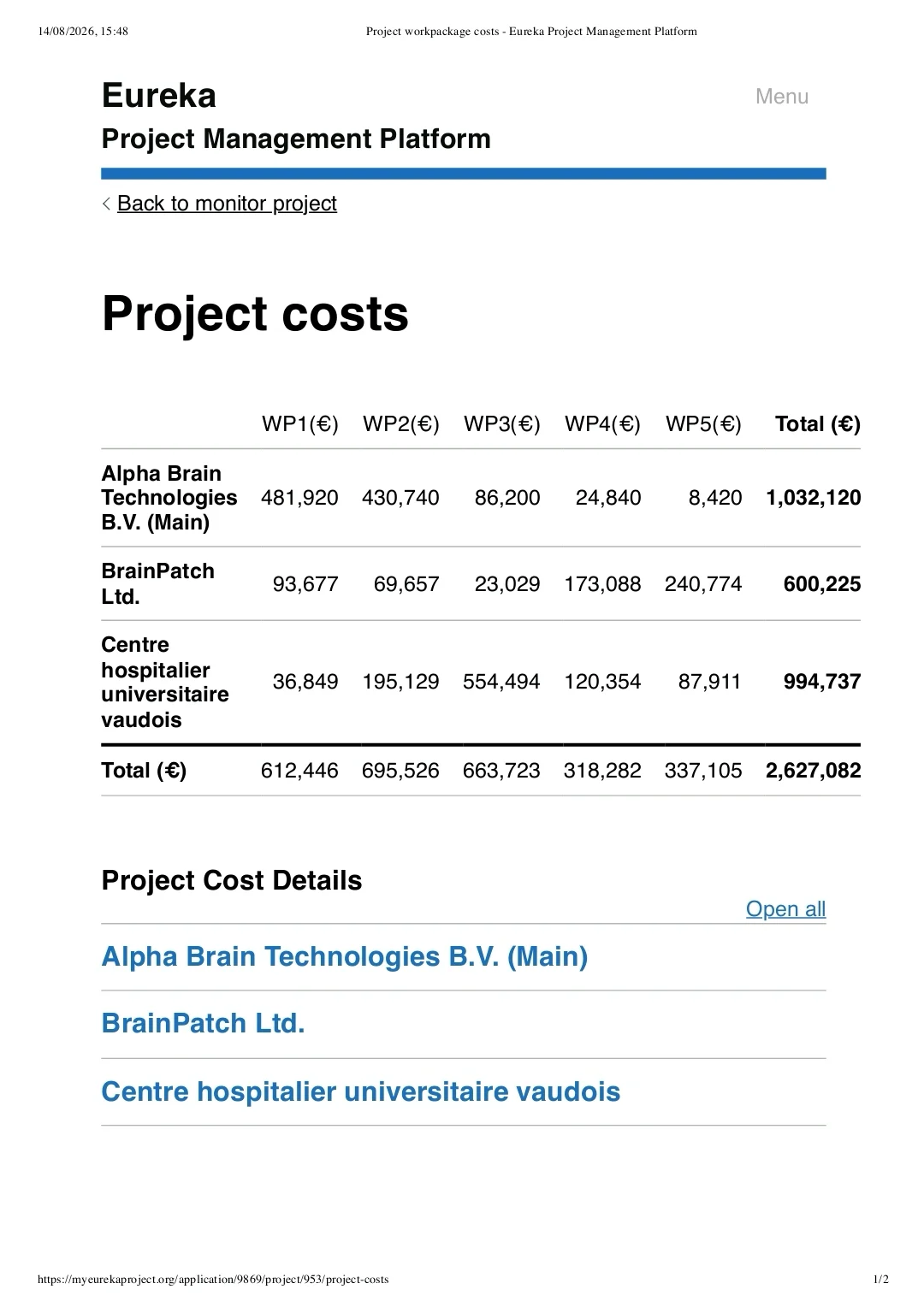
REVERSE project budget in the Eureka Project Management Platform: total consortium costs of €2,627,082 · Document provided by BrainPatch
An international project with official confirmation
BrainPatch.AI’s participation in REVERSE is recorded in UKRI’s Gateway to Research database, where the company is listed as the Lead Participant for the UK’s part. That status applies to the UKRI record for UK funding; Alpha Brain Technologies leads integration of the full system and AI prediction across the international consortium.
Behind the record is a joint development programme. For BrainPatch.AI, it expands the use of its engineering expertise and connects the company’s development with work now being done by researchers in AI, neurotechnology and clinical medicine.
The official source for the grant is UKRI, project 10191239: REVERSE — Prevention of Seizures by Closed-loop wearable in Epilepsy. The funding programme is Eurostars, with UK participation supported by Innovate UK (UK Research and Innovation).
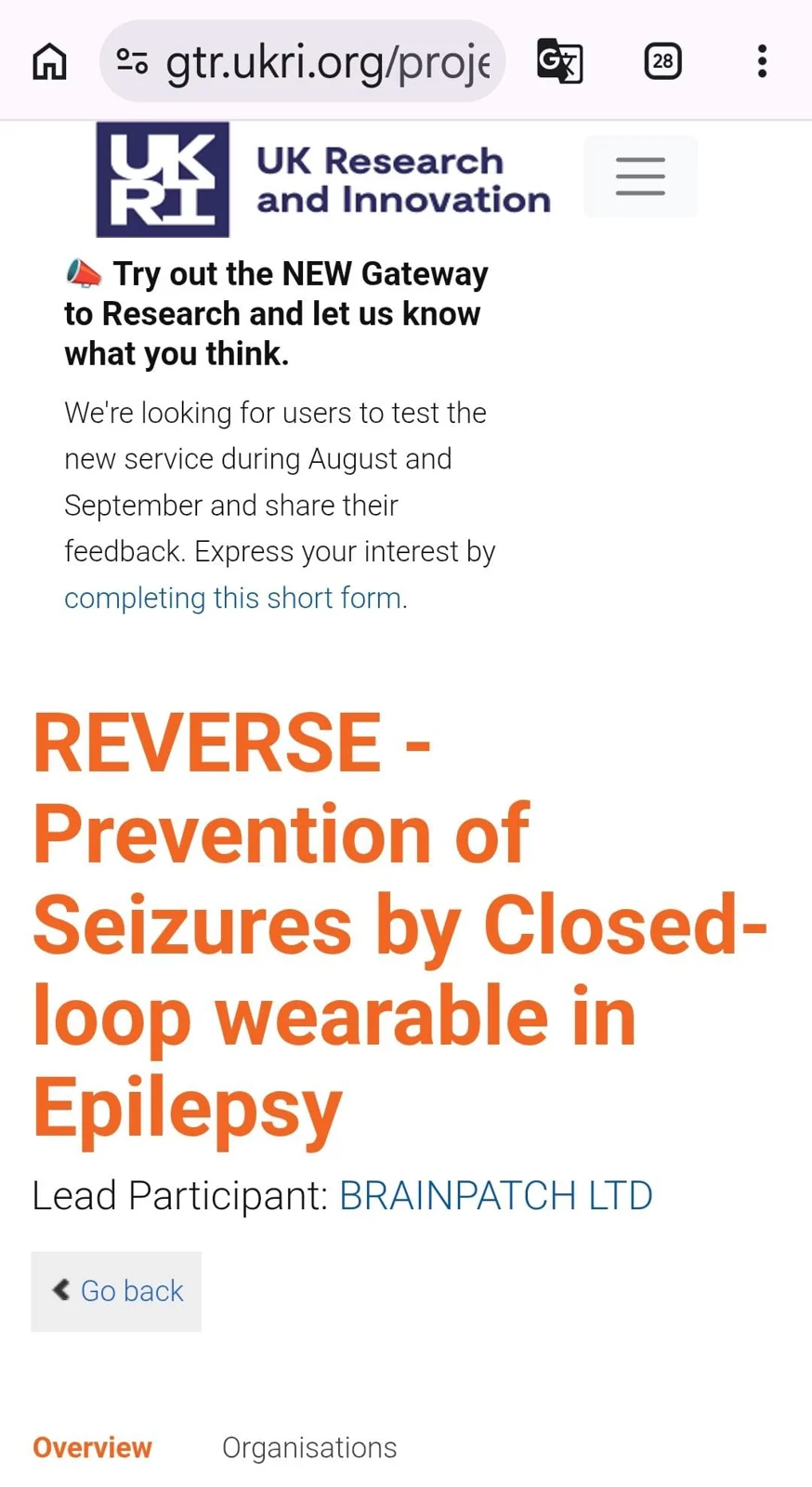
REVERSE project page on the UKRI website, BrainPatch listed as Lead Participant · Screenshot provided by BrainPatch
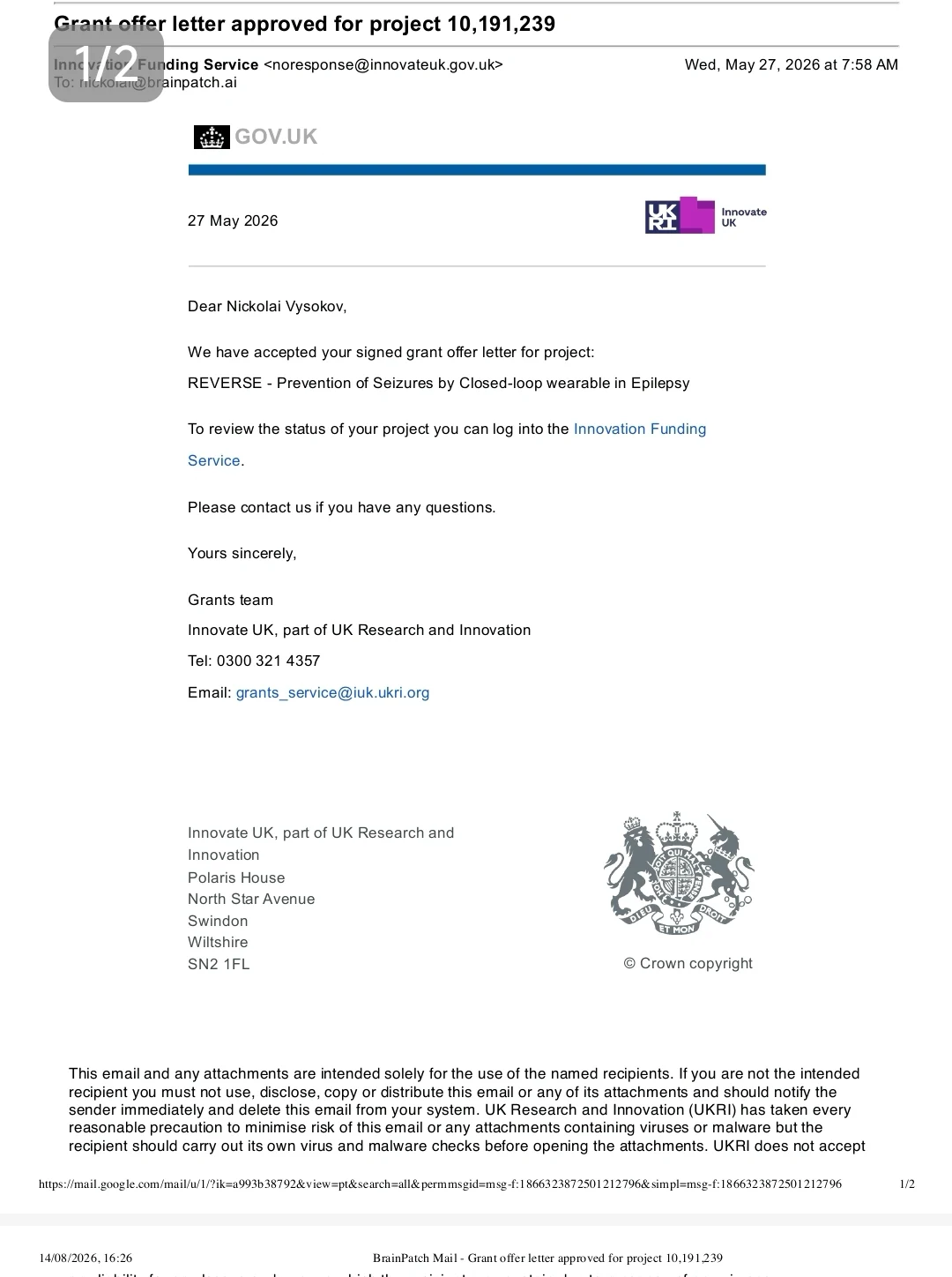
Innovate UK confirmation of the accepted signed grant offer, 27 May 2026 · Document provided by BrainPatch
From research to consumer devices
BrainPatch.AI is developing along two tracks. In REVERSE, the company is working on the technology behind a future medical product, while its consumer devices are already on the market. Both draw on its experience developing non-invasive neurostimulation, from electronics and software to the finished device.
The BrainPatch® e·Meditation® consumer range is designed for relaxation and meditation. The device is a wireless headset controlled through an app. This gives people a way to experience neurotechnology through a familiar use.
These devices have a separate purpose: they are not the REVERSE system and are not offered as a treatment for epilepsy. The company’s participation in medical research shows the depth of its technical work, but future clinical results will not apply to products sold today.
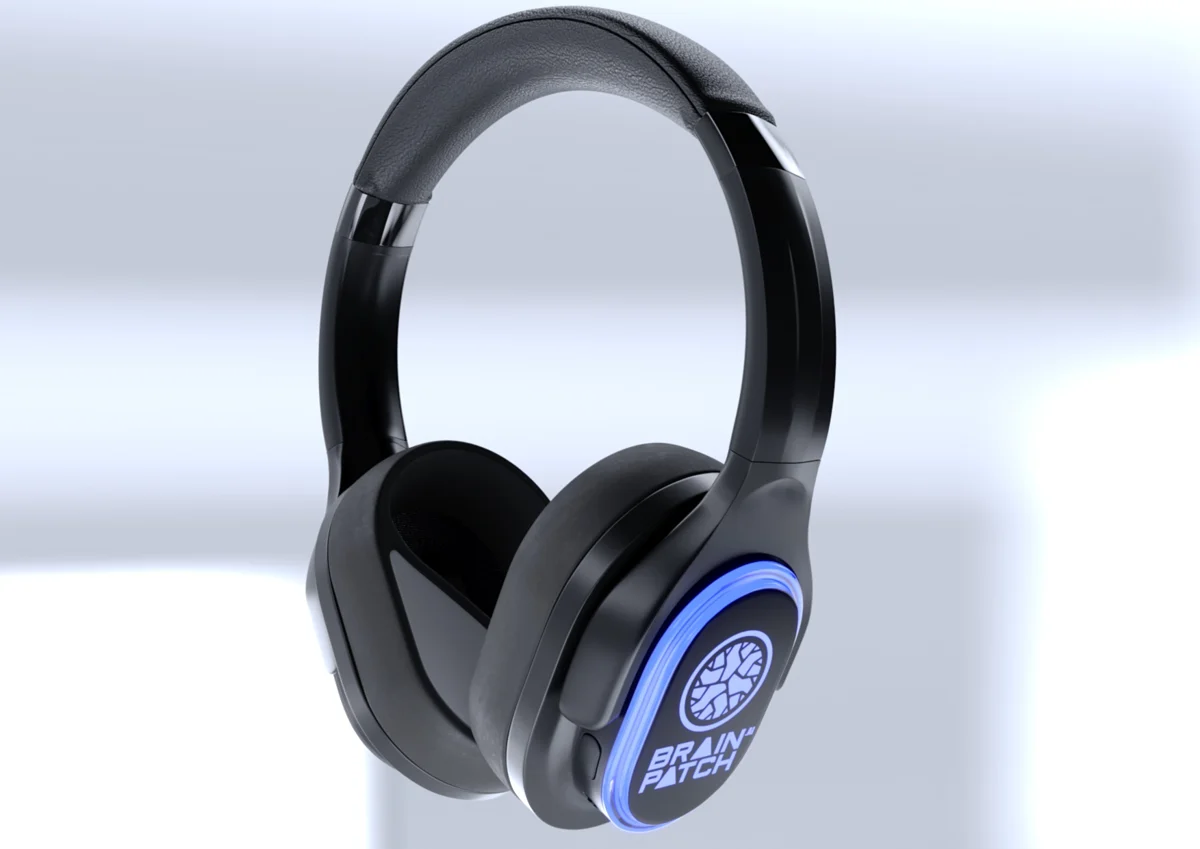
BrainPatch e·Meditation headset · Image: BrainPatch
From Selfridges in London to Times Square in New York
BrainPatch consumer devices are already available at Smartech in London’s Selfridges department store on Oxford Street, where shoppers can see and try out new electronics. The setting gives BrainPatch direct contact with international customers.
According to BrainPatch, its products also went on sale in November 2026 at tm:rw in New York’s Times Square. NBA legend and entrepreneur Shaquille O’Neal became an investor, partner and global ambassador for the venue.
In Kazakhstan, BrainPatch devices are available from the company’s official representatives.
The European consortium and high-profile retail venues show two sides of BrainPatch’s development: helping create the next generation of neurotechnology and reaching customers in their everyday lives. Read more in the BrainPatch profile on raem.kz and the article on how BrainPatch sold out its first batch in Britain.
raem.kz video on BrainPatch and the REVERSE project · Video: raem.kz