
Astana-based technology startup Cyberlabs has earned official acceptance into StartX, the prestigious Stanford University-affiliated startup acceleration community. Cyberlabs engineers an advanced Interactive Cyber Range—a virtual «flight simulator for cybersecurity specialists» that allows students and enterprise defense teams to simulate live offensive attacks, remediate real-world vulnerabilities, and counter threat actors inside an isolated sandbox without endangering production corporate infrastructure.
Acceptance into StartX represents a significant validation for Central Asia’s deep-tech landscape. For historical context on Kazakhstani founders penetrating Stanford’s entrepreneurial ecosystem, read our analysis of Silkway Accelerator by Google for Startups and Astana Hub.

Beyond Theory: A Living Network to Hack Legally
The global cybersecurity training paradigm suffers from a profound structural flaw: academic curricula teach theoretical cryptography and network protocols from textbooks, leaving graduates utterly unprepared when confronted by real-world advanced persistent threat (APT) groups.
Cyberlabs dismantles this divide by deploying over 75 interactive scenario ranges spanning banking API breaches, Active Directory privilege escalation, industrial SCADA telemetry interference, and ransomware remediation. Trainees are assigned realistic offensive and defensive mandates within high-fidelity simulated enterprise architectures.
AI as Real-Time Defense Mentor, Not an Essay Generator
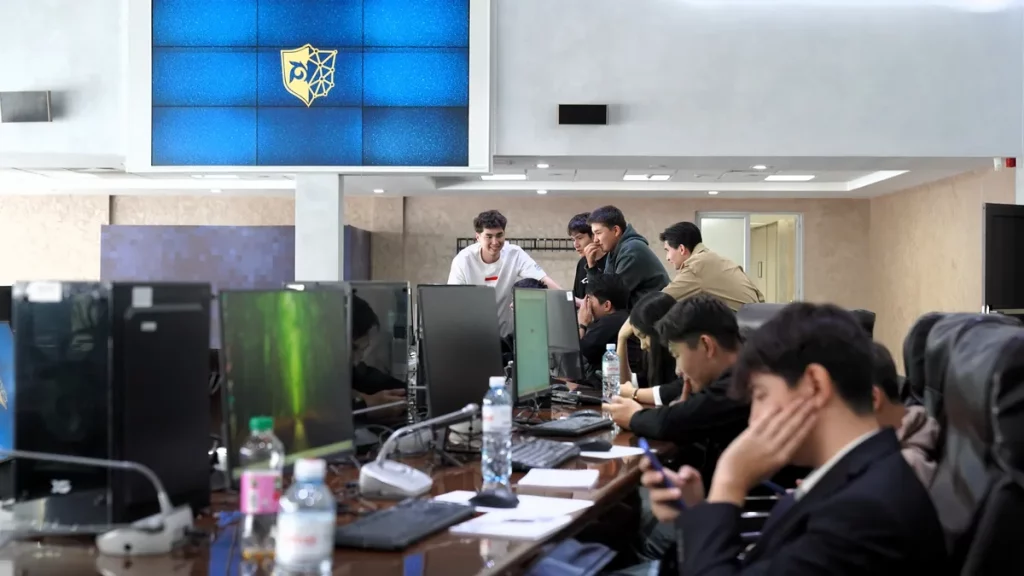
A central technological pillar of the platform is an embedded AI mentor. Rather than generating static homework solutions, the neural agent monitors network packet telemetry, command-line inputs, and terminal latency in real time. If a student executes an incorrect firewall configuration or overlooks an SQL injection vector, the AI provides contextual Socratic prompts, steering the learner toward diagnostic discovery without handing over the direct answer.
Surging Need: 30,000 Cyber Incidents in Kazakhstan in One Quarter
The commercial urgency for simulated training is acute. Official telemetry from Kazakhstan’s State Technical Service registered over 30,000 critical cybersecurity incidents targeting domestic infrastructure within a single recent quarter, encompassing government registries, municipal transit networks, and commercial banking APIs. To understand how regional cybersecurity sentinel TSARKA protects domestic perimeters, explore our profile on TSARKA Group, WebTotem, and ethical hacking in Central Asia.

The StartX Ecosystem: Stanford’s Zero-Equity Alliance
Founded in 2009, StartX is not a standard venture accelerator. Unlike Y Combinator or Techstars, StartX does not take equity from participating founders, operating as a non-profit foundation backed by Stanford University and Stanford Health Care. Its community encompasses over 1,900 serial entrepreneurs who have collectively raised over $36 billion in venture capital.
With an admission rate rigorously maintained below 5%, entry requires demonstrating peer-reviewed technical differentiation and rapid institutional adoption. Cyberlabs secured its admission through an institutional partnership between StartX and NU STeP, the entrepreneurship incubator of Nazarbayev University, formalized under a bilateral agreement established in 2022 to provide elite Kazakhstani engineering ventures direct access to Silicon Valley venture syndicates.
For Cyberlabs, acceptance into StartX unlocks direct enterprise procurement channels across North American universities and Fortune 500 corporate security departments, marking a pivotal milestone in Kazakhstan’s emergence as an exporter of high-value cybersecurity software.
Sources: Cyberlabs Corporate Disclosures; StartX Stanford Community Registry; Nazarbayev University NU STeP Innovation Bulletins; State Technical Service of Kazakhstan (STS) Telemetry Reports.