
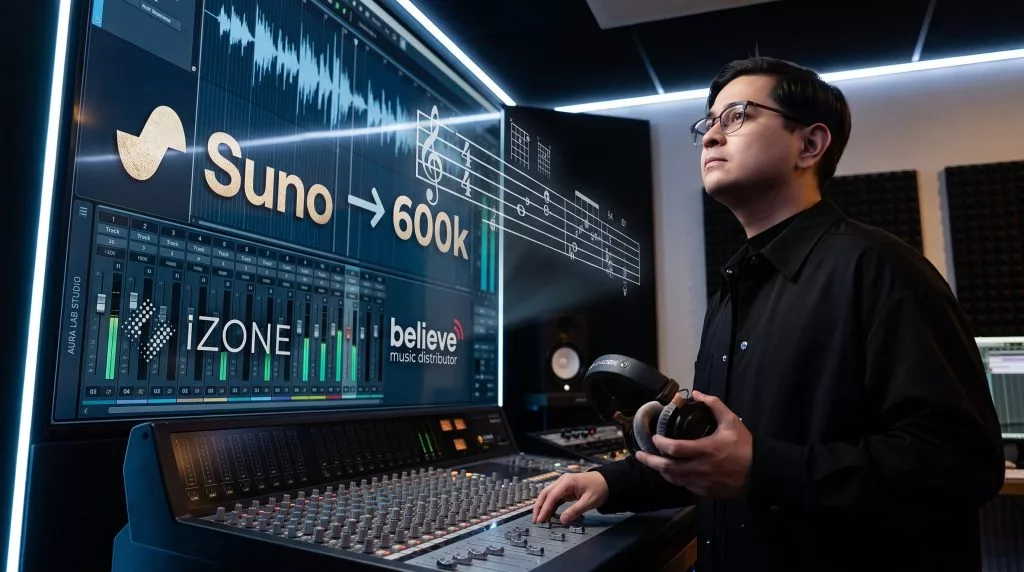
Dimash Tokmyrza, a sound engineer at Aura Lab Studio, once sent a guitarist a part generated by a neural network. The musician replied that he understood how it should sound, but the chord did not exist: it was physically impossible to play on the fretboard. After that, Dimash stopped using generated music as a track’s foundation, but did not abandon AI altogether.
Dimash has spent almost his entire life in music: nine years of music school, four years of college and four years of undergraduate study. He has worked in sound engineering and production for more than eight years. He says the studio’s complete song-production service has fallen from around KZT 1.2 million to KZT 600,000 over three years. Customer numbers have risen, while income has stayed the same. This is one studio’s experience, not Kazakhstan-wide market data.

Suno Wrote a Guitar Part That Could Not Be Played
— How does your work operate, and where does AI come in?
We write everything ourselves from scratch. Someone brings lyrics; we sit down with a guitar, work out the chords, and then I arrange the track. I do not use AI as the foundation.
Once I needed to record guitar and took a part from a generated track. I sent it to a guitarist, who said: “I understand what is playing here, but that chord does not exist. I physically cannot play it.” You cannot place your fingers that way on the fretboard. We had to find a replacement.
After that, I stopped beginning with generated music. I record the production myself first, then give it to AI to refine individual elements.
Duduk, Zurna and Other Rare Instruments: Where Generation Helps
— What does AI do best?
It imitates hard-to-access instruments well: the duduk, zurna and similar timbres. I know people in Kazakhstan who can play them, but they do not usually record in studios. Generation lets you quickly establish whether an instrument belongs in an arrangement. If the idea works, you can look for a live performer.
Sometimes a generated part sounds convincing enough to use in a recording. But AI is my assistant, not the foundation of production. I would not use it as the foundation.
“Someone Gets Lost in the Lyrics”: Hearing That They Did Not Write Them
— Do clients bring AI-written lyrics?
I have never deliberately checked. But it can be noticeable during recording: someone who wrote their own lyrics performs them freely. If they start getting lost in their own words, someone else or AI wrote them.
Ozone Cuts Work on a Track From Seven Hours to Around Three
— Where else does AI save time?
iZotope makes the Ozone plugin series. I upload a reference track and the software adjusts the relevant elements of my material to match it. It does that very well.
— How much faster is the work?
About 40%. Mixing from scratch takes around seven hours. With Ozone, I can finish in around three. Sometimes I forget a plugin and it adds it itself; it has an advanced understanding of production. As I understand it, it was trained on music at the level of Kanye West, Drake and Chris Brown.
iZotope describes Master Assistant differently: an assistant that analyses a track and adjusts tonal balance, width and dynamics to a selected reference (izotope.com). The company does not claim training on specific artists’ music.
— How much do you spend on these services?
Suno’s top plan costs $30 a month and lets you do almost everything. Moises costs around $8. I use Moises to check a mix at the end, although recently I have felt I do not particularly need it.
Drifting Tempo and a Gritty Sound Give Generation Away
— Do clients come with finished AI songs?
They come and say: “I want this, but performed live.” That is normal and common. But generation creates many obstacles that we have to correct as we work.
The biggest problem is tempo. If you set it to 113 BPM, it will not hold that to the end: it drifts between 111 and 115, speeding up and slowing down.
I had a released track that was around 60% generated. A friend of mine is a DJ who plays in clubs. His console automatically detects tempo and prepares the transition to the next track. It could not do that with this song because the tempo kept drifting.
The interviewee asked us not to publish the track or artist’s name.
— Can you also hear that a track is generated?
Easily. You hear it in the vocal parts and voice processing. Instruments sound blurred and do not separate from one another. There is also saturation, meaning added harmonics. Too much of it makes the sound gritty, as though sand is pouring out.
I am completely sure that without that excess, it would produce mid-level production. It will get there soon: I remember what AI was like a year ago and what it is like now. Two years ago, Suno’s pronunciation of Kazakh words was immediately noticeable. Now it is almost perfect.
Why Believe Rejected a Finished Release
— Have you had a generated track rejected by a distributor?
Yes, recently. It was not our production; someone simply gave us a finished recording. The voice was live, everything else was not. The release did not go through. I received an email rejecting it, saying the metadata was AI-generated and all information needed checking. It comes through like a strike.
We release through Believe, one of the strongest distributors in the industry. As I understood it, it has a Shazam-like system that searches Suno’s database and flags a match. Then you must either remake the recording or it will not be accepted.
I think releasing such tracks will become harder. Platforms are taking this seriously. Spotify recently removed, I think, almost 120 million tracks. Even if a release passes, an “AI detected” flag remains in the distributor account, meaning no promotion or playlists.
The scale of Spotify’s cleanup was overstated in the interview. In its 25 September 2025 announcement, the service said it had removed more than 75 million spam tracks in twelve months; it did not describe all of them as AI-generated (newsroom.spotify.com). Believe publicly says it automatically blocks distribution of tracks made wholly or partly on unlicensed GenAI platforms (believe.com). Dimash’s description of a Shazam-like search across Suno’s entire database is not confirmed. Suno announced plans to introduce audio watermarks and digital fingerprints to help platforms identify tracks’ origins (suno.com); this does not imply an automatic ban on all music made with the service.
More Customers, Half the Average Price
— How has AI affected prices and studio income?
We offer a complete song-production service. We write the lyrics and arrangement, give the client the finished material to study for three or four days, then they return and we record the vocals.
About three years ago, the full process cost almost KZT 1.2 million. The same work now costs around KZT 600,000. We have more customers and lower prices, with income remaining roughly the same.
— Why have customer numbers increased?
People who once wanted their own music but could not afford it or come up with it now create an AI draft. Then they come to us to make it professional. It is faster, cheaper and more accessible.
Dimash Tokmyrza Estimates AI Is Used in 60% of Kazakh-Language Tracks
— How widely do Kazakhstani artists use AI?
I think around 60% of tracks in the Kazakh music industry now involve it: an idea, an arrangement or individual parts. I cannot disclose details; these are real hits.
This is the sound engineer’s personal estimate based on his industry experience, not a market study.
A Paid Suno Subscription Grants Commercial Rights, but Does Not Guarantee Copyright
— Who owns a song Suno creates from someone else’s music?
When you buy a subscription, the rights legally remain with you. But it is still a fifty-fifty situation. You can consider the song yours, or choose not to credit yourself as its author because the model learned from other people’s songs. It is ambiguous: yours and not yours at the same time.
On the other hand, nothing appears from a vacuum. Gustav Holst wrote “Mars” in his suite “The Planets.” John Williams used that as a basis for Star Wars music; the Imperial March is similar. You always need inspiration.
Under Suno’s rules, Pro and Premier subscribers are considered owners of songs created during their subscription and receive commercial-use rights, including streaming distribution. The service warns separately that this does not guarantee full copyright protection, which depends on national law and the extent of human creativity (help.suno.com).
“AI Should Remain an Assistant, Not a Track’s Foundation”
— How do you feel about AI being built into music software?
I am relaxed about it. The same happened with plugins: they emulate analogue hardware, and the first clones were met with similar suspicion. Now the 1176 and LA-2A are studio gold standards used worldwide. People will view Suno that way for around five years, then it will become normal.
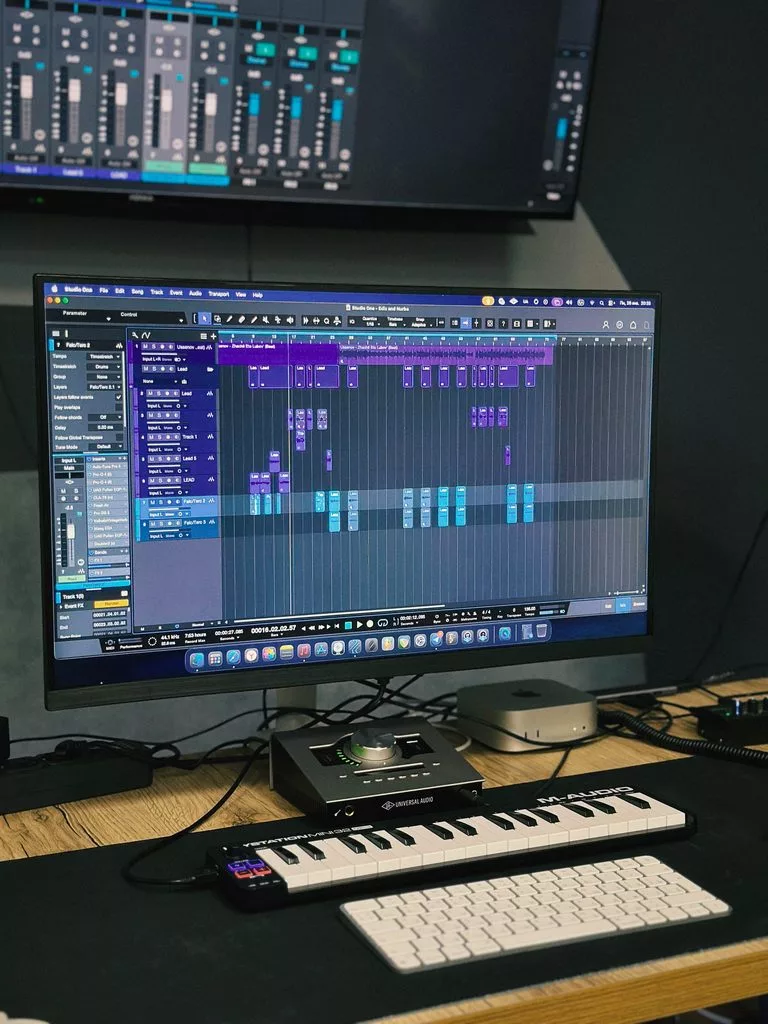
My workstation is Fender Studio Pro 8, formerly Studio One. Moises is integrated into it, so you can generate music within the program while working. Its generation does not reach Suno’s level, but it is possible. It also has an assistant: describe two piano tracks, two guitar tracks and four others with certain presets, and everything is ready in two minutes. Manually, I would spend half an hour.
Image-Line’s FL Studio has Gopher, an in-program AI assistant. FL Studio focuses more on arrangement, and the assistant functions as a sound search: describe what you want and receive options.
Both examples are publicly documented. In January 2026, Fender brought PreSonus products under its own brand: Studio One Pro became Fender Studio Pro, with version eight released under the new name (musicradar.com, soundonsound.com). Moises integration, including stem separation, backing-track generation and vocal transformation, and the DAW assistant arrived in version 8.1 (presonus.com, moises.ai). Image-Line’s Gopher initially acted as an FL Studio reference guide. The FL Studio 2026 release on 9 July added project actions such as arranging tracks, setting levels, routing mixer channels and writing scripts (image-line.com, routenote.com).
— How do you see AI’s future use in music?
I oppose using generation as the foundation. It constructs music illogically and can produce a chord that simply does not exist.
As a supporting tool, it is good. Everyone uses GPT, although three years ago people were wary. Suno similarly offers possibilities: what happens if you add a dombra, kobyz or Armenian instruments? If nobody in Kazakhstan played duduk, you would have to fly to Armenia, find a musician and record them, spending time, money and resources. This way, you understand in a couple of minutes whether it fits. If it does, you call the musician and they come to record the part live. That is the point of AI.