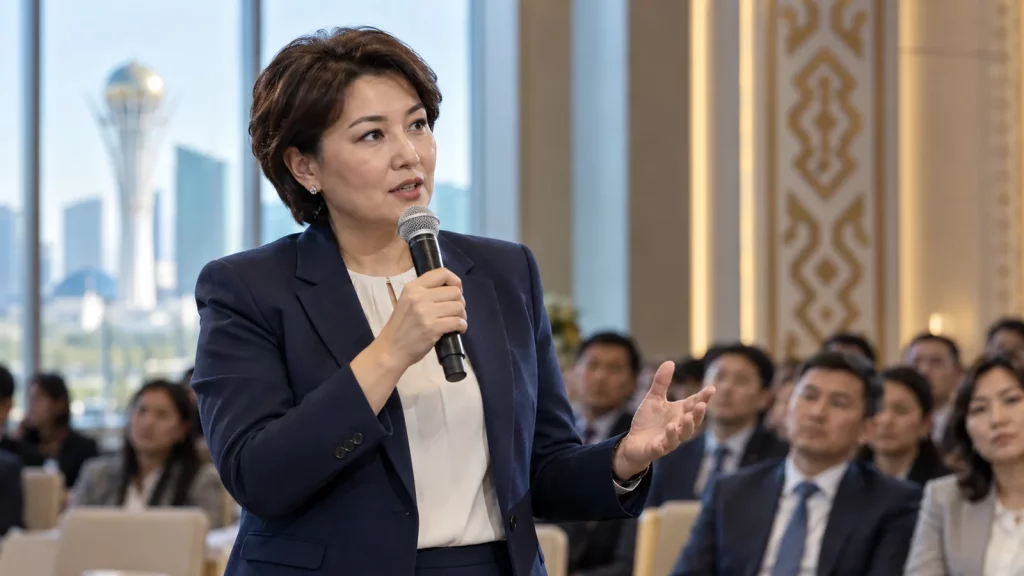
Illustration: AI
Civil servants in Kazakhstan are prohibited from uploading classified documents and documents marked for official use only to external artificial intelligence models. Yekaterina Smyshlyayeva made the statement at the AI & Digital Bridge 2026 forum in Astana. She said local models allow users to work offline, but information security requirements still apply.
What happened
Smyshlyayeva discussed the restrictions during the session “Investing in Talent in the AI Era”. She focused specifically on the transfer of government documents to external AI services and on monitoring such activity.
“Uploading documents marked as classified or for official use only is strictly prohibited,” Smyshlyayeva said.
In her view, detecting violations is one of the challenges. Tools for this kind of monitoring already exist, with startups among those developing them. Smyshlyayeva expects more effective solutions to emerge, but did not name any specific products or give a timeline.
What this means
Smyshlyayeva described another approach to handling information: local artificial intelligence models. These systems can operate in an isolated environment without internet access. They can also be fine-tuned for professional tasks.
According to Smyshlyayeva, the Law on Artificial Intelligence provides a legal framework for local models. She also said that national solutions built on these models have already been developed and are being deployed in Kazakhstan.
However, running models locally does not in itself remove security requirements. As Smyshlyayeva stressed, protecting information remains mandatory when using these models. The ability to work offline does not mean users are free to handle official data as they please.
How Smyshlyayeva uses AI
Smyshlyayeva said she regularly tests artificial intelligence herself and fine-tunes models in her professional fields. These include Legal Tech, or technology for legal work.
She linked this experience to her involvement in drafting the artificial intelligence law: before regulating a technology, it is necessary to understand how it works. The discussion of practical AI applications took place at the AI & Digital Bridge 2026 forum, held in Astana on October 1–3.