
Illustration: AI
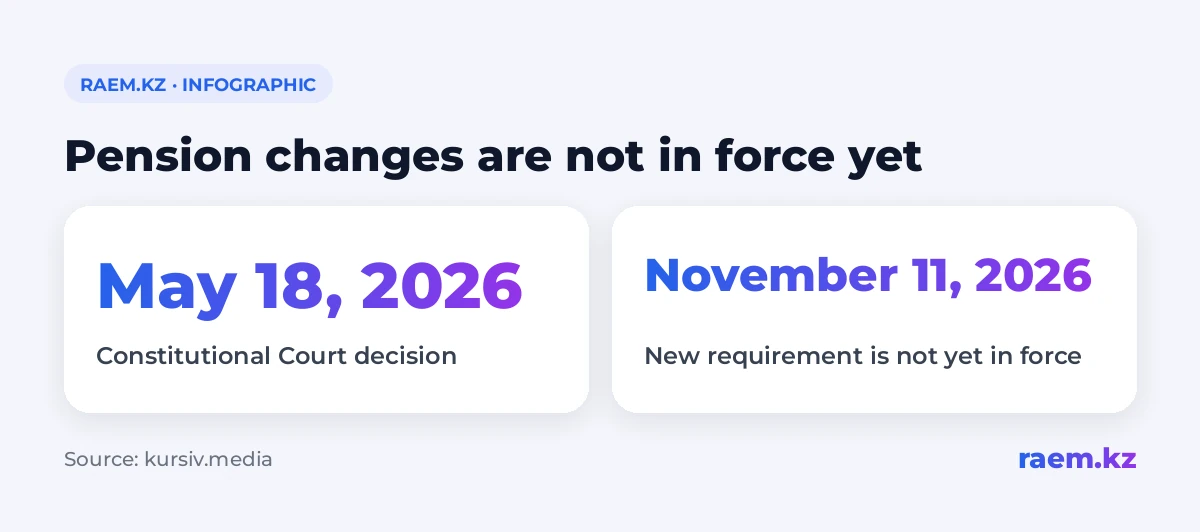
Kazakh citizens living abroad permanently could be required to confirm each year that they do not receive an equivalent state pension in their country of residence. Without that confirmation, pension applications could be rejected and existing payments suspended. As the Constitutional Court explained, amendments to the Social Code are under consideration by the Kurultai (kursiv.media). The new requirement is not yet in force.
Which pensions the changes would affect
The bill covers two payments: the state basic pension and the old-age pension. The proposed conditions apply to Kazakh citizens who live permanently outside the country.
There is an important detail here: the proposals specifically concern state payments. There are currently no grounds for extending the proposed requirement to pension savings in the Unified Accumulative Pension Fund.
Keeping your pension entitlement after moving abroad
According to the Constitutional Court’s explanation, Kazakh citizens should not lose their entitlement to these pensions simply because they move abroad. To qualify, they must reach the statutory retirement age and meet the other legal requirements.
The court stated that living permanently in Kazakhstan cannot be a mandatory condition for granting the country’s citizens a state basic pension or an old-age pension. The proposed amendments to the Social Code stem from this ruling.
What pensioners would need to confirm each year
Under the bill, pensioners would need a document confirming that they do not receive the corresponding pension payment in their country of residence. The proposal would require them to submit this confirmation annually, meaning once a year.
The condition concerns the absence of an equivalent pension. It does not mean a ban on all income or all payments abroad.
When applications could be rejected or payments suspended
If the amendments are adopted as described, failing to provide annual confirmation would affect access to a Kazakh pension. An application for a pension could be rejected. If a pension has already been granted, payments could be suspended.
Pension entitlement after moving abroad and compliance with payment conditions are therefore separate issues. Moving abroad should not, in itself, strip citizens of their pension entitlement, but the bill would require additional confirmation for them to receive payments.
When the new conditions would take effect
As of 11 November 2026, the new requirement is not yet in force. Lawmakers still have to consider the bill, and the final wording may change.
The amendments are based on the Constitutional Court’s ruling of 18 May 2026. The case arose from a referral by the East Kazakhstan Regional Court concerning the pension rights of citizens who had moved abroad permanently.
In plain English
If you live abroad, you do not yet need to treat annual confirmation as a current obligation. For now, keep track of whether the amendments are adopted and what their final conditions are. The proposed rule concerns two state pensions, while the court’s ruling protects citizens’ entitlement to them regardless of their country of residence.