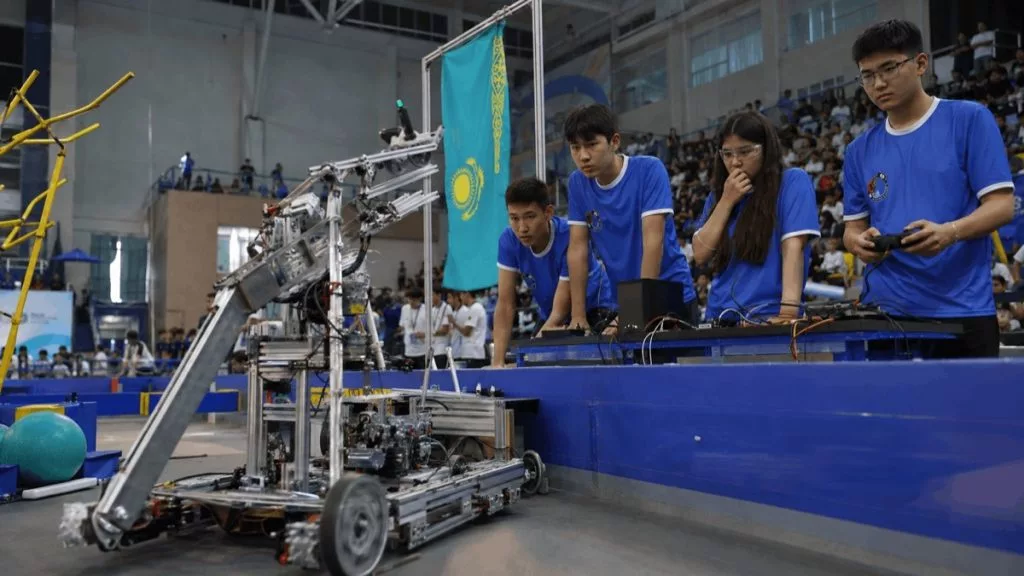
From August 24 to 26, approximately 40 student engineering teams gathered in Astana to compete for the honor of representing Kazakhstan at the 2026 FIRST Global Challenge. The tournament winners shoulder a historic responsibility: defending a championship streak that has remained unbroken since 2022.
Hosted at the Kazakh National University of Sports in Astana, FIRST Global Challenge Central Asia 2026 served as the premier regional qualifier. Over three intense days of autonomous testing and alliance matches, judges selected the national squad that will travel to Incheon, South Korea, for the global robotics championship.
Scheduled for October 7–10, the Incheon championship will convene high school engineering prodigies from more than 190 nations. For Team Kazakhstan, this is far from an ordinary international contest: four consecutive Kazakhstani delegations returned home decorated with the premier gold Grand Challenge Award. Now, a freshly minted roster must attempt to extend that dynasty to five consecutive titles.
Around 40 Elite Teams Compete in Astana
The national qualifiers featured high school engineers aged 14 to 18. Alongside Kazakhstani teams, top squads from Uzbekistan participated in friendly exhibition heats, though the official qualifying berth remained strictly reserved for Kazakhstan’s national winners.
To reach the live tournament arena, participants completed three grueling vetting stages: technical project applications, rigorous hardware documentation submissions, and the global Social Media Challenge demonstrating team outreach. A simple registration form was nowhere near enough to enter the arena.
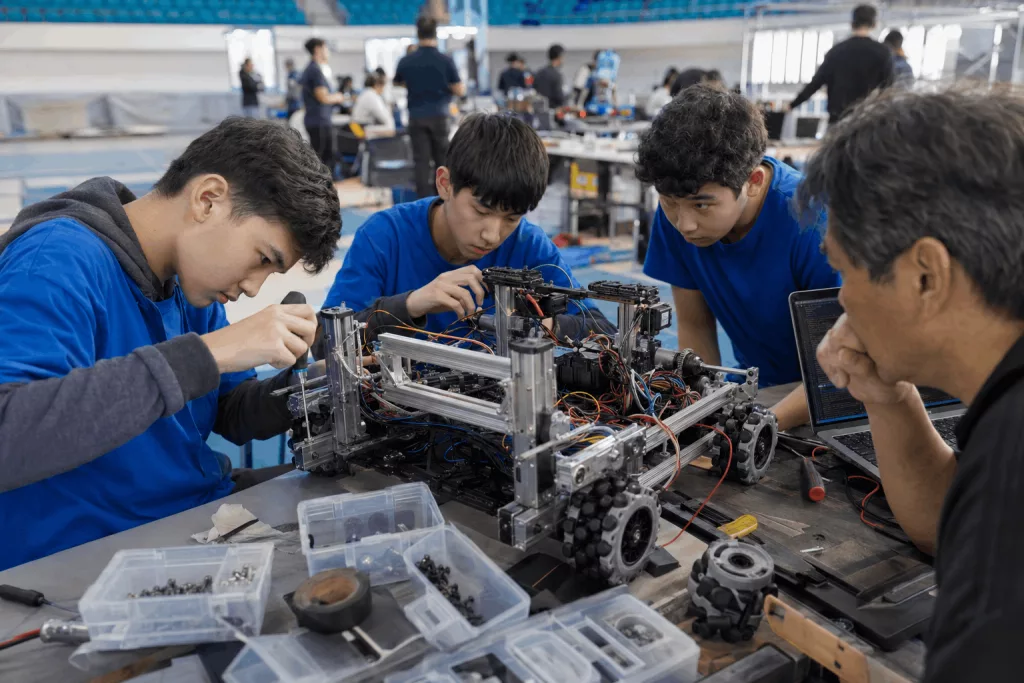
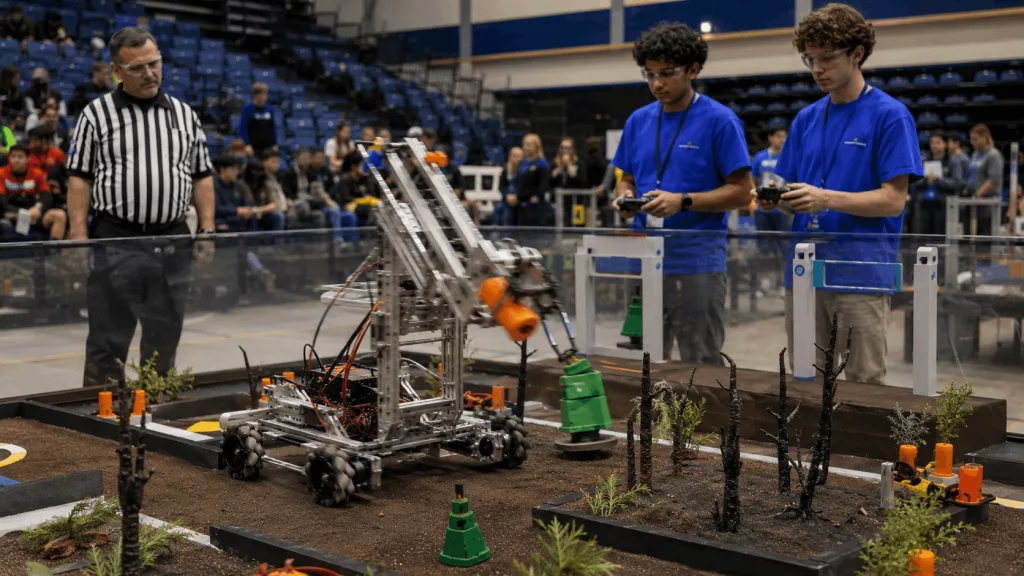
In Astana, students presented engineering portfolios, live algorithmic codebases, custom mechanical drivetrains, and strategic teamwork. The central test unfolded on the official FIRST Global Challenge competition grid, where custom-fabricated robots executed complex autonomous routines and teleoperated manipulation tasks.
The qualifier was organized by the USTEM Foundation with strategic support from the Ministry of Artificial Intelligence and Digital Development, the Ministry of Education, Daryn National Center, Astana Hub, and private sector sponsors.
The 2026 Challenge: Autonomous Wildfire Mitigation
Each FIRST Global Challenge season targets a critical global sustainability crisis. In previous years, students engineered robots for carbon capture, hydrogen distribution, sustainable agriculture, and marine habitat regeneration.
The 2026 theme, Igniting Innovation, challenges teams to engineer robots that navigate and operate in simulated wildfire zones. Core operational imperatives include rapid fire suppression, barrier deployment to mitigate flame propagation, and robotic ecosystem rehabilitation across scorched landscapes.
At the international final in South Korea, national delegations must also present applied STEM research proposals. Students analyze regional wildfire vulnerabilities within their home territories and present scalable technological interventions utilizing computer vision, edge telemetry, and aerial robotics. As noted by FIRST Global, entries are evaluated on real-world industrial scalability rather than simplistic classroom demonstrations.
Understanding Kazakhstan’s Four-Year Championship Dynasty
The FIRST Global Challenge features multiple award categories spanning industrial design, innovation, technical documentation, and international alliance cooperation, alongside tournament match rankings. Kazakhstan’s dominant youth engineering ecosystem also mirrors domestic excellence seen in competitive computing, such as the achievements of ICPC world champions.
Kazakhstan has captured the premier gold in the Grand Challenge Award for four consecutive years. This trophy is bestowed upon the team that scores the highest cumulative match points across the entire global tournament, proving superior mechanical reliability, operator agility, and autonomous consistency.
The Winning Sequence: Geneva, Singapore, Athens, and Panama
Geneva 2022 (Carbon Capture): Team Kazakhstan secured its inaugural gold in Switzerland among 162 nations, capturing both the Grand Challenge Award and a bronze USTAR Award for engineering documentation, while teaming with Lithuania, Switzerland, and Senegal in match playoffs.
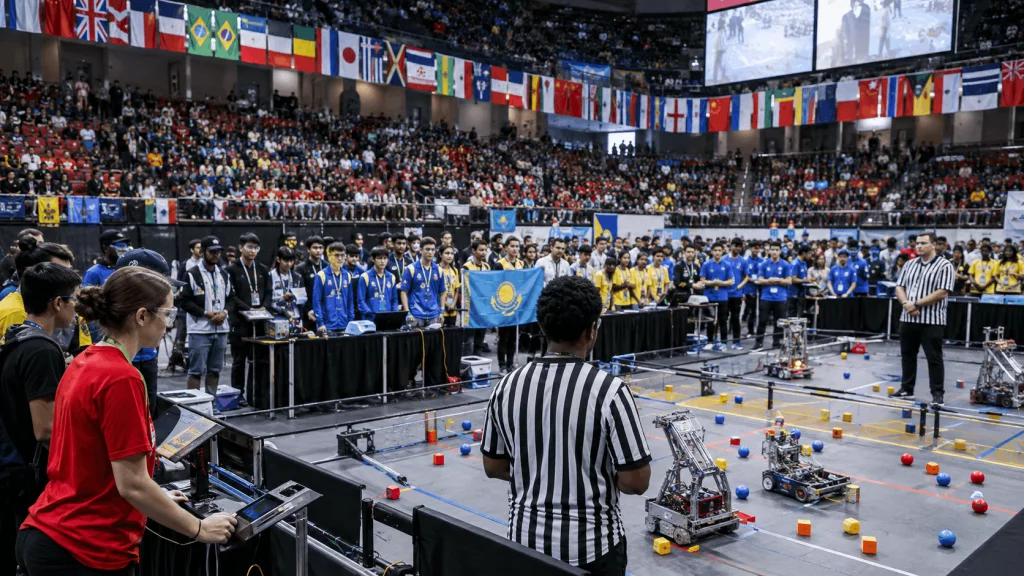
Singapore 2023 (Hydrogen Horizons): Facing 191 national teams, Kazakhstan defended its title with a flawless match point average, earning back-to-back Grand Challenge gold alongside the silver Innovator Award and the Judges Award for technical design.
Athens 2024 (Feeding the Future): In Greece, Kazakhstan dominated the preliminary and playoff rankings among 180 countries, securing its third consecutive Grand Challenge gold and silver in the Albert Einstein Award for playoff alliances.
Panama City 2025 (Eco Equilibrium): Competing against 191 nations, Team Kazakhstan pulled off an unprecedented double triumph—clinching their fourth consecutive Grand Challenge gold and winning the prestigious gold Albert Einstein Award as the overall world champion alliance captain.
A New Squad Every Single Year: The Power of Systemic Preparation
Crucially, Kazakhstan’s historic run is not the product of a single gifted cohort. According to USTEM Foundation head Asylbek Murzakhmetov, the national team’s roster has been completely renewed every single year. Not a single student has competed twice.
This demonstrates that Kazakhstan’s international dominance stems from a resilient institutional feeder system—integrating regional robotics leagues, specialized coaching, and rigorous national selection—rather than isolated statistical luck. For the newly chosen squad traveling to Incheon, this legacy represents both immense institutional knowledge and immense pressure to deliver a fifth straight world championship.
Victory Unlocks Undergraduate Bolashak Scholarships
Starting in 2026, competitors possess an unprecedented academic incentive: the FIRST Global Challenge was officially inducted into Kazakhstan’s elite roster of international STEM competitions recognized for direct undergraduate admissions under the prestigious presidential Bolashak scholarship program.
Medalists holding 1st, 2nd, or 3rd degree honors obtained within the past three years are eligible to compete for full state-funded scholarships at premier global universities across artificial intelligence, robotics, data science, and mechanical engineering, as confirmed by the Center for International Programs.
The chosen national roster will be finalized at the conclusion of the Astana qualifiers, giving the winners approximately six weeks to refine their robotic chassis before facing 190 nations in Incheon.