
Photo: Gustavo Fring / Pexels
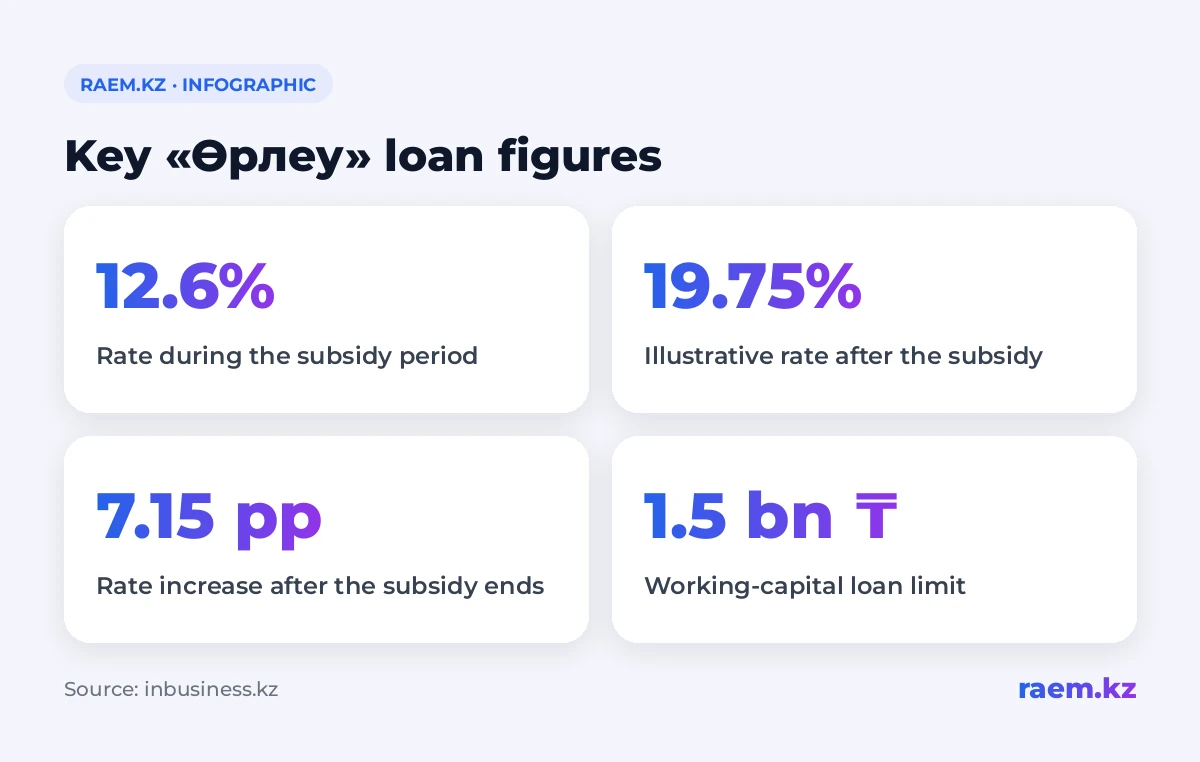
Under the new Orleu terms, businesses will pay 12.6% a year during the one-year subsidy period, then the full rate specified in their loan agreement. The limit on subsidised working capital loans is rising from 200 million to 1.5 billion tenge. Finance specialist and QazExpertClub expert Venera Zhanalina explained the changes (inbusiness.kz). Business owners will also need to increase revenue per employee and their total payroll.
Which loans are affected by the changes
The new terms apply to working capital financing through a new mechanism under the Orleu programme. This money covers a business’s day-to-day operations, such as buying raw materials before customers pay.
The maximum subsidised loan will rise to 1.5 billion tenge. Meanwhile, the subsidy period will shrink from three years to one. Zhanalina believes the higher limit could give companies that need large sums for day-to-day operations more options.
How much you’ll pay once the subsidy ends
During the subsidised year, the business owner pays 12.6% annual interest. The government covers the difference between that and the bank’s nominal rate. Once support ends, the borrower pays the full rate specified in the agreement.
In Zhanalina’s calculation, moving from 12.6% to a hypothetical rate of 19.75%, used as an example, raises the rate by 7.15 percentage points. With an outstanding balance held at 100 million tenge and the rate unchanged at 19.75%, the additional interest would total around 7.15 million tenge over a year.
This is an illustrative calculation: if the debt is repaid gradually, the additional cost will be lower. Borrowers will not have to repay the loan early when the subsidy ends, but they will have less money left for day-to-day operations.
How much revenue and payroll must grow
Business owners must increase revenue per employee by at least 10%. This measure is assessed at the end of the financial year in which the project is approved.
They will also need to increase their total payroll by at least the cumulative inflation rate. The rules allow some deviation. Total payroll is the total amount a business spends on employee pay.
If a project is approved towards the end of the year, there will be less time to meet the targets. Where there are objective reasons, the rules allow the deadline to be extended by up to one financial year, the expert explained.
Who decides whether a business gets a subsidy
First, the bank assesses the borrower and decides whether to issue a loan. Then the Damu fund determines whether the project meets the conditions for government support. Bank approval alone does not guarantee a subsidy.
The fund has five working days to review a complete set of documents. This period does not include the bank’s assessment, document preparation or the signing of the subsidy agreement.
According to Zhanalina, lending limits will no longer be allocated between banks. This could prevent business owners from being turned down because a particular bank has no remaining allocation.
What other support options remain
The changes do not apply to all subsidised loans for small and medium-sized businesses. Orleu continues to offer investment loans for up to ten years.
For micro and small businesses, the Isker Aimaq programme offers loans of up to 200 million tenge. The subsidy period is up to three years. The programme covers both investment and working capital loans.
In plain English: what to check before applying
A year of subsidies reduces initial costs, but payments may rise afterwards. Zhanalina says this transition is particularly challenging for seasonal businesses and companies with long production cycles.
Before applying, check the rate that will apply once support ends and ask the bank for a repayment schedule covering the full loan term. Compare it with when you expect customer payments to arrive. Separately, assess whether you can meet the revenue and payroll requirements in the year your project is approved.