
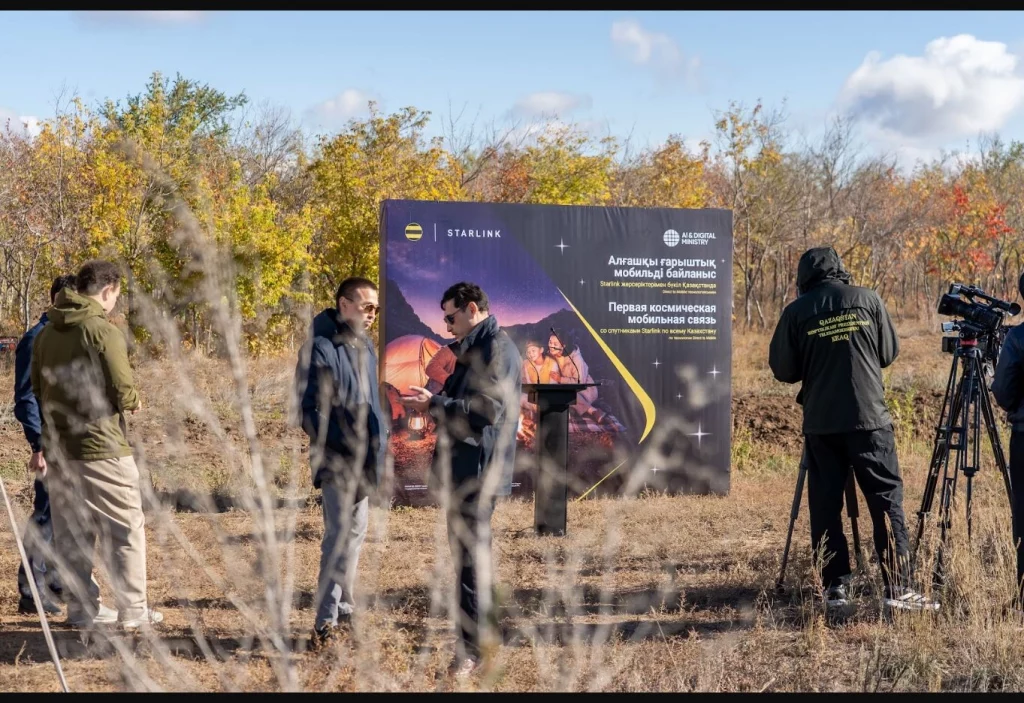
Starlink Mobile satellite connectivity using Direct to Cell technology has launched in Kazakhstan. The joint service from Beeline Kazakhstan and Starlink lets compatible smartphones connect directly to satellites where ordinary mobile network coverage is unavailable.
No satellite phone, separate antenna or Starlink terminal is required. At launch, the service works on LTE-compatible Android smartphones with a Beeline SIM card. Users can access messaging and basic internet services at speeds of up to 2 Mbps.
What Beeline and Starlink have launched
Direct to Cell turns Starlink satellites into a type of base station in low Earth orbit. Smartphones communicate with them using the mobile operator’s spectrum, and traffic is routed into Beeline’s regular network.
The main difference from conventional satellite communications is that users do not need specialized equipment. A compatible phone and mobile operator’s SIM card are sufficient.
Beeline Kazakhstan and Starlink announced their partnership in 2025. In February 2026, Kazakhstan hosted Central Asia’s first Direct to Cell field trials: a regular smartphone successfully sent messages and made a call through a messaging app. The technology has now moved from testing to a consumer service.
What users can do now
At launch, Starlink Mobile supports:
- send and receive messages;
- use messaging apps;
- open websites and mobile apps;
- use maps and navigation;
- transfer data at up to 2 Mbps.
That speed is sufficient for messaging, downloading a route, sending coordinates and using undemanding apps. However, Direct to Cell should not yet be regarded as a full replacement for regular 4G or home Starlink satellite internet.
High-quality video, large file downloads and stable video calls may be difficult. Native voice calls over the mobile network have also not been announced as a main available service.
Beeline’s website lists a Starlink Mobile Promo option at launch: one month free, unlimited internet and ten SMS messages. The operator may change the terms after the promotional period, so users should check them in the Janymda app before connecting.
Which phones support Starlink Mobile
The service is available on compatible LTE-enabled Android smartphones, meaning devices that support fourth-generation mobile networks.
Having 4G alone does not guarantee compatibility. Connectivity may depend on the specific smartphone model, modem, operating system version and manufacturer updates.
iPhones are not supported at launch. Beeline says devices running other operating systems will be connected later.
How to connect to Starlink Mobile
To connect, you need:
- An active Beeline Kazakhstan SIM card.
- An LTE-compatible Android smartphone.
- The latest version of the Janymda app.
- Starlink Mobile activated in the app.
- Permission for the app to access location.
- Data roaming enabled.
When the terrestrial network is unavailable, the smartphone should automatically connect to the satellite network. A roaming icon will appear, and the operator name will change to Beeline Starlink.
If automatic connection fails, the network can be selected manually in the SIM card settings. It may appear as Beeline Starlink or under the code 401 04.
After connection, users should receive an SMS with an activation link. If the message does not arrive, the service can be activated through the Starlink Mobile section of the Janymda app.
Why a clear view of the sky is necessary
Satellite connectivity requires an unobstructed view of the sky. Beeline recommends moving at least 50 meters away from large buildings, tall trees and other objects that could block the signal.
Establishing a connection may take several minutes. Inside a vehicle, dense forest, gorge, building or between high-rise buildings, signal quality may deteriorate or connection may be impossible.
The service is primarily intended for places with no terrestrial coverage:
- steppe and mountain areas;
- remote highways;
- hiking and travel routes;
- remote settlements;
- industrial and infrastructure sites outside cities.
Once users return to ordinary coverage, the smartphone automatically switches back to Beeline’s terrestrial network.
How Starlink Mobile differs from regular Starlink
Starlink Mobile and conventional Starlink satellite internet are different services.
Regular Starlink requires a separate terminal, antenna and Wi-Fi router. It is designed for homes, offices, businesses or transport and provides considerably higher speeds.
Direct to Cell works directly with a smartphone and SIM card. Its main purpose is to close mobile coverage gaps, enabling people to send a message, open a map or contact emergency services where there are no base stations, rather than replace home internet.
What the launch means for Kazakhstan
For Kazakhstan, with its vast territory and low population density, a satellite extension to the mobile network may be more practical than building base stations in every sparsely populated area.
The technology’s greatest value lies along highways, in the steppe and in the mountains, rather than in major cities with reliable coverage. It could be useful for tourists, drivers, rescuers, medical staff, road services, geologists and employees at remote industrial sites.
Direct to Cell does not fully solve connectivity problems. Service depends on smartphone compatibility, satellite visibility, weather, network load and the services permitted by the operator. Speeds of up to 2 Mbps are significantly lower than ordinary mobile internet.
Nevertheless, Starlink Mobile’s launch means satellite connectivity in Kazakhstan is becoming an extension of the ordinary mobile network, albeit with limited speeds and capabilities, rather than a separate service for owners of specialized terminals.