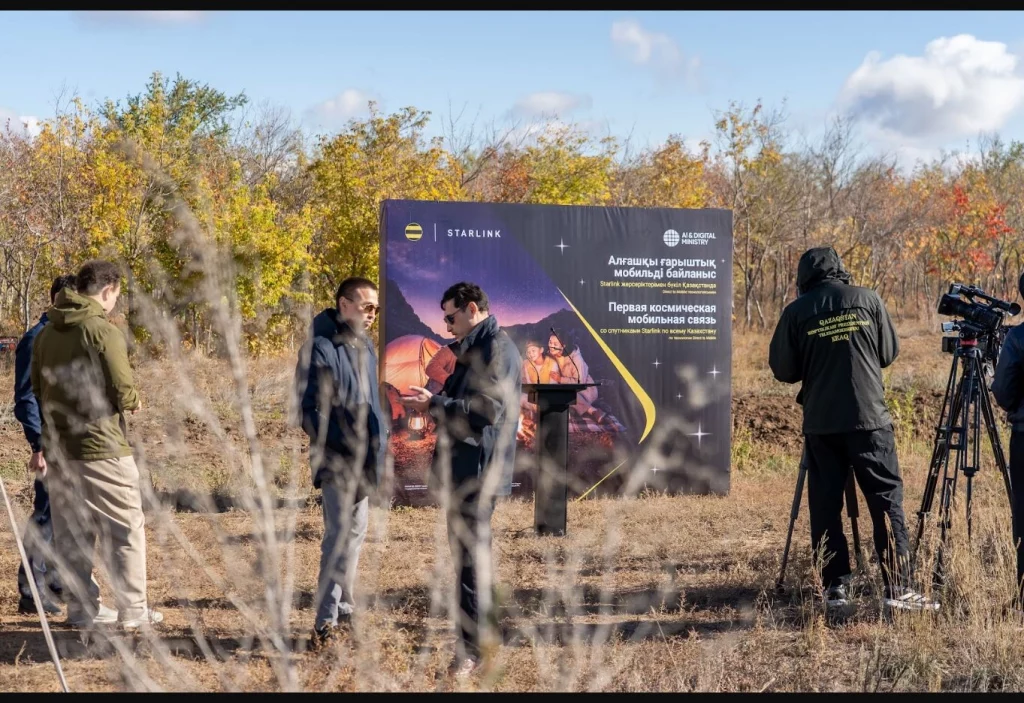
Satellite mobile connectivity via Starlink Mobile’s Direct to Cell technology has officially commenced commercial operations in Kazakhstan. The pioneering joint service between Beeline Kazakhstan and SpaceX’s Starlink enables compatible smartphones to connect directly to orbital low-Earth-orbit (LEO) satellites in geographical areas completely lacking terrestrial cellular coverage.
Connecting requires no specialized satellite phones, external dish antennas, or bulky Starlink terminals. In its initial deployment phase, the service functions seamlessly on standard Android smartphones equipped with 4G LTE modems and active Beeline SIM cards. Users can transmit SMS messages and access basic internet services with data speeds up to 2 Mbps.
How Direct to Cell Connects Standard Phones from Orbit
Direct to Cell effectively transforms Starlink satellites into orbital cell towers operating roughly 500 kilometers above the Earth. Equipped with advanced eNodeB radio payloads, satellites communicate over standard terrestrial cellular frequency bands licensed by Beeline, relaying data packets into the operator’s domestic core network.
The fundamental innovation of the technology is eliminating proprietary hardware barriers: any compatible consumer handset communicates directly with space. The commercial partnership between Beeline Kazakhstan and Starlink was first announced in 2025. Following successful field testing in February 2026 — the first in Central Asia — the platform has progressed from laboratory validation to live consumer availability.
Current Capabilities and Supported Services
At launch, operational bandwidth is tailored for mission-critical text communications, messaging apps, and lightweight telemetry. Users can send and receive emergency SMS texts, exchange text messages via messengers, and query basic navigational maps.
With data transfer rates throttled to 2 Mbps, high-definition video streaming, heavy downloads, and video calling remain unfeasible. Native voice calling over satellite is planned for future firmware upgrades. For the promotional launch window, Beeline is offering the Starlink Mobile Promo tier, providing one month of connectivity and a bundle of 10 SMS messages to test the service.
Device Compatibility and Activation Prerequisites
The initial deployment exclusively supports verified Android smartphones with 4G LTE capabilities. However, 4G support alone does not guarantee connection; compatibility depends on specific baseband modem chipsets and manufacturer firmware versions. Apple iPhone iOS compatibility is slated for subsequent release phases.
To establish satellite connectivity, users require:
- An active Beeline Kazakhstan SIM card or eSIM.
- A compatible LTE-enabled Android smartphone.
- The latest version of the Janymda mobile application.
- Active service subscription enabled in app settings.
- Granted location permissions and data roaming toggled on.
When terrestrial cell towers fade, the handset searches for satellite signals, displaying a roaming icon and updating network operator text to “Beeline Starlink” (network ID 401 04).
Open Sky Line-of-Sight Requirements
Direct to Cell operates strictly via direct radio line-of-sight to the sky. Users are advised to position themselves at least 50 meters away from high-rise buildings, dense tree canopies, or deep canyons that obstruct signal propagation. Signal acquisition typically takes between two and five minutes.
The service is designed explicitly for remote wilderness locations devoid of cell towers: expansive steppe highways, mountain trekking routes, rural outposts, and remote industrial extraction sites. Once users return within terrestrial tower radius, handsets autonomously hand over to standard terrestrial 4G/5G networks.
What Starlink Mobile Means for Kazakhstan
For Kazakhstan — the world’s ninth-largest country by landmass with vast stretches of sparsely populated terrain — orbital mobile infrastructure provides an elegant, cost-effective complement to terrestrial base stations. Constructing fiber backhauls and power lines to isolated desert highways or remote pastures is economically prohibitive.
Starlink Mobile directly bridges these coverage dead zones, providing a vital safety net for long-haul drivers, agricultural workers, geological survey teams, and emergency rescue services. Satellite connectivity ceases to be a specialized luxury for satellite dish owners; it is now an integrated safety feature in ordinary smartphones.