Photo: Kampus Production / Pexels
Kazakhstan is proposing to let the National Bank transfer some pension assets to private firms without savers choosing a manager themselves. The mechanism is set out in the Capital Market Development Programme for 2026–2030, inbusiness.kz reports (inbusiness.kz). Murat Temirkhanov, adviser to the chairman of Halyk Finance’s management board, believes it would help attract large private players. For now, this is a proposed mechanism: there is no basis for saying money is already being transferred.
Who will be able to choose a pension fund manager
The programme envisages two ways to transfer savings to investment portfolio managers, or IPMs. These are companies that invest money entrusted to them. Under the first option, savers decide for themselves whether to transfer their savings to a private manager.
Under the second, the National Bank makes the decision. It allocates some pension assets to companies it appoints to invest the money. This is the option that would involve transferring money to private managers without each saver choosing a company individually.
How the National Bank will choose companies
The proposal is to allocate funds through a competitive selection process open to licensed Kazakhstani asset managers. Separate portions of the portfolio containing shares and bonds would be set aside for this purpose. Financial documents refer to these as sub-portfolios.
The National Bank would be able to decide which companies to entrust with assets and how much each would receive. According to Temirkhanov, a similar approach is already used when foreign-currency assets from the Unified Accumulative Pension Fund (UAPF) and the National Fund are placed with foreign investment companies.
Why transfers without savers’ decisions are being proposed
Temirkhanov believes voluntary transfers are not yet bringing enough pension money to private firms. He attributes this to savers’ distrust, passivity and lack of financial knowledge. This is his assessment as a finance professional.
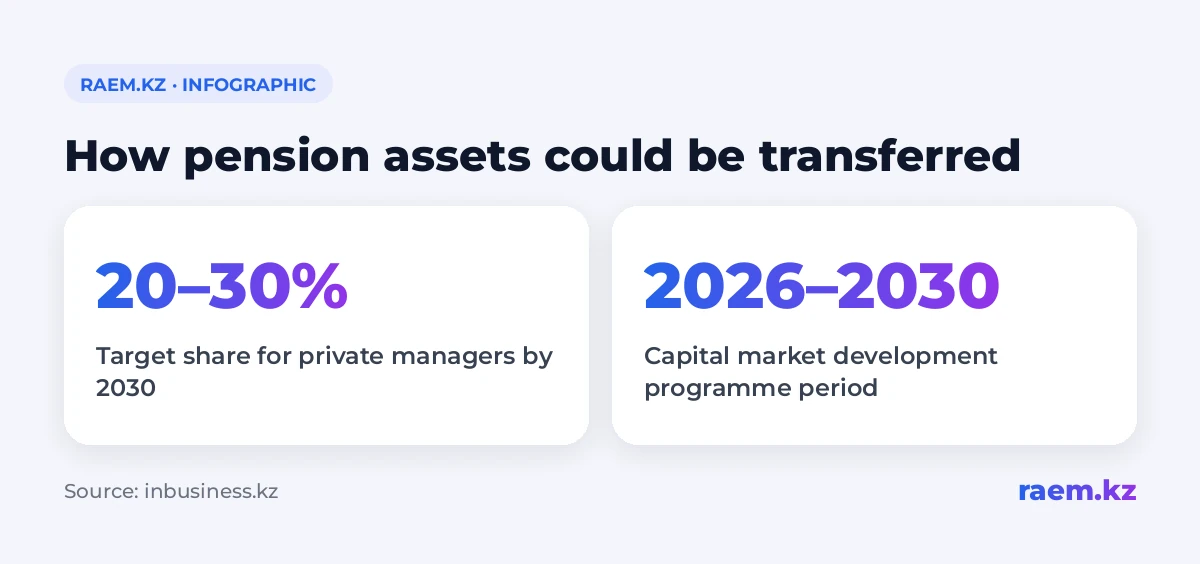
In his view, voluntary decisions alone will not be enough to bring private managers’ share to 20–30% by 2030. Transfers through the National Bank are intended to speed up that process. For savers, the main difference is who chooses the company: they do, or the National Bank does.
Who will oversee private managers
According to Temirkhanov, IPMs are supervised by the Agency for Regulation and Development of the Financial Market, or ARDFM. He believes the current system allows their work to be monitored.
At the same time, he considers the requirements for managers excessively strict. In his view, they hold back capital market development. Oversight alone does not guarantee future returns: the proposal concerns how pension assets are managed.
How long the transition could take
Temirkhanov proposes a transition period of four to five years. During that time, private firms could build experience and establish a track record. The National Bank would assess their results and gradually expand the role of the best-performing managers.
He expects this approach to support Kazakhstan’s stock market. Another expected effect is fewer opportunities to channel pension money into government projects on non-market terms. These are expected outcomes, not results already achieved.
In plain English
The proposal is to transfer some pension money to private firms through a competitive selection process run by the National Bank. In that case, the choice of manager would rest with the National Bank. If you keep track of your savings, the distinction to make now is between a proposal and the current rules: a report about the programme does not in itself mean your money has already been transferred.