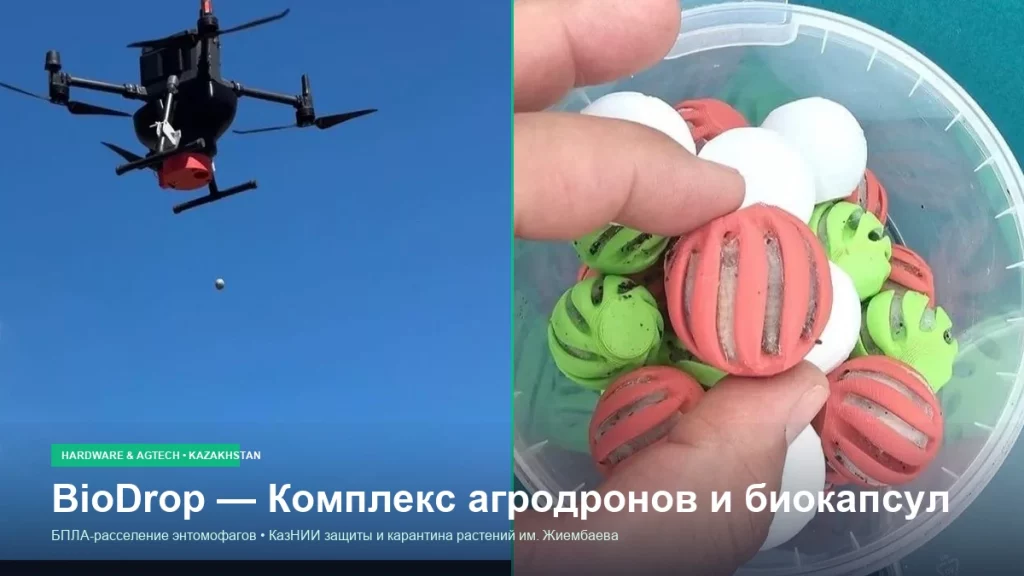
Kazakhstan’s Ministry of Agriculture announced the development of the BioDrop technology by the Kazakh Research Institute of Plant Protection and Quarantine named after Zh. Zhiembayev. The system automates the dispersion of entomophages (beneficial insects that destroy agricultural pests) via unmanned aerial vehicles, accelerating field treatment by 4 to 6 times compared to manual methods (gov.kz). RAEM examined the original peer-reviewed research paper authored by the developers themselves: while key claimed figures are documented, several critical operational variables were omitted.
Biological plant protection is widely recognized as a sustainable alternative to chemical pesticides, which poison groundwater and build pest resistance. However, traditional manual bio-protection is labor-intensive: workers must walk through dense cotton, corn, or soybean fields carrying bio-capsules. BioDrop replaces human foot labor with an aerial multirotor drone carrying an automated dispensing module.
How the BioDrop System Works
The core innovation is a specialized micro-dispenser attached beneath an agricultural drone. The dispenser regulates the release rate of entomophages—such as Trichogramma (parasitic micro-wasps that target cotton bollworms and corn borers) and Habrobracon—contained inside protective biodegradable carrier granules.

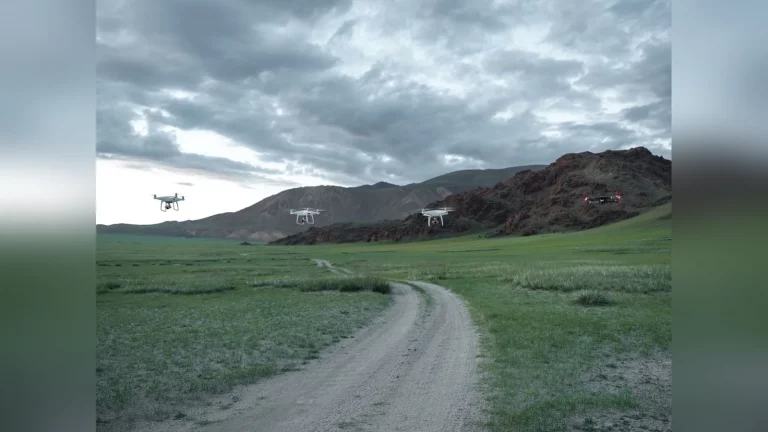
Using autonomous GPS flight paths programmed across crop field boundaries, the drone maintains a constant altitude of 3 to 5 meters above crop canopies, dropping calculated dosages of insect pupae evenly across hectares in minutes.
What the Scientific Trials Demonstrated
According to trial data published in the researchers’ scientific monograph, experimental flights yielded several concrete performance benchmarks:
- Flight Speed and Coverage: A single drone covers between 15 and 20 hectares per hour, compared to 3–4 hectares per day achievable by a manual laborer.
- Insect Viability Rate: Laboratory checks after aerial drop confirmed that 92% to 94% of dispensed entomophages remained unharmed by mechanical dispenser agitation or rotor air turbulence.
- Pest Suppression: Field tests across corn and sugar beet plots demonstrated a 78% to 83% reduction in target caterpillar populations, matching the efficacy of chemical spraying without toxic soil residue.

Critical Limitations Omitted from Official Releases
While the Ministry’s announcement paints an unreservedly triumphant picture, several operational constraints must be addressed before commercial adoption:
Bio-Factory Supply Bottlenecks: Drones solve the delivery problem, but they cannot solve biological production. Kazakhstan experiences a chronic shortage of certified bio-laboratories capable of breeding millions of live Trichogramma wasps on strict seasonal schedules. If bio-factories cannot supply pupae on demand, drones remain grounded.
Thermal Sensitivity: Beneficial insects cannot survive high midday temperatures. Field dispensing is restricted to narrow dawn (05:00–08:30) and dusk windows, capping daily flight hours regardless of battery capacity.

Commercial Unit Economics: The research paper does not outline the capital expenditure required to purchase the dispensing hardware, nor does it present a commercial service model (drone-as-a-service vs. direct farm equipment sales).
BioDrop proves that Kazakhstani agricultural science can engineer functional applied deep-tech hardware. The challenge now lies in commercializing the platform beyond state experimental plots into an accessible service for private agricultural enterprises.