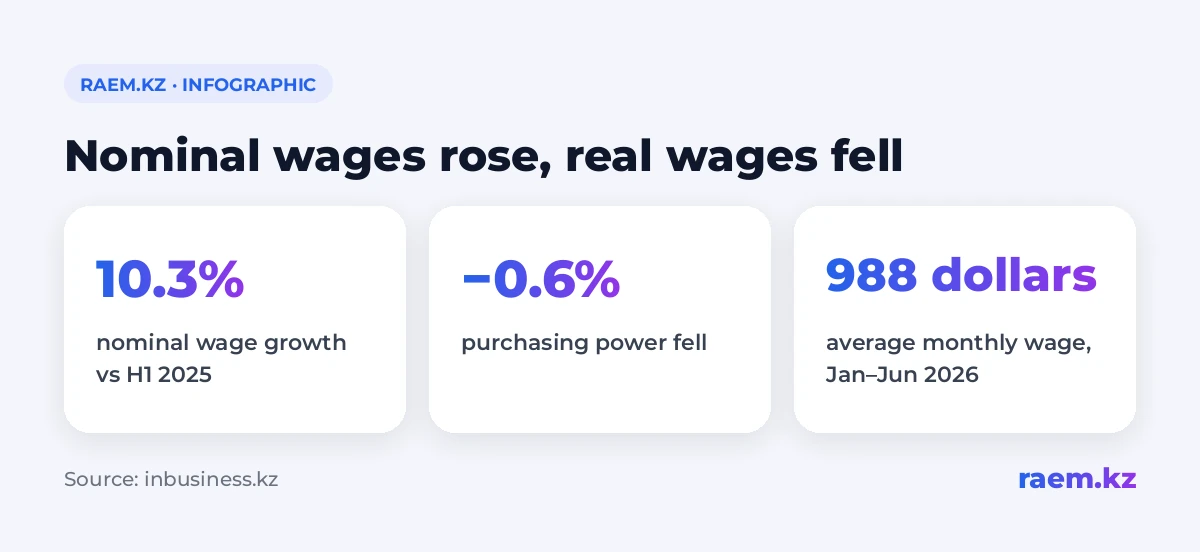
Kazakhstan’s average nominal salary rose by 10.3% in January–June 2026 compared with the same period last year, while real wages fell by 0.6%, according to Kursiv’s September 8 report citing Eurasian Economic Commission statistics. Average monthly nominal pay reached $988.

How much the average salary grew
Kursiv reports a nominal wage increase of 10.3% and a real wage index of 99.4% for the first half of 2026. The latter corresponds to a 0.6% decline from January–June 2025.
A separate October 15 review by Izdatel, drawing on Bureau of National Statistics data, also lists average monthly pay of 480,461 tenge, nominal growth of 10.3% and a real wage index of 99.4% for January–June 2026. This provides confirmation through a national statistical source rather than another retelling of the EEC figures. Izdatel uses a different exchange-rate basis for its dollar estimate, so it does not independently confirm the $988 amount.
The same EEC-based first-half figures appear in Inbusiness’s October 28 report citing Finprom. Inbusiness and Finprom form one reporting chain, rather than two independent confirmations.
Nominal pay measures earnings in money terms, without adjusting for changes in prices. A national average does not mean every worker received the same raise, and it cannot automatically be applied to a particular industry, such as IT in Kazakhstan.
Why higher pay did not increase purchasing power
Real wages account for changes in consumer prices. They help show whether earnings can buy more goods and services than before. The reported decline means that average nominal wage growth did not fully offset rising prices over the period.
How salaries compare with neighboring countries
Finprom’s report, citing the Eurasian Economic Commission, gives the following average monthly nominal salaries for the first half of 2026:
| Country | Average monthly nominal salary |
|---|---|
| Kazakhstan | $988 |
| Kyrgyzstan | $615 |
| Uzbekistan | $591 |
| Tajikistan | $358 |
Based on these rounded dollar amounts, Kazakhstan’s average was almost 61% higher than Kyrgyzstan’s, 67.3% higher than Uzbekistan’s and about 2.8 times Tajikistan’s.
A comparison in dollars does not show how much a salary buys locally. That also depends on prices in each country.
Where real wages grew
The Inbusiness report citing Finprom puts Kyrgyzstan’s real wage index at 115.3% and Tajikistan’s at 114.9% for January–June 2026, corresponding to increases of 15.3% and 14.9%. Their reported nominal wage increases were 27.5% and 19.6%, respectively.
What the figures mean for your budget
To assess your own raise, compare the change in your pay with the cost of the goods and services you regularly buy. National averages show the overall direction, while your household’s purchasing power depends on your earnings and expenses.
A decline in average real wages does not mean every household experienced the same change.