Photo: Bia Limova / Pexels
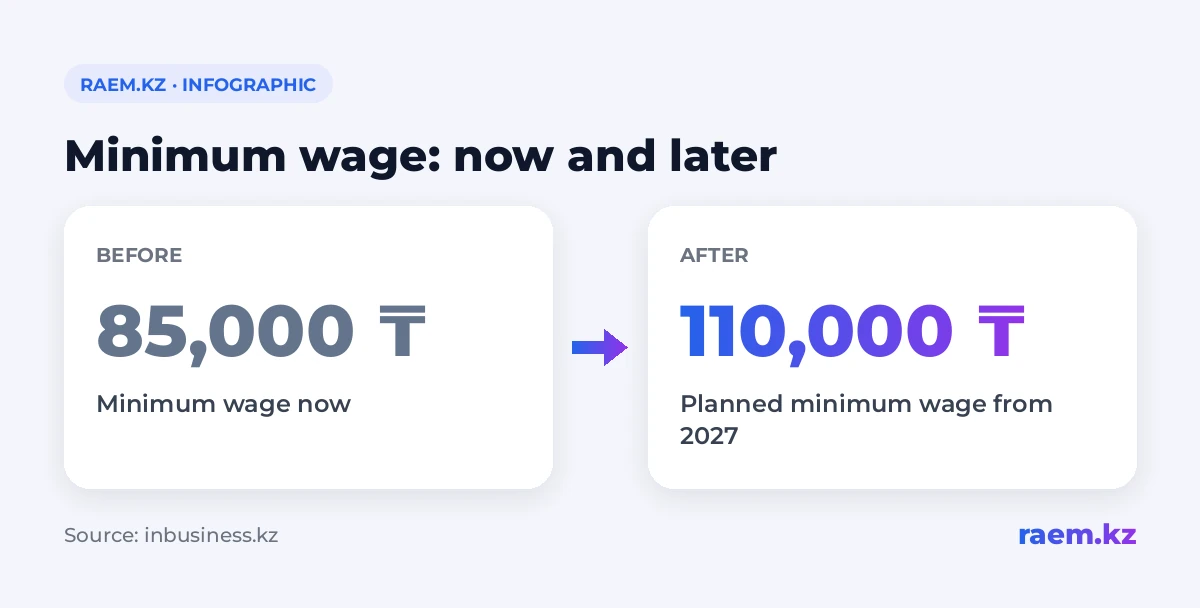
Kazakhstan plans to raise its minimum wage from 85 thousand to 110 thousand tenge in 2027. If the increase goes ahead, employees who work their full required hours and fulfil their duties will have to be paid at least the new minimum. The Ministry of Labour expects incomes to rise for around 1.8 million employees, including more than 370 thousand public sector workers (inbusiness.kz). But a higher minimum wage does not mean an automatic increase in all salaries and benefits.
Who should get a pay rise to 110 thousand tenge
According to the Ministry of Labour, around 1063 thousand employees earn between 85 thousand and 110 thousand tenge. The new minimum wage will raise the pay floor for this group.
Under the Labour Code, employers cannot pay less than the minimum wage to employees who work their full required hours and fulfil their duties. If the increase goes ahead, these workers’ pay will have to rise to at least 110 thousand tenge a month.
Paying wages is one of employers’ obligations in Kazakhstan, alongside formalising employment arrangements and making contributions. For those earning the current minimum, the planned increase would be 25 thousand tenge a month, or 29.4%.
Can pay stay below the minimum wage
Yes, part-time workers can earn less than the minimum wage. This applies, for example, to someone working half-time.
In these cases, pay is calculated in proportion to the hours worked or the amount of work completed. So pay below 110 thousand tenge does not, by itself, mean the rules have been broken: working hours must also be taken into account.
What we know about pay rises for public sector workers
The Ministry of Labour’s forecast includes more than 370 thousand public sector workers. The ministry is now working with the ministries of finance and national economy to clarify which categories of civilian public sector employees will be covered by the increase.
The ministries are also calculating the costs. The overall estimate of 1.8 million workers remains a forecast of how many people could see their incomes rise.
How the income limits for social contributions will change
A higher minimum wage will change the lower and upper income limits used to calculate social contributions. According to the Ministry of Labour’s calculations, the limits would shift as follows:
| Measure | Current level | With a minimum wage of 110 thousand tenge |
|---|---|---|
| Minimum income used in the calculation | 85,000 tenge | 110,000 tenge |
| Maximum income used in the calculation | 595,000 tenge | 770,000 tenge |
For entrepreneurs, this is covered separately: what individual entrepreneurs should consider when the minimum wage rises.
Will pensions and childcare benefits rise
There will be no automatic increase across all pensions and social benefits. Some payments are calculated using other measures, including the subsistence minimum and the monthly calculation index.
The Ministry of Labour expects newly awarded benefits from the State Social Insurance Fund to rise gradually. Their amounts depend on social contributions over the previous 24 months. Maternity benefits use a 12-month period.
The calculated maximum childcare benefit is 40% of seven times the minimum wage. With a minimum wage of 85 thousand tenge, that is 238 thousand tenge; at 110 thousand tenge, it would be 308 thousand tenge. The difference is 70 thousand tenge, but this is the upper limit, not a flat increase for every recipient.
Put simply
If you earn less than 110 thousand tenge, check your pay and set working hours. For those working their full required hours, the planned minimum wage increase would require pay to rise to at least the new minimum. Part-time pay could remain below that level, while social benefits would depend on the rules used to calculate them.