
Photo: Thirdman / Pexels
Managers at foreign companies in Kazakhstan earn an average of 1.4 million tenge, compared with 998 thousand tenge at privately owned Kazakhstani companies. In foreign IT companies, the average reaches 4.1 million tenge before deductions. The comparison varies by sector: privately owned Kazakhstani employers pay more in finance and insurance.
The ownership comparisons below come from the Bureau of National Statistics’ survey of businesses for April 2026, reported by Data Hub and cited by Kapital.kz. These form a single chain of data sources.
How much managers earn at foreign and Kazakhstani companies
Foreign companies pay managers more in 12 of the 16 sectors surveyed.
The comparison covers foreign-owned and privately owned businesses. Kazakhstani employers here therefore refers to privately owned companies. State-owned enterprises are excluded from this comparison.
Who counts as a manager in the statistics
In the survey, a manager is an employee who heads an organisation or one of its divisions. The category therefore covers managers at different levels, including those responsible for only part of a company.
The averages apply to this entire category of employees. They should not be read as salaries paid exclusively to company heads.
How much managers earn in IT
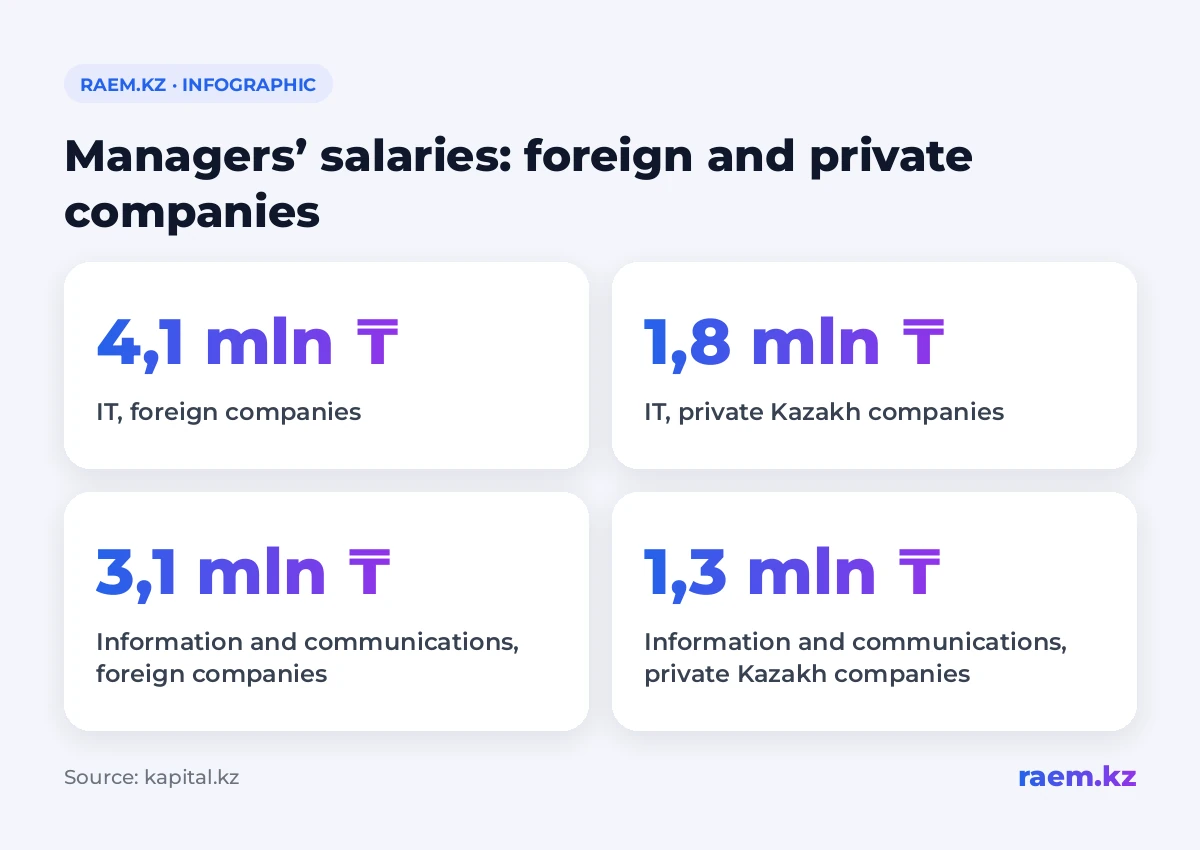
In IT, managers at foreign companies earn an average of 4.1 million tenge. At privately owned Kazakhstani companies in the sector, the average is 1.8 million tenge.
IT also influences the figures for the broader information and communications sector. Here, average management salaries are 3.1 million tenge at foreign employers, compared with 1.3 million tenge at privately owned Kazakhstani companies.
An independent source, Antal Kazakhstan’s Job Market Overview and Salary Survey 2025–2026, provides a separate benchmark for senior technology roles. Its IT and telecom table lists average minimum and average maximum salaries of 1.8 million and 4.5 million tenge for IT directors and technical directors. The figures are before taxes and exclude bonuses.
Antal combines its own survey, recruitment database and consultant assessments; it says its salary benchmarks primarily reflect international companies. This independently supports the scale of pay for senior technology roles, but does not verify the April 2026 average of 4.1 million tenge or the precise pay gap by ownership. Those comparisons remain based on the BNS survey reported through Data Hub and Kapital.kz.
When comparing job offers, it also helps to consider the broader picture of IT salaries in Kazakhstan. The BNS figures discussed here specifically cover managers and cannot be applied to all IT professionals.
Which other sectors show a sizeable gap
In real estate and other services, average management salaries at foreign employers are more than twice as high. Here is how several sectors compare:
| Sector | Foreign companies | Privately owned Kazakhstani companies |
|---|---|---|
| Real estate activities | 1.4 million tenge | 598 thousand tenge |
| Other services | 1.3 million tenge | 595 thousand tenge |
| Finance and insurance | 1.8 million tenge | 2.1 million tenge |
Average management salaries at foreign companies exceed 900 thousand tenge in almost every sector surveyed. They exceed 2 million tenge in two broad sectors: information and communications, and professional, scientific and technical activities. In the latter, the average is 2.1 million tenge.
Where Kazakhstani companies pay more
Finance and insurance is one example where privately owned Kazakhstani businesses pay more. Managers here earn an average of 2.1 million tenge, compared with 1.8 million tenge at foreign companies.
According to the survey analysis, foreign employers in this sector pay 14% less. The overall pay advantage at foreign companies therefore does not reflect the situation in every sector.
How to compare these salaries with a job offer
The benchmark depends on the sector, the company’s ownership and the seniority of the role. When comparing an offer with these figures, check the amount before deductions: the BNS figures include taxes and other mandatory payments, so they represent gross pay rather than take-home pay.