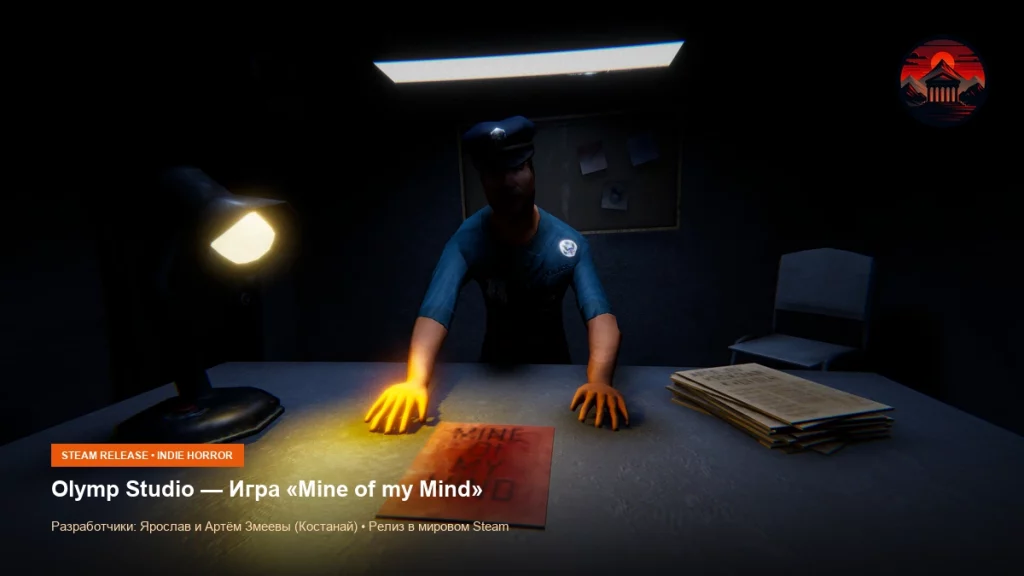
On July 8, 2026, psychological horror title Mine of my Mind launched on Steam—telling the eerie story of an underground coal miner whose routine shift gradually dissolves into a psychological nightmare. On the official Steam storefront, the developer and publisher are listed under identical branding: Olymp Studio.

Behind this title stands a compact Kazakhstani independent team. On their official portal, the studio identifies Kostanay in northern Kazakhstan as its home base and states that its operational core comprises three people: Yarik leads visual style and game design, Artem oversees C# codebase architecture and skeletal animations, and Nikita manages digital marketing, social media presence, and storefront relations.
For an established AAA gaming studio, three people would barely form a sub-department. For an independent game studio, three people represent the entire enterprise.
Mine of my Mind did not become an overnight viral sensation. At the time of this analysis, the game maintained 15 user reviews on Steam, 80% of which were positive. In the US Steam storefront, the game carries a retail price of $3.99. Yet the tangible milestone of a completed, verified Steam release offers a revealing case study into the grassroots layer of Kazakhstan’s GameDev ecosystem: not a venture-backed hundred-person studio in Almaty, but three indie developers creating a product from scratch, managing distribution, and finding international players.
Operating from Kostanay in a Borderless Gaming Economy
Locating in Kostanay changes virtually nothing about modern PC game publishing. Valve does not differentiate whether a build upload originates from Montreal, Tokyo, or northern Kazakhstan. Game distribution, customer payments, regional currency conversions, and automated patch deployments operate through standardized global APIs.
What location does influence, however, is the operational burn rate. In secondary regional hubs, the personal living costs required to sustain independent development over 12–18 months are substantially lower than in Almaty or Astana. This lower overhead affords micro-studios the breathing room to complete long production cycles without seeking predatory early-stage venture capital.
Why a Three-Person Micro-Studio Created Its Own Publishing Entity
The most intriguing architectural choice on Olymp Studio’s Steam profile is the decision to self-publish under the exact same name rather than contracting with an established indie publisher.
For inexperienced game developers, partnering with an established boutique publisher (like Devolver Digital, tinyBuild, or Raw Fury) offers significant advantages: pre-existing marketing reach, streamer contacts, localization funding, and storefront platform featuring. However, traditional publisher contracts routinely demand 30% to 50% of net post-Steam revenues after recouping initial marketing advances.
By establishing Olymp Studio as both developer and publisher, the Kostanay team preserves 100% of its post-Steam revenue share (Valve retains its standard 30% platform cut) and builds direct commercial equity in its own brand. If Olymp Studio launches subsequent games, player wishlists and brand recognition remain unified under one storefront identity.
The Economics of Micro-Indie Game Development
A standard formula utilized by indie game analysts (Boxleiter / VG Insights methodologies) estimates commercial performance from review counts: multiplying Steam review numbers by a factor between 30 and 50 to estimate total unit sales.
With approximately 15 reviews at a $3.99 list price (subject to regional discounts and Steam sales), gross sales for Mine of my Mind likely represent a few hundred units. After Steam’s 30% platform fee and applicable regional value-added taxes, net earnings are modest. However, for a micro-studio, a first title serves a different primary purpose: completing the brutal production loop from concept to Steam greenlight, mastering QA testing, understanding Steam algorithm visibility, and building an active Discord community.
One release can be an ambitious experiment; two or three consecutive releases establish a sustainable production pipeline. If earnings from the first title are modest, founders fund the next cycle with personal sweat equity. If earnings reach modest scale, the team can license commercial 3D asset packs, commission professional voice acting, or contract sound design specialists.
Why Kazakhstan Needs More Stories Like Olymp Studio
As explored in our comprehensive Kazakhstan GameDev Market Analysis, the domestic gaming sector encompasses 30 to 40 active commercial studios, yet remains heavily skewed toward mobile hypercasual products and outsourced contract art.
Olymp Studio represents a distinct, critical archetype: a regional indie micro-team tackling the PC hardcore market, building narrative IP in psychological horror, and interacting directly with international PC players on Steam. Demonstrating that developers in Kostanay can build, ship, and monetize PC titles without relying on state grants or metropolitan headquarters is precisely what will diversify Kazakhstan’s creative digital economy.