Washington has escalated tariffs on industrial drones and Canadian exports, tightened scrutiny on high-voltage electrical grid transformers, and targeted low-cost parcel exemptions. Concurrently, the US broadened beef import quotas to counteract domestic inflation. Over a rapid two-week window, American trade authorities enacted a barrage of regulatory measures altering global trade corridors—with direct operational consequences for Kazakhstan.
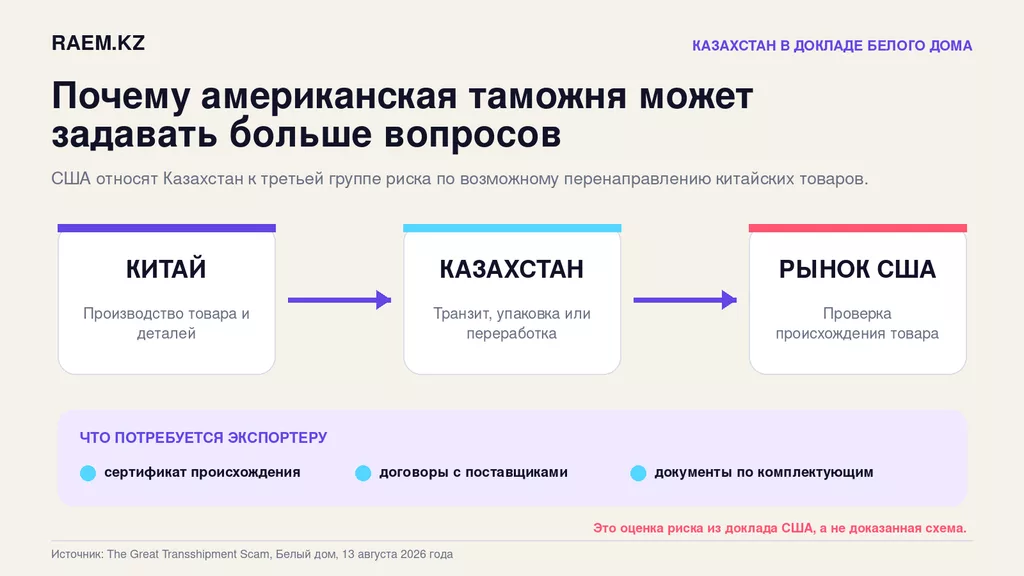
New US tariffs struck commercial drones, quartz architectural slabs, and lumber imports. Crucially, the White House published an exhaustive intelligence assessment on Chinese tariff circumvention, categorizing dozens of third-party countries into operational risk tiers. Kazakhstan was formally categorized within Risk Group 3.
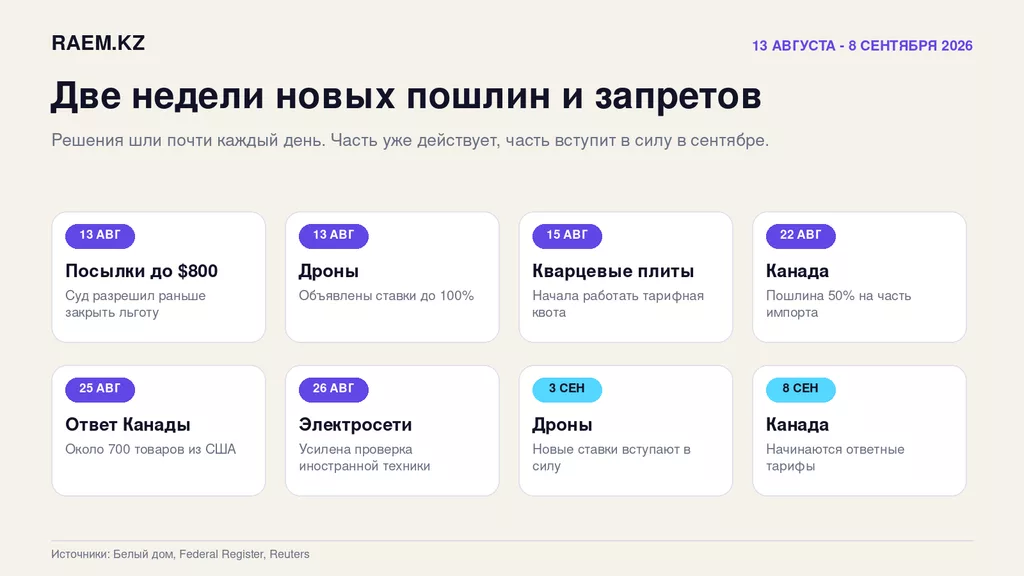
Two-Week Chronology of US Trade Policy Decisions
The velocity of US regulatory shifts during mid-to-late August 2026 illustrates an aggressive, multifaceted enforcement campaign:
| Date | Regulatory Policy Decision | Substantive Market & Trade Impact |
|---|---|---|
| August 13 | Federal Court upholds early termination of de minimis customs exemption | Allows customs authorities to levy tariffs ahead of schedule on parcels under $800 from China, Mexico, and Canada. |
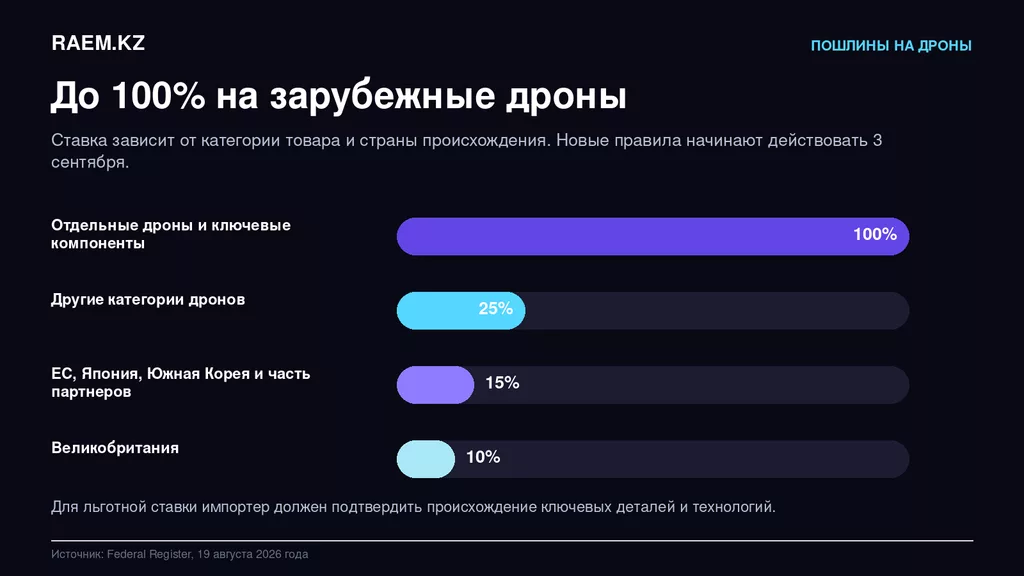
| August 13 | White House announces prohibitive tariff hikes on unmanned aerial vehicles | Establishes a 100% tariff rate on designated commercial drones, dock stations, and critical flight modules starting September 3, with 25% rates on components. |
| August 13 | White House issues global report on Chinese tariff circumvention transshipment | Over 40 nations and territories designated as diversion risk corridors. Kazakhstan formally placed into Group 3 monitoring. |
| August 15 | Implementation of 4-year tariff-rate quotas on imported quartz slabs | Imports of engineered stone and interior architectural quartz slabs face steep anti-dumping duties to protect domestic fabricators. |
| August 22 | Enactment of retaliatory countervailing duties against Canadian lumber and paper | Imposes targeted duties across Canadian softwoods following prolonged North American trade disputes. |
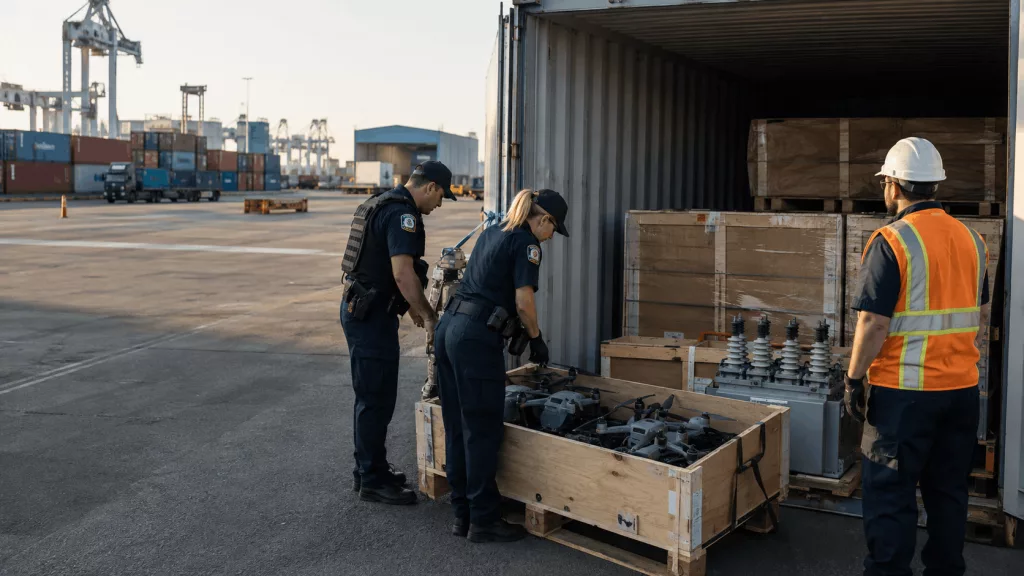
| August 26 | Department of Energy mandates supply-chain auditing for power grid equipment | Stringent national-security cyber audits mandated for large transformers and grid automation hardware originating from designated foreign adversaries. |
What Group 3 Classification Means for Kazakhstan
The most consequential document for Astana is the White House report analyzing third-party transit jurisdictions utilized to reroute Chinese goods subject to US Section 301 tariffs. Being designated in Group 3 places Kazakhstan under heightened compliance scrutiny by the US Treasury’s OFAC and Department of Commerce.
The primary concern among Western trade enforcers is the phenomenon of nominal re-packaging and origin obfuscation. Products manufactured in China (particularly dual-use electronics, drone assemblies, microcontrollers, and specialized chemicals) are imported into Central Asian free economic zones, undergo superficial packaging changes, receive local certificates of origin, and are re-exported.
Kazakhstani commercial banks and logistics operators have responded by imposing rigorous KYC protocols. Tier-1 banks (including Halyk Bank and Bank CenterCredit) routinely reject payments and freeze trade clearing if product HS codes appear on dual-use export control watchlists.
Critical Minerals and the Geopolitical Balancing Act
Concurrently, the United States is actively courting Kazakhstan as an alternative source of critical raw materials (titanium, scandium, lithium, and rare earths) to diminish Western reliance on Chinese refining monopolies.
This dual dynamic creates an intricate geopolitical landscape for Kazakhstan. On one hand, domestic logistics operators must avoid secondary sanction pitfalls and strict US tariff enforcement. On the other hand, Kazakhstan’s mining and metallurgical sector stands to capture billions of dollars in Western direct investment by establishing clean, certified mineral supply chains directly with the US and Europe.