Photo: Daniil Ustinov / Pexels
Buyers of a Coffeebox franchise secured a court ruling terminating their contract and ordering repayment, but the family says it has yet to receive the money. Almira and Yerlan Irbatyrov, from Ust-Kamenogorsk, paid 4 million tenge, and the court ordered the seller to pay them 4,622,177 tenge plus costs (raem.kz). The contract and receipts name different limited liability partnerships (LLPs). This detail helps explain who received the payment and which company the court ordered to repay the money.
How much the Irbatyrovs paid for the franchise
On 4 September 2025, Yerlan Irbatyrov signed contract No. 217 with Coffeebox KZ LLP. It was a comprehensive business licence agreement with supply provisions — a coffee machine franchise.
That same day, Almira transferred 4 million tenge in three payments. Payments of 2 million and 600 thousand tenge went through Kaspi Kredit, with another 1.4 million sent through Kaspi Gold.
Which company received payment for the machine
The fiscal receipts name COFFEEBOX.KZ LLP as the recipient. Yerlan, however, signed the contract with Coffeebox KZ LLP.
These are two separate legal entities with different business identification numbers, or BINs. In the Irbatyrovs’ case, the court ordered repayment by Coffeebox KZ LLP, the company that signed the contract.
When the machine was delivered and what complaints arose
The equipment was handed over on 25 November 2025 — more than two months after payment. The formal complaint states that the machine repeatedly broke down.
According to the account in the complaint, requests for servicing did not resolve the problems, and the equipment could not be used for its intended purpose. The dispute over terminating the contract and refunding the money then went to court.
How much the court awarded the Irbatyrovs
On 6 May 2026, District Court No. 2 of Almaty’s Auezov District terminated the contract. Case No. 7540-26-00-2/2383 was heard under a simplified procedure.
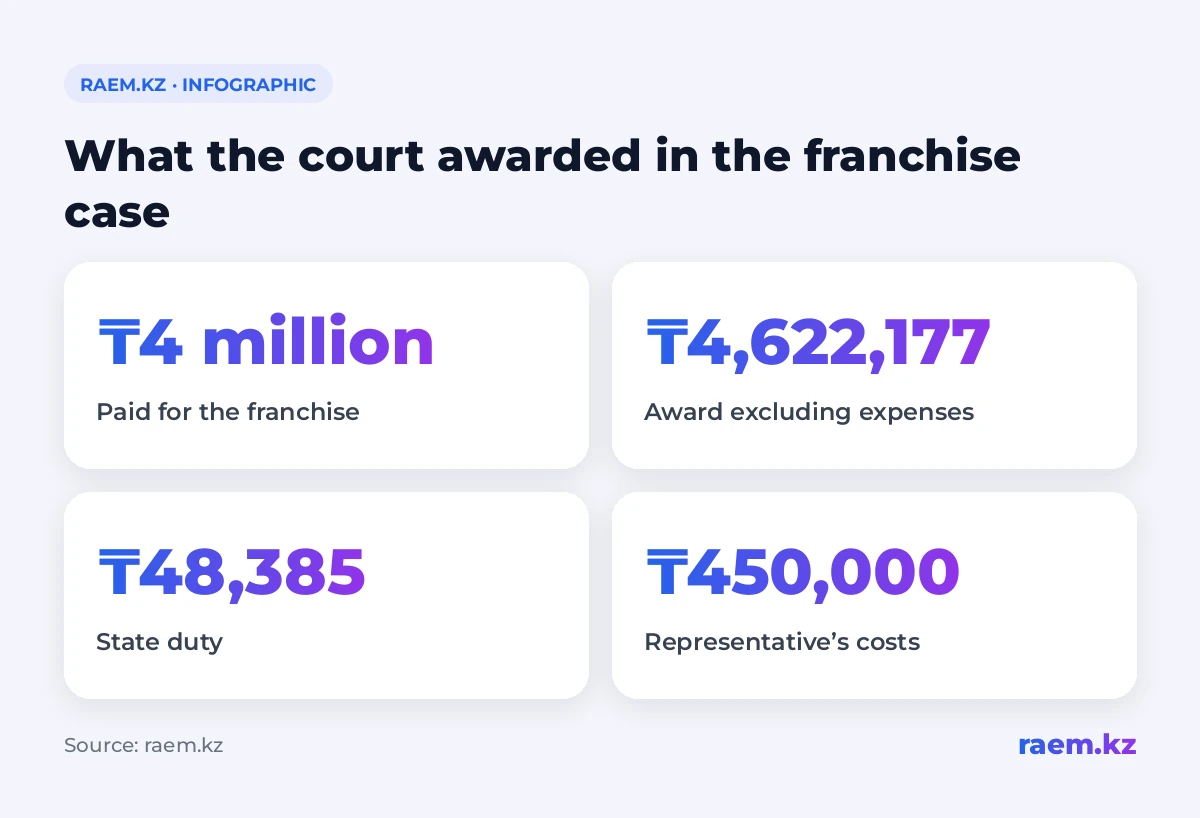
Coffeebox KZ LLP was ordered to pay:
- 4,622,177 tenge;
- 48,385 tenge in court fees;
- 450,000 tenge in legal representation costs.
The 4,622,177 tenge is listed separately from court costs. The family says the money has not yet been returned. The claim that the companies’ accounts have no funds is also the Irbatyrovs’ assertion, rather than a fact established here.
What rulings another claimant secured
Entrepreneur Aibol Seitzhanov also secured court awards. On 18 June 2026, the Specialised Interdistrict Economic Court of Almaty issued a ruling in case No. 7527-26-00-2/8371. COFFEEBOX.KZ LLP was ordered to pay 3,233,328 tenge in damages, 50 thousand tenge each in contractual penalties and compensation for moral harm, as well as costs.
On 1 October 2026, District Court No. 2 of Auezov District issued a ruling in case No. 7540-26-00-2/7556 against Coffeebox KZ LLP. It awarded 3,183,328 tenge, a contractual penalty of 175,301 tenge and court fees of 33,587 tenge — a total of 3,392,216 tenge.
A lawyer’s advice
We asked Nariman Isanov, a lawyer at Fenix Law, to comment on the situation.
First, he says, buyers should understand exactly what they are paying for. “Under the law, a franchise is not the purchase of a machine, but the right to operate under someone else’s brand, with its expertise, standards and support,” the lawyer says, citing Article 896 of the Civil Code. If the contract describes only the equipment in detail and says little more than a few general words about the brand and support, he says, the buyer is getting “a machine with a markup for the name”.
An imbalance in obligations should also raise concerns: payment requirements are strict, while delivery deadlines, warranties, repairs and refunds are vaguely defined. That leaves the buyer carrying almost all the risk.
If one LLP signs the contract and another receives the money, that alone does not always constitute a violation: within a group of companies, one legal entity may accept payment on behalf of another. But Isanov stresses that there must be a clear basis for this arrangement, set out in the contract. Article 275 of the Civil Code allows the payer to demand proof that the payment is being received by the seller or someone authorised by the seller.
Before paying, the lawyer advises checking the company’s BIN and how long it has been operating, its tax debts, court cases and enforcement proceedings, the authority of the person signing the contract, and whether the trademark is registered and who owns it. “If it belongs to someone else, the franchisor effectively has nothing to grant you,” Isanov explains. He also advises calling several existing franchisees yourself, without the manager present, and asking how long it took to launch and how the equipment performs.
Income promised in a presentation guarantees nothing: legally, what matters is what the contract says. The lawyer advises putting commitments on a quick launch, servicing and revenue into the contract, with deadlines and liability for failing to meet them, and splitting payment into stages — an advance, delivery, acceptance and launch, followed by the balance. Buyers should be especially cautious if the full amount is demanded upfront, particularly if it must be borrowed.
“Winning in court and getting your money back are two different things,” Isanov says.
The Irbatyrovs say their money has not yet been returned. If you have already bought a franchise, keep the contract, receipts, the machine handover document and requests for servicing: they document payment, delivery of the equipment and complaints.