
Illustration: AI
Since 2022, foreign internet companies have paid 178.8 billion tenge in VAT into Kazakhstan’s budget, according to State Revenue Committee figures as of August 1, 2026. The charge is known as the ‘Google tax’, though in practice it is closer to a tax on shoppers. It is built into the price of a ChatGPT or Claude subscription, a game on Steam or a parcel from Temu. raem.kz looked at where these billions come from, who brings them in and why the total is growing faster in 2026 than before.
What is the ‘Google tax’?
The ‘Google tax’ is VAT that foreign companies pay in Kazakhstan on sales of digital services to people in Kazakhstan, as well as online sales of goods. The system has been in place since January 1, 2022. Companies do not need an office in the country: they use a simplified VAT registration process, file their own returns online and pay the tax in tenge.
The name is misleading. This is not a tax on profits, and Google is not handing over a share of its earnings to the budget. VAT is an indirect tax: by definition, the end customer pays it, while the company simply collects it as part of the price and passes it on to the government.
How much has been collected each year?
According to the State Revenue Committee, receipts grew more than fivefold over four years:
- 2022 — 10.4 billion tenge;
- 2023 — 24.3 billion tenge;
- 2024 — 35 billion tenge;
- 2025 — 57.6 billion tenge;
- January–July 2026 — 51.5 billion tenge.
Collections in the first seven months of 2026 already amount to almost 90% of the total for 2025. If this pace continues, this year will set a record. A more recent figure has also been circulating on social media: 69.6 billion tenge as of September 28. We could not find an official State Revenue Committee publication with that figure: the latest published data are as of August 1.
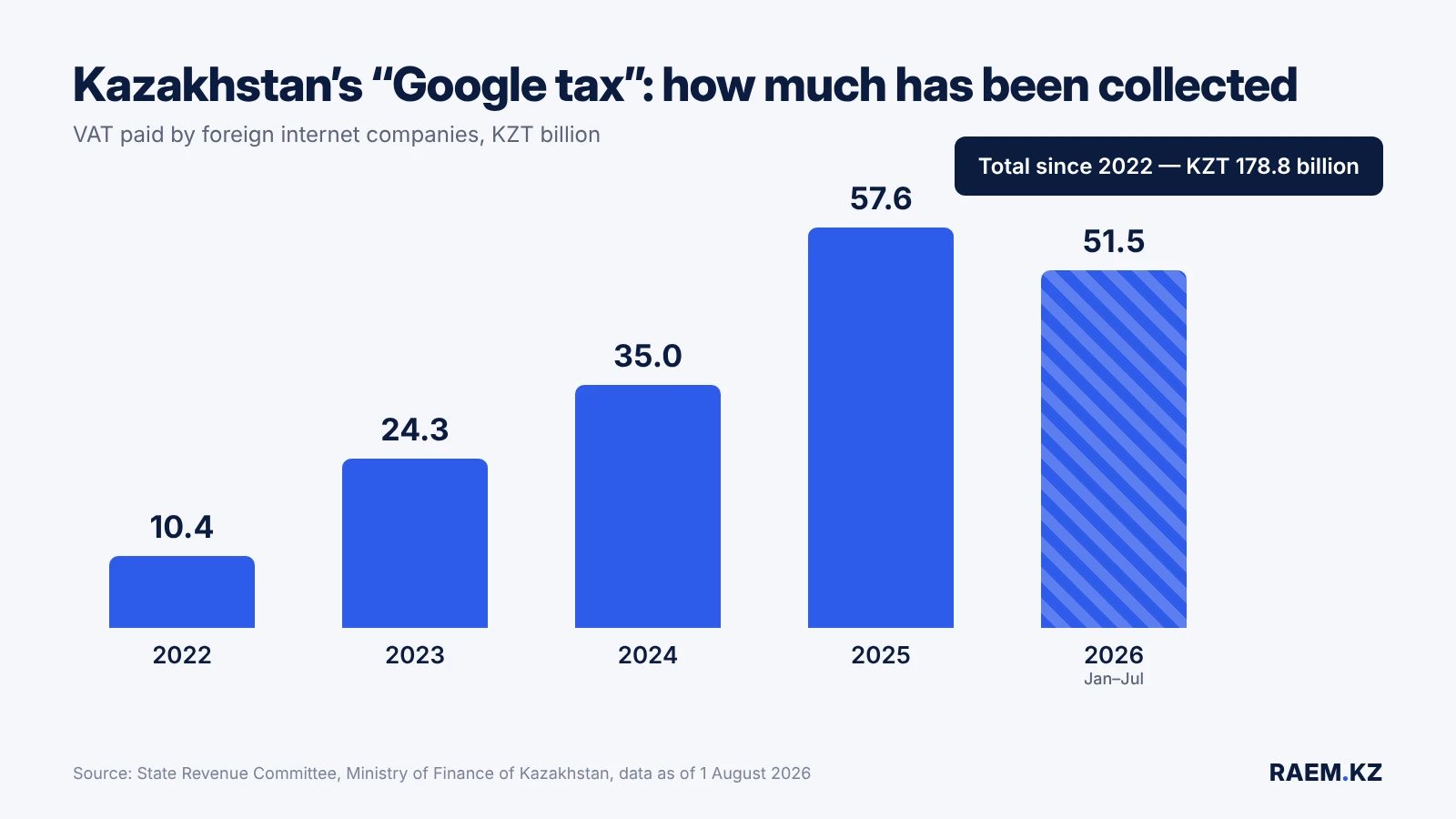
Kazakhstan’s “Google tax” receipts by year, 2022–2026 · Infographic: raem.kz
Who pays the most?
The biggest payers in 2025, according to the State Revenue Committee:
- Elementary Innovation Pte. Ltd., a Singapore company linked to Temu — 13.3 billion tenge;
- Apple — 11.2 billion tenge;
- Valve (Steam) — 10.3 billion tenge;
- Google — 7.3 billion tenge;
- iHerb — 4.9 billion tenge.
These five companies brought in 47 billion tenge, or more than 80% of all receipts for the year. Other prominent names pay orders of magnitude less: Netflix — 353.9 million tenge, Spotify — 293.1 million tenge, Zoom — 183.2 million tenge, Nintendo — 54 million tenge, Coursera — 33.2 million tenge.
The leading payers show what drives the tax. The top spot belongs to a marketplace for cheap goods rather than a technology giant. App and game stores take second and third place. In other words, most of the ‘Google tax’ comes from purchases by people in Kazakhstan: parcels, apps, games and subscriptions.
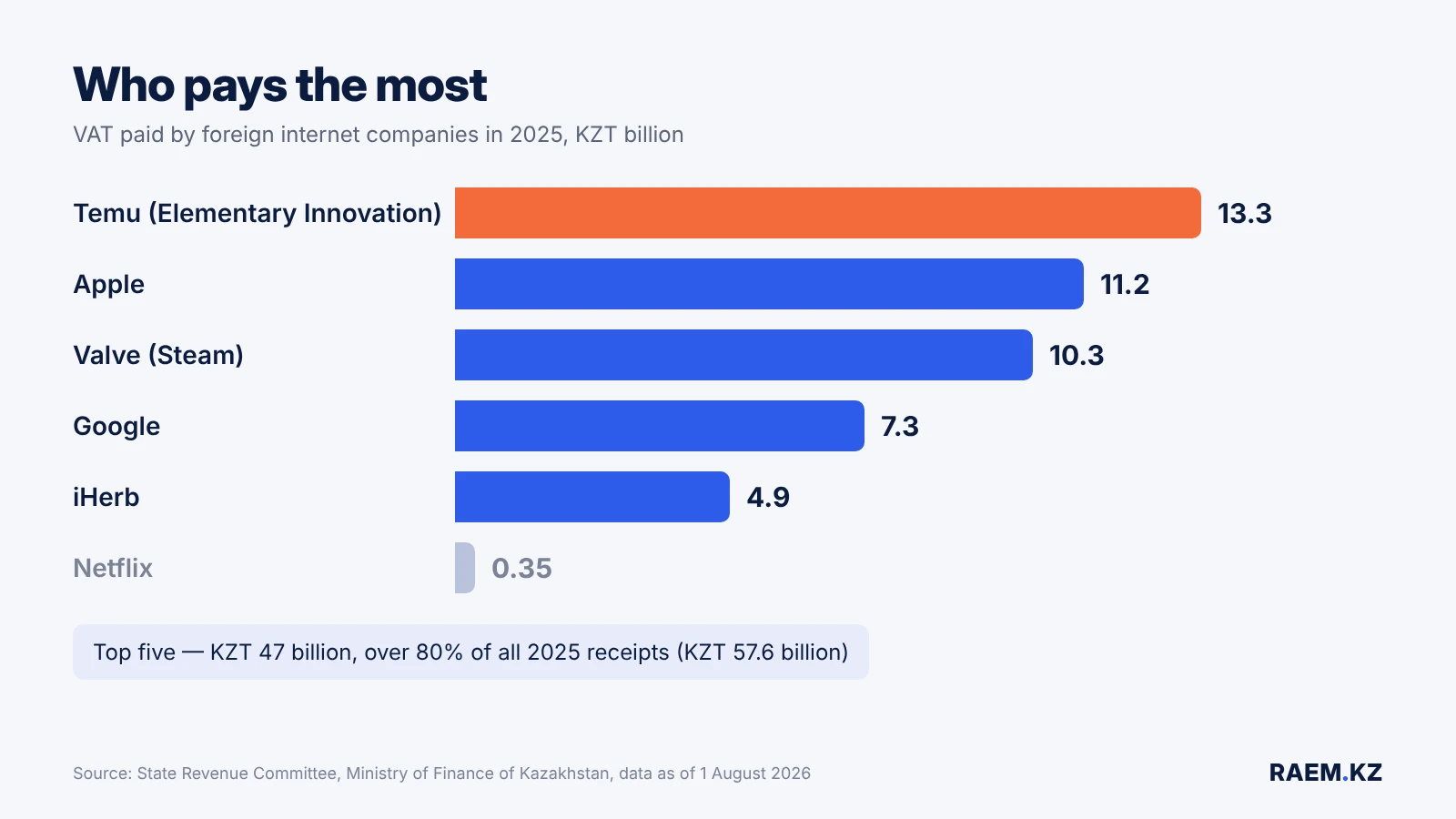
Largest “Google tax” payers in 2025 · Infographic: raem.kz
How many companies are on the register?
The number of foreign taxpayers is growing fast. There were 116 in October 2025, rising to 120 by February 2026 and 133 by August 2026. They include Apple, Amazon, Alibaba, AliExpress, Google, Meta, Microsoft, Netflix, OpenAI, Ozon, Temu, TikTok, Samsung and Sony. OpenAI (ChatGPT), Canva, Chess.com and Russian streaming service Okko joined the register in autumn 2025.
The State Revenue Committee makes a specific point: registration does not mean a company pays tax in every reporting period.
Why are we paying more in 2026?
The main reason is the new Tax Code, which took effect on January 1, 2026. The standard VAT rate rose from 12% to 16%. Foreign platforms selling goods and services to people in Kazakhstan must pay VAT from the very first payment by a customer in Kazakhstan.
As early as August 2025, lawyer Chingis Oralbayev warned that major platforms would most likely just build Kazakhstan’s VAT into their prices, leaving customers to pay it. Smaller sellers, he said, might stop shipping to Kazakhstan altogether if the additional burden proved too great.
There is also a penalty from 2026. According to the State Revenue Committee, foreign services that fail to register and pay VAT may be blocked, and there were plans to publish a list of such companies.
Parcels: the next step
Rules for parcels from foreign online stores are changing separately. Amendments to the Eurasian Economic Union’s Customs Code introduce a new category: ‘e-commerce goods’. The duty-free import threshold will remain at €200, but the current 15% duty on the amount above the threshold will be replaced by a 5% duty on the parcel’s full value, plus 16% VAT. The National Bank estimated that the added cost to shoppers would rise from 15% to 21%. The new rules will take effect once all Eurasian Economic Union countries have ratified the protocol.
What does this mean for users?
When someone in Kazakhstan pays for a subscription, a game or a parcel, part of the payment goes into Kazakhstan’s budget as VAT. Since 2026, the rate has been 16% instead of 12%. Foreign companies act as tax collectors rather than taxpayers in the economic sense. Growth in the ‘Google tax’ therefore reflects, above all, growth in digital spending by people in Kazakhstan themselves.
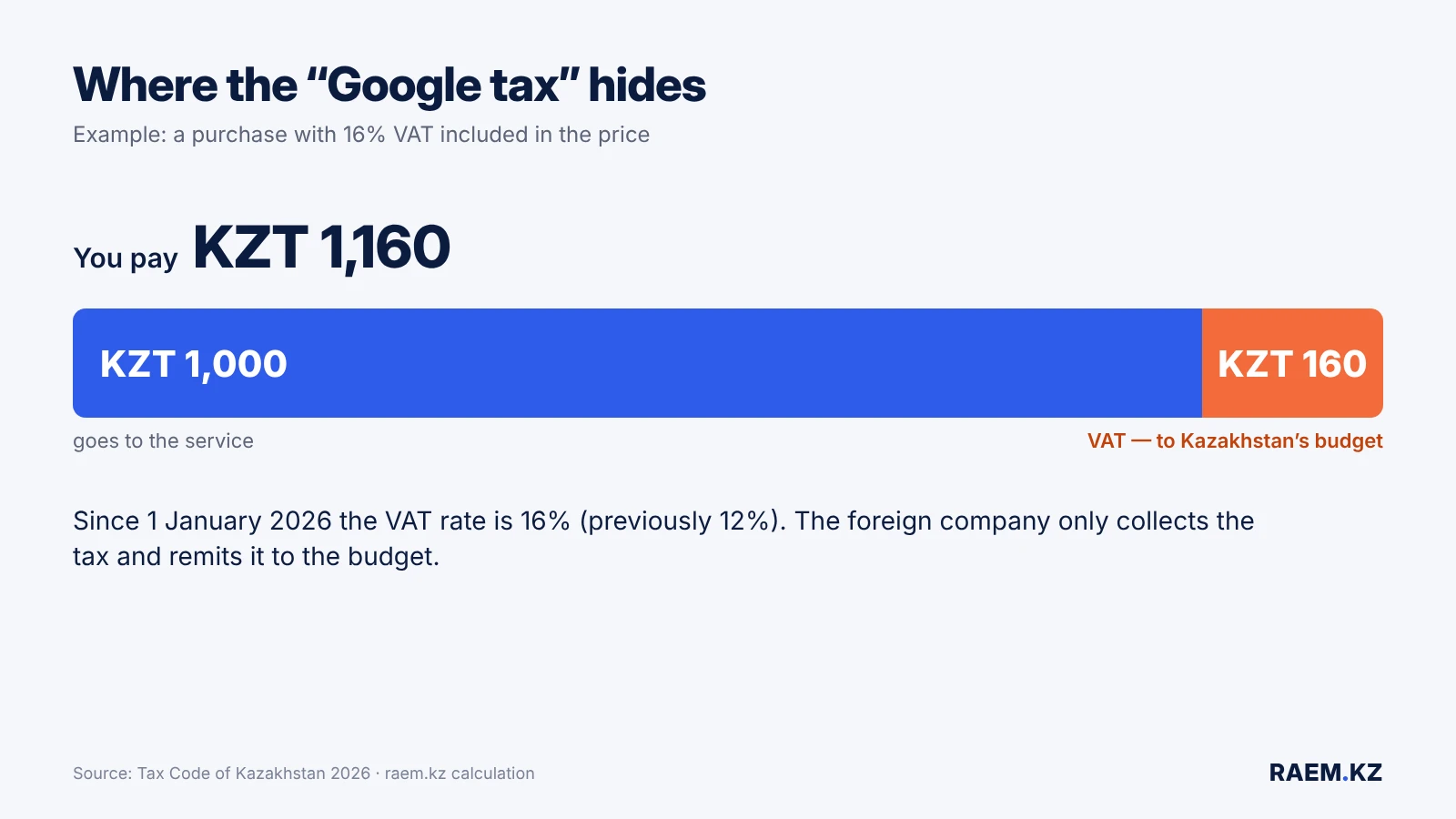
How much VAT is in a purchase with 16% tax · Infographic: raem.kz
Sources: State Revenue Committee of Kazakhstan’s Ministry of Finance (gov.kz, data as of August 1, 2026, November 6, 2025 and February 2026), Kazinform, Kursiv, BES.media, Digital Business.