

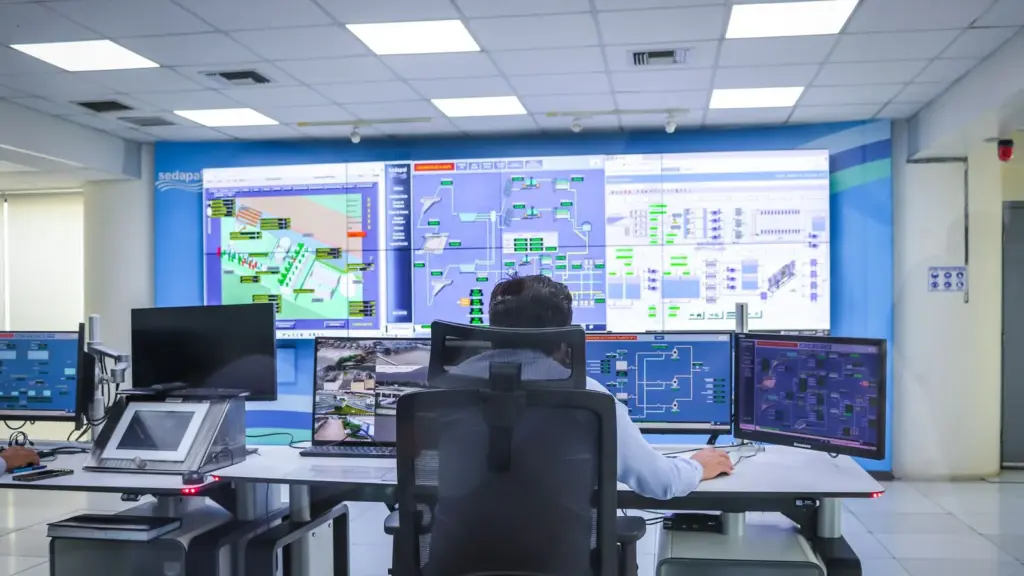
Photo: Fernando Narvaez / Pexels
Kazakhstan’s Ministry of Internal Affairs is testing an “Electronic Protection Zone”. The trial is working out how police will receive an alert if a person who poses a threat comes within 20 metres of a victim.
The trial is under way in six regions, Interior Minister Yerzhan Sadenov said in response to a parliamentary inquiry (inbusiness.kz). Kazakhstan currently uses 2,851 electronic monitoring devices equipped with GPS and GSM modules. Here’s how the pilot works and what other digital tools police have, from drones and cameras with analytics to smart badges and robot dogs.
Pilot runs in Shymkent and five regions
The system is being tested in Shymkent and the Akmola, Almaty, Mangystau, Turkistan and Zhetysu regions. The ministry is conducting the technical trial with KaR-Tel LLP.
According to the ministry, the system is designed to locate both the person who poses a threat and the victim at the same time, and automatically detect when they come dangerously close. During the trial, officials are testing how to record when the distance falls to 20 metres or less, generate an alert on the monitoring platform and send it to the police operations centre.
Police in the pilot regions are testing the response procedure: automatically registering the alert, sending it to the centre, dispatching the nearest patrol and digitally recording the measures taken.
Coordinates update at least every two minutes
The devices transmit coordinates over 2G, 3G and 4G mobile networks. According to the minister, the platform updates them “at intervals of no more than two minutes”.
Permitted areas and times can be set for each person under monitoring. The system records when someone crosses a boundary, removes the bracelet without authorisation or tampers with it. It also reports a low battery or a lost connection to the device.
Rules still to be settled and how the pilot will be assessed
The ministry is also working on rules for special software on victims’ phones, including how it will be used, their consent and the protection of personal and location data.
“At the same time, we are working on the legislative and organisational rules governing the use of special software on victims’ mobile devices,” Yerzhan Sadenov said.
Separate legislation would be needed for a court to impose an electronic bracelet as a standalone restriction in an administrative or criminal case, the ministry said.
After the pilot, the ministry will assess its effectiveness by looking at police response times, the number of violations detected, the measures taken and cases of repeat violence.
Earlier, Kurultai member Aizhan Aimaganova proposed that the ministry introduce an “Electronic Protection Zone” to protect people from domestic violence (azattyq-ruhy.kz). She argued that an expensive new information system was unnecessary and proposed a mandatory procedure for police to follow when an alert is triggered.
Drones detected more than 20,000 traffic violations
The “Electronic Protection Zone” is part of a broader shift to digital tools in policing. One of those tools is road surveillance drones. Police used them to detect more than 20,000 traffic violations in the first eight months of 2026, the ministry told BES.media (bes.media).
The most common violations involved seat belts (3,198 cases), using a phone while driving (2,055) and driving into oncoming traffic (1,678). We covered how this works in one region in our story on violations detected by drones in Zhetysu.
Cameras with analytics and robot dogs
In its 2025 year-end report, the ministry said it was introducing video analytics algorithms alongside the launch of the National Video Monitoring System, including to develop the “Safe City” project (gov.kz). Drones and integrated hardware and software systems helped reduce road deaths by 10%, according to the ministry.
We explained how such cameras work in our story about Flock and Sergek. In Astana, robot dogs help police identify wanted people using facial recognition.
Smart badges and police reports through eGov and Kaspi
In the West Kazakhstan region, local and patrol officers wear 800 smart badges with facial recognition, while 300 cameras with analytics have been installed in Uralsk (gov.kz). People there can contact the police through the “Law and Order” feature in eGov Mobile, Kaspi.kz and Halyk Bank.